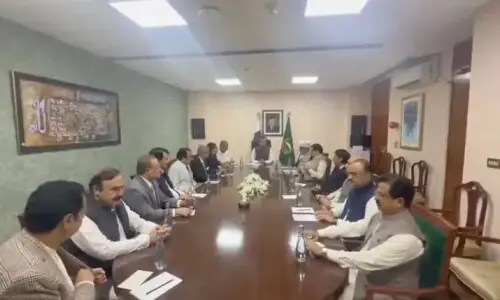
Positive outcome of talks
THE latest round of meetings between the Indian and the Pakistani foreign ministers has produced positive results which vindicate the guarded optimism that had been expressed on the eve of the talks. While the joint commission was revived after a lapse of 16 years, two agreements were also signed. One relates to the pre-notification of flight testing of ballistic missiles by the two countries. The second is a memorandum of understanding for the establishment of a communication link between Pakistan Maritime Security Agency and the Indian Coast Guards. These, along with the joint statement that is expected to give a roadmap for resolving the Siachen and Sir Creek disputes, indicate that the second round of the composite dialogue has ended on a positive note. Considering that a number of agreements have been signed and implemented in the last two years, India-Pakistan relations can be said to be moving in the right direction.
The three areas in which a pronounced impact is noticeable are the strategic sector, the people-to-people contacts and economic cooperation. The pre-notification accord as well as the earlier agreement on prohibiting attacks on nuclear facilities (1988) are major confidence-building measures that will reduce tension between the two countries. Their significance is considerable, in view of the hostile relations between India and Pakistan for decades which led to three wars between them. The agreement on the communication link has a humanitarian aspect in that it should preempt the taking of prisoners of the fishermen who sometimes stray unknowingly into the territorial waters of the other side. By promoting people-to-people contacts by facilitating communications, the two governments have intensified the nature and extent of friendly ties between them. Air links have been established on Mumbai-Karachi and Lahore-New Delhi routes, the rail connection has been restored at Wagah and the Khokrapar sector will also be connected soon. Bus services already link Lahore and New Delhi as well as Muzaffarabad and Srinagar, while Amritsar and Lahore and Amritsar and Nankana Sahib will soon be linked. These are welcome moves though one wishes that the process of granting of visas is made less cumbersome and easy. The revival of the joint commission should encourage trade and economic cooperation.
While the composite dialogue, which has brought the leadership of the two countries at all levels into frequent contact, it has encouraged the people on one side to seek greater friendship with those on the other side. But all this does not mean that the core issue of Kashmir that has vitiated the climate in the region for such a long time has been pushed into the background. True, it has not been touched so far and no solution has been explored. But many steps that have been taken have a direct bearing on the Kashmir dispute. For instance, the intra-Kashmir contacts, the APHC meetings with the leadership in New Delhi and Islamabad and some agreement on Siachen when it is reached are pointers to the concern the two sides have for a Kashmir solution. Given the transformed geostrategic environment in the subcontinent and the wind of change shaping global politics, it is inevitable that India and Pakistan have to sort out their differences on Kashmir so that South Asia no longer remains the most dangerous flashpoint in the world.
Sabotage in Balochistan
TERRORISTS have blown up a gas pipeline in Balochistan once again, disrupting fuel supply to five districts, besides the provincial capital. Sabotage of pipelines, electric installations and railway tracks has been going on in the province for many years. But there was a truce of sorts on the gas front after things settled down earlier this year. It is, thus, after quite some time that a gas pipeline has been blown up. Those doing these things should ask themselves what cause they are promoting by denying gas to people in Quetta and other places during Balochistan’s harsh winter. They should know that it is exactly elements like these who have in the past undermined rather than advanced the cause of the Baloch people by resorting to such criminal acts.
The province has, no doubt, moved away from the kind of explosive situation that existed in January-February this year. But there are still no signs of any political breakthrough on issues that are agitating the minds of the Baloch people. The much-delayed Mushahid Hussain report was presented to the Senate last month, and it contains some useful suggestions. It recommends reserving 5.8 per cent of the federal jobs for the Baloch, shifting the head offices of the Gwadar Port Authority from Karachi to the port itself, the withdrawal of the Frontier Constabulary and Coastal Guards and an increase in gas royalty for certain districts. Action must now follow on the 17 recommendations made in the report. Both politically and economically, Balochistan needs to be satisfied and given the place it deserves in the national scheme of things. The ‘mega’ projects — the Gwadar port, the coastal highway, the Mirani dam and the copper and zinc projects — should help plough money into its economy. But the Baloch complaint about getting jobs in these projects need to be removed. In matters of employment the Baloch must get preference. This must be kept in mind not only by the government but also by the contractors involved in these projects. As for provincial autonomy, the issue must be seen in the larger context because the two other small provinces too have the same grievances as Balochistan has.
Controlling thalassaemia
THE government seems least concerned about the growing incidence of thalassaemia, a genetic blood disorder afflicting nearly 10 million people in the country. For lack of funds the NWFP health department is unable to launch an awareness drive about the disease, while our lawmakers are dragging their feet over promises to enact legislation making blood-screening for thalassaemia mandatory for couples before marriage. The issue is no doubt a sensitive one in a country where 37 per cent of marriages are said to be between first cousins. But considering the lifelong complications for children born of a wedlock between persons with a family history of the disease on both sides, such a law is necessary so that couples at least know the risks involved in such a union. According to one estimate, 5,000 thalassaemic children are born every year in the country while the carrier rate among the population is about six per cent. Moreover, risky blood tranfusions, associated with the more dangerous form of the disease, frequently complicate matters.
The response to this problem has been inadequate and there are very few thalassaemia centres in the country while campaigns to enlighten people on the subject are practically non-existent. The result is that many families are not even aware of this flaw in their genetic makeup and are thus unprepared for the onset of this disorder affecting their offspring. This is all the more reason for the government to introduce mandatory testing — as it has been done in Iran — so that couples with a family history of thalassaemia can make an informed choice about marriage. There may be a strong lobby opposing such a move for cultural reasons, but a firm stand has to be taken in order to save children from the crippling effect of thalassaemia.
Aftermath of the vote in Vienna
THE voting that took place at the IAEA in Vienna last week on the EU-3’s resolution calling upon the Agency to consider reporting Iran to the UN Security Council for not complying with the nuclear non-proliferation treaty is a major development, not only for what happened during the voting itself, but more importantly, for the message that it sent out to the world.
In the first place, the EU-3 (Britain, France and Germany) that had long advocated maintaining the dialogue process with Iran as the only practical option to achieve the goal of non-proliferation, finally gave in to American pressure. Of course, the ground for this policy shift on the part of the EU was already evident from its expression of disappointment at the defeat of the so-called “pragmatic” Rafsanjani and victory for the perceived “hardliner” Ahmadinejad.
The latter’s strong attack in his speech at the UN General Assembly, at what he characterized as “nuclear apartheid”, reinforced the perception of the new leader as a person who would not compromise on Iran’s core interests. Nevertheless, the EU’s decision to end the dialogue and refer the matter to the IAEA was a confirmation of how far the EU countries could resist American pressures.
The US position has always been simple and straightforward. The Bush administration, both publicly and privately, has spoken of its strong dislike for the current political dispensation in Iran. Tehran is accused of opposing the Palestine-Israel peace process, supporting Hamas and the Islamic Jihad and expanding its influence in Iraq. To this volatile mix, Washington has added the unpardonable sin of nuclear ambition on the part of the Iranians.
US officials and policy analysts have, therefore, not refrained from ruling out any of the various options to deal with the so called “strategic challenge” that Iran allegedly poses to their interests. Of all these options (engagement, international sanctions, military action and regime change), it is only the last that some US officials believe will meet their concerns.
One would have thought that the present mess in Iraq would deter the Bush administration from seeking new fields of adventure, but influential figures in the administration continue to advocate that it is better to go for a regime change now, rather than at a later stage when Iran could perhaps have developed nuclear weapons. It appears that they are not satisfied with America’s current domination of the region. Hegemonism knows no limits. Even though Iran has been helpful to the Americans on both the Iraq and Afghanistan fronts, the sins of the mullahs are far too many.
The American neo-cons continue to look on Iran as the one single impediment that prevents them from gaining total supremacy over the entire region, stretching from Morocco to Indonesia.
Washington must also be pleased with the tremendous success it has had in bringing India within the fold of its global strategic designs. The recent Indo-US agreements amount to a clear shift in both capitals. They are not only important for what they state — their real significance lies in the intentions that they betray.
The extraordinary commitment made by Bush to the Indian Prime Minister Manmohan Singh in which he not only promised to bring about fundamental changes to American non-proliferation laws, but also to use his influence with other world leaders to bring them on board as well, in America’s desire to provide India with nuclear technology and the wherewithal to become a global player in this century, was on a scale and of a magnitude that was truly breathtaking. It would be naive on our part to claim that Pakistan remains unconcerned with this development.
India’s decision to join the western powers on the IAEA vote may have surprised Tehran, for it ostensibly went against the long-held Indian policy of maintaining close and cooperative ties with Tehran. Their traditional friendship had been further reinforced in recent years by their collaboration in support of the Northern Alliance in its efforts to oust the Taliban regime and by the massive deals on the energy front, including a strong interest in the gas pipeline project. But if Tehran was genuinely surprised, it had obviously overlooked the blossoming Washington-Delhi romance.
In fact, evidence of a sea change on India’s part was evident only hours after the Bush-Singh meeting in July, when the latter volunteered his concern over Ahmedinejad’s election and voiced doubts as to whether it would be possible to knit together an international consortium to finance the Iran-Pakistan-India pipeline project. I had then observed that the IPI project may become the first of many sacrifices that India may have to offer at the feet of the new god it had decided to worship.
Iran has expressed its “sense of deep hurt and disappointment” at India’s vote against her in the IAEA. According to press reports, the Iranian ambassador to New Delhi is reported to have told the Indian foreign secretary that “the vote was not just against Iran, but against the non-aligned movement”, adding that this move could “endanger” Indo-Iran relations.
Around the same time, the foreign ministry spokesman in Tehran was quoted as having warned that “we will reconsider our economic cooperation with those countries that voted against us”.
Of course, this does not mean that Iran will lash out at India or engage in any other hasty move. It is much too mature and intelligent to do any such thing. There are tremendous advantages to maintaining close political and economic ties to Delhi. It also knows that the issue will go before the IAEA again next month and it needs to maintain a moderate, reasonable attitude, so as not to lose any more friends.
But there is no doubt that the Indian action caught the Iranians offguard. It was after all a major reversal of a policy long espoused by New Delhi. Praful Bidwai, a veteran Indian journalist, described Delhi’s action as “the greatest ever foreign policy shift.”
India will, of course, claim that by siding with the US and the EU, it prevented an immediate referral of the issue to the UNSC and has, therefore, done Tehran a favour. But the truth, bitter as it may be for Iran, is that India had no other option than to line itself up with the Americans.
US members of Congress had publicly warned that India could no longer play on both sides of the street and that the entire American commitment on the transfer of nuclear technology could be jeopardized if India did not vote against Iran.
Dr Stephen Cohen of the Brookings Institution, one of America’s foremost experts on South Asia, complimented India for “showing a new maturity”, while Michael Krepon of the Stimson Centre was closer to the truth when he pointed out that “had India not voted to support the IAEA resolution, the nuclear cooperation agreement could have been in big trouble on Capitol Hill”.
The next test (and one of direct interest to us)will be the Iran-Pakistan-India gas pipeline project. This $ 7.3 billion dollar project is considered to be the most attractive, both economically and technically. But it faces increasing American opposition.
The Indian petroleum minister has long been a strong advocate of this project and he continues to claim that the Vienna incident would not “adversely affect” either the pipeline project or the plan for import of Indian LNG.
But the IPI project faces increasing American opposition. Prime Minister Manmohan Singh was warned during his July and September visits to the US, to stay away from it. The IPI project will remain on the drawing board, but may remain a fond hope, rather than a reality, till such time that there is a fundamental change in Tehran.
Pakistan’s abstention was both morally right and politically wise. No wonder, President Ahmadnejad is reported to have thanked his Pakistani counterpart.
True, our relations with the US have become extremely close and we are cooperating with it on a whole range of issues. But national interests demand that there be clearly delineated red lines and both friends and foes must know this.
Iran is one such red line. Notwithstanding the many irritants that crop up at regular intervals in Pakistan-Iran relations, Islamabad must never be a party to any of the “plans” being considered in Washington.
While we cannot and should not seek to stand in opposition to the Americans, it would be a folly of monumental proportions to be a party to their designs against Iran either.
The writer is a former ambassador.
| © DAWN Group of Newspapers, 2005 |