Pace of business reforms
THE Governor of the State Bank of Pakistan Dr Ishrat Husain is candid in admitting that unemployment and inflation are two key problems which the country confronts.Unemployment and under-employment are, more or less, universal in the world today. They are there even when the economic growth rate is high. In an effort to reduce the cost of production and price of exports in order to withstand international competition industries are shedding their workers to the minimum possible number.
But they seek to achieve that along with a low inflation rate, particularly in the West. But high inflation is not uncommon in many developing countries, particularly now spurred by high world oil prices. But inflation hurts the poor and unemployed much more, particularly those with large families to support, as is the case in in Pakistan. That makes the need for inflation to be curtailed severely.
Inflation rate went above nine per cent in the last financial year and then came down marginally to 8.7100. The government’s efforts are directed at making that rate stay at eight per cent. Even eight per cent is a high rate in monetary terms for the low income groups because of the accumulated inflation of decades in the country. The people calculate inflation in rupees and not in terms of percentages.
Inflation also leads to devaluation of the rupee which is already about Rs 16 lower than the Indian rupee to a dollar. And that enhances the price of imports, particularly oil which is now priced around 64 dollars a barrel.
Sustained higher price of oil means higher electricity prices, heavier transport costs and a host of other higher production costs. Only the exporters are delighted as they get more money for their exports but that will be a short term gain. As they will have to pay far more for their imports for production purposes.
The July-August imports at 1.55 billion showed a rise of 176.3 per cent over the same period last year, while the exports increased by 13 per cent. That shows the increasing deficit trend fuelled by the soaring price of oil and other oil-based items.While the rising oil prices are a matter of continuing concern as the forecasts are that the prices will stay high for quite some time.
Meanwhile, water has become the centre of a national policy debate. That includes both drinking water and water for hydel power generation and irrigation. A very comprehensive national water policy is being prepared. Prime Minister Shaukat Aziz presided over a high powered meeting on Monday to determine the contours of that policy. A National Water Body is also planned to implement and supervise that policy.
The World Bank, too, has come up with outlines of its financial policy to fund the large dams.
While Sindh’s leaders are generally opposed to Kalabagh Dam, and large dams in general, as they fear they would mean less water for their province, the Sindh chief minister Dr Arbab Ghulam Rahim has stressed the need for construction of big dams, without mentioning Kalabagh specifically.
Meanwhile, the water policy draft prepared by the experts committee headed by Sindh’s top expert Abbasi has been returned by the ministry of water with a comment that it should be submitted after consulting the stakeholders. Clearly, President Musharraf who had earlier undertaken the task of taking a decision on the big dams does not want to do that by himself and invite the political odium that will follow, as some provinces will be supporting his decision while others will be opposing it. But it is known that his top priority is for Kalabagh on which a great deal of feasibility studies had already been done, with financial assistance from the World Bank.
Another decision which he is reluctant to take by himself is about the final National Finance Commission award. The centre is now reported to have agreed to part with 48 per cent of the jointly collected revenues. Now the provinces have to agree on how to divide the 48 per cent revenues, if they agree to this share, among themselves.
When the provinces and the centre disagreed on the divisible pool, it was left to the president to decide the issue. But he could not make up his mind.Even now he is evidently trying for a consensus through the good offices of the prime minister.
It is not only the big dams which are at issue but also simple drinking water, which is the source of 60 per cent of the stomach ailments in the country. Over a thousand persons were taken to hospitals for treatment in southern Sindh after consuming contaminated water. Nine or more of the children died. This is a frequent occurrence in Sindh and they pay heavily for the polluted water.
Now the president and prime minister have promised safe drinking water and electric power for all by the year 2007. The commitment has been made repeatedly. And the Karachi Administration has drawn up a plan costing Rs2.4 billion to provide water supply to the city. One hopes the project will come through, and ensures safe and steady supply of water.
Another major development programme is for Balochistan and will cost Rs 134 billion. Prime Minister Shaukat Aziz is confident that the programme will be a success as the pro- development candidates have won the local body elections in Balochistan. He has also promised an airport which can handle international flights at Gwadar.
Now the time-frame for Iran-Pakistan-India gas pipeline has been approved at a meeting of the joint working group between India and Pakistan. Work on the project is to start in 2007. Meanwhile, all the financial and technical issues will be settled. Fifteen months are long enough for that.
Meanwhile a meeting of the officials of Turkmenistan, Afghanistan and Pakistan is to take place in Ashakabad to discuss the three-county gas pipeline in October. India is also interested in the project. But it is not certain if there is enough gas for all the four. So further studies of the gas reserve will have to be made. India can join the project later.
With the oil prices going up and up the more gas we can get from the region the better. Cooperative arrangements with other Muslim countries to achieve that is ever better. And now we are supposed to talk to Qatar with which the discussions began originally. But with Qatar the gas pipeline has to pass under the sea which will be a costly affair.
With foreign investment in Pakistan increasing, a good deal of interest is being shown in reducing the cost of investment, cost of production, doing business and reducing the cost of exports. While the Group of 20 is agitating for an end to the barriers in the West against export of agricultural commodities, the developing countries have to do the best they can to reduce the cost of their products and improve their quality, packaging and presentation.
Foreign investors who want their managerial personnel to live in Pakistan and work there want the quality of life to improve here rapidly.This is possible only after an improvement in law and order and not by spending a great deal on personal and family security. If some people are living too well at a high cost that does not mean that all is well. Better law and order depends on the quality of the police and the efficiency of the judiciary. If the people have no faith in the police and fear them, the quality of life is not good. With all the loans we are getting to improve the quality of the police and the judiciary we ought to have a far better police by now. But they have not improved them.
But in one area — doing business in 2006 — South Asian countries have picked up reform pace. We seem to have done very well. In the pace of the reforms we are among the top ten in the world. A World Bank and International Finance Corporation report says: “South Asian Countries are increasing the pace of reforms to help small and medium business generate more jobs, but heavy legal burdens on business in most countries in the region remain.” It says, Pakistan was the top reformer in the region and is at No.10 globally, making it easier to start business, reducing the cost of registering property, increasing penalties for violating corporate governance rules replacing a requirement to licence every shipment with two year duration licence for traders.
India ranks rather low at 116th,and China is 91st ranking, and behind all South Asian countries except Afghanistan in the overall case of doing business.
Evidently some of the corporate reforms have been taken note of by the international community wanting to do business with Pakistan. India on the other hand is too cautious and slow to move when it comes to dealing with foreigners because of the traditional suspicion.
In the area of transfer of property a great deal remained to be done in Pakistan, beginning with elimination of corruption. There are now a number of radical proposals to modernize the system prompted by prime minister Shaukat Aziz; but the healthy changes need to be carried out quick.
UN: is the tide turning?
THE 60th meeting of the UN General Assembly currently underway in New York, is unique in one way; it is the largest ever congregation of kings, presidents and heads of government.
Yet, it has achieved little compared to its long agenda. Nevertheless, the session was significant because it made the member states realize that a lot was wrong with the world and that, in varying degrees, apathy, inaction and the elongated egos of key member states were responsible for it.
The realization of the extent of damage done to the world suggests that the tide may be turning. Agreement on empowering the UN to intervene when governments grossly violate human rights or fail to suppress civil wars and genocide is commendable but the members can’t claim credit for it. Their failure to prevent many wars and instances of genocide remains unforgivable. The other commendable successes of the session are the creation of the peace-building commission to revive war-torn countries and the civil rights council that would come down heavily on human rights violators. But the Millennium Development Goals that demand a collective effort under UN aegis to eradicate national economic imbalances through purpose-oriented assistance and lifting of barriers to trade are more significant.
However, deriving satisfaction from the rhetoric about responsible behaviour in the future is to be overly optimistic. Firstly, the collective genius of the leaders failed yet again to define “terrorism” in universally accepted terms. Secondly, without permanent arrangements to intervene effectively in civil wars or genocide, the UN remains handicapped. Thirdly, promises to rid the planet of the curse of poverty, hunger and disease are again optimistic. Finally, and most regrettably, agreement on the long overdue induction of more permanent members into the Security Council remains a pipe dream.
Undoubtedly, any act that results in either direct or indirect injury to the innocent is a crime. But the continued denial of legitimate rights and persecution by an occupying force entitles the persecuted to regain legitimate freedom using every available option against that force. Simply put, it means that while terrorist acts by outfits like Al Cued are reprehensible, the same does not apply to freedom fighters. The UN failed to define it as such because it is not in western interests to embarrass countries like Israel, India, Russia, etc.
In spite of its verbosity about empowering the UN to intervene militarily, the declaration doesn’t enshrine the resolve to create a permanent UN peacekeeping force. Not only should such a force be created, it should have regional centres in Asia, Africa, Latin America and Europe to act swiftly. Unless this arrangement is made, peacekeeping will remain a myth; it won’t discourage a resort to arms for settling disputes. Those who oppose the creation of the peace-keeping force will carry the blame for perpetuating the UN’s inability to pre-empt conflicts.
Poverty alleviation measures won’t be implemented because that requires rich countries to cut subsidies, lift barriers to trade, and check environmental pollution. It effectively implies that western countries must lower their high standards of living to allow a rational sharing of the world’s resources. Such a move would be resented by their voters whose grandiose lifestyle was earlier financed by the wealth drained out of European colonies, and later, by subsidies and protective trade barriers that their governments can’t afford to cut, let alone withdraw.
The hope that the resumption of the WTO’s Doha round at Hong Kong will lead to a miraculous concession — 20 per cent (or $72 billion) cut in subsidies by the West and its diversion to developing countries — is far-fetched. The West hasn’t realized that this is the route to winning the war on terror in spite of the fact that this meagre amount would be more than adequate to fund the UN’s Millennium Development Goals, and present a caring rather than an aggressive image of the West.
In controlling environmental pollution and its contribution to planet warming, little can be achieved in the short-term because while the East slept over the problem, throughout the past century major inventions in the West were based on energy from fossil fuel. Harmful effects of burning fossil fuels (the expanding hole in the ozone layer) surfaced as early as the late 1970s. Yet, even in the West nuclear technology remained geared to fabricating lethal weapons and its transfer was therefore denied to the Third World.
To make matters worse, supporters of globalization applauded India, China and Far Eastern economies for rapidly expanding their industrial bases realizing little that once these economies reached less than one-third of their potential, this planet would run short of fossil fuels. This bubble was inflated by palming off to these countries second-generation technologies being phased out by the West, and thus globalized the energy crisis.
It is no secret that nuclear technology is the only cost-effective mechanism for producing clean energy. But there is hostile reluctance to sharing it with the Third World. There are dangers in using this technology but they are not insurmountable. Firstly, western producers can collaborate in running nuclear plants and, secondly, the IAEA can depute permanent inspectors at these sites to prevent both accidents and nuclear proliferation. Such arrangements can work but the West is not yet prepared to accept that this planet is no longer its sole property.
The same imperial stance is manifested by the veto power and permanent status of the five members of the UNSC. This group (representing the West on UNSC far in excess of the West’s fair share), hasn’t realized that because of such blatant injustices, the Third World perceives the UN to be little more than a poodle of the West.
Unless the West dilutes its hegemony over the UN and accepts the changing ground realities that will slowly but surely allow “the meek to inherit the earth” this institution may disintegrate turning this planet into a jungle. If, however, the Hong Kong round helps to rationalize WTO regulations, hope for a better future will be re-kindled.
No alternative to democracy
ALLAH Buksh while taking sips of hot tea at a dhaba is watching a television talk show on a local private channel. The verbal battle between various members of different political parties is amusing him as they all are repeatedly referring to him as the main cause of all their activities. Yes! They are referring to Allah Buksh — the common people of Pakistan. He is so occupied with the hot discussion on television that even the flies humming around him are not bothering him.
He is not able to identify all the leaders on the miniscreen but he knows that they are going to make his and other ordinary people’s fortune. Allah Buksh is excited. Now ordinary people like him will be empowered when the local bodies elections will pave the way for better living standards for everyone. Now Allah Buksh’s children will not sleep on empty stomachs. They will get clean drinking water and proper health facilities. His wife will not fall victim to the unskilled birth attendant of the neighbourhood. His sahib will give him his salary on time and not threaten repeatedly to dismiss him.
A loud roar of the debate from the dhaba television set brings him back to reality. He then realizes that they are not talking about education or health, they are not concerned with employment or infrastructure issues. In fact they are above such petty and mundane problems. They are talking about the uniform of the president, the rigging of the elections, the registration of the madressahs, the failure and success stories of the past and the mud slinging of the present. Allah Buksh puts his tea cup back on the table and watches the television with disenchantment. He gets up and walks away with just one question in his mind, “Where do I stand?”
This incident underscores two questions that should concern our policy makers: do we really believe that the poor and the excluded can have access to the centres of power and authority? Can they really be a meaningful part of the decision making process at the grassroots level of the administration? Even the local body election results reinforce the belief that the underclass has limited chances of getting answers in the affirmative to the two questions.
However, one thing is certain, the electoral process can be used to create the illusion of the transfer of power to the grassroots. The fact is that ordinary people who labour hard to gain some esteem are being used as puppets. The real power continues to lie in the hands of those few influential persons who have been ruling for centuries. The devolution plan which led to the current local bodies election proved to be a device to reward the favorites in politics, along with ‘special instruction’ to discourage extremism.
It seems that Pakistan can have the ‘demo’ of democracy rather than the true meaning and spirit of the word. Democracy prevails where a head of state has to resign over the Watergate scandal. It means the railways minister bows out when a rail accident occurs. It demonstrates its strength when a Hutton inquiry report seriously troubles the head of government and high officials.
Democracy is no doubt a remarkable form of government. But the sort we have doesn’t make it a desirable system for the masses of our country. In the last 58 years, Pakistan has not been able to come up with a workable model of democracy. Incompetent and family inherited politics, the military’s repeated interventions, incomplete parliamentary tenures and the haphazard transfer of power from one government to another have led us nowhere.
A cursory look at the main political parties on the national scene establishes some basic facts. Even those which came to office with a huge mandate had faulty policies and could not stem the tide of corruption. The last nail in the coffin was the nuclear testing which literally pushed the country into a serious financial and economic crisis.
The need is to lay emphasis on the ‘system’. How the country should be ruled is the question for political activists to ask. We have grave serious problems to deal with. Our living standards are falling. Our education system is deteriorating. Health care is becoming inaccessible to the poor. Unemployment is on the rise. Safe drinking water has become a luxury. Nepotism and corruption have become a way of life.
The defence expenditure is hurting our economy. One cannot obtain justice and the sense of insecurity is acute. We have to look for a system that can address these problems. May be a government of technocrats with the best combination of economists, academicians and politicians could do something. It seems a better option to find ways to amend our system and to make it a real welfare state where one is able to live his life with respect and honour and enjoy fundamental human rights.
Connecting the dots
PROFESSOR Siegfreed Hartcroft teaches an interesting course. He is an expert in “connecting the dots.”
It is an important science, because connecting the dots is the only way of finding out how we are doing in the world.
I found Prof Hartcroft working at a large blackboard.
“Anything new?” I asked him.
“The draft Iraqi constitution. The writers decided to bypass the Sunnis and have a referendum.”
“That is good?”
“The dots don’t connect because the Sunnis are not included in the government.”
“That’s not what President Bush says.”
“He’s just putting the best face on it. He always says the dots connect everything in Iraq. We in the political science business call it ‘Dubya’s wishful thinking.”’
I looked at the blackboard. “I see the dots don’t connect in the northern part of the country.”
“You have to think of Iraq as the key domino in that part of the world. Up here are the Kurds. They have the oil. But Turkey is fearful of them because the Iraqi Kurds could unite with Turkey’s Kurds.
“Down here are the Shias who also have oil. They are supported by the Iranians over here. The dots don’t connect in the middle because that is where the Sunnis are, and they don’t have any oil.”
“Allah is punishing them?” I asked.
“Allah, and the Kurds and Shias. The Sunnis were in charge under Saddam Hussein and they did terrible things to the Kurds. Now it’s payback time. That’s why the dots don’t connect.”
“Where are the Coalition forces?”
“They’re all over the map, trying keep the peace. The problem is that the insurgency is also all over the map, car-bombing allied forces and the Iraqi police and politicians who are trying to write a constitution.”
“At this rate, you’re going to run out of dots,” I said.
He picked up his pointer. “Now this is Syria. The insurgents come from there, and also from Jordan. The Al Qaeda cells enter from Saudi Arabia and are very dangerous.”
“Something has to connect. This is worse than Vietnam,” I told him.
“It’s because in Iraq you fight the enemy street by street, home by home. The tanks and planes don’t have the same impact as hand-to-hand fighting.”
“If we believe what Secretary Rumsfeld says, we will prevail, and as soon as the Iraqis are able to defend themselves our boys can come home.”
The professor said, “But he never mentions the lack of armour under the Hummers.”
I said, “If you were secretary of defence, would you?”
The blackboard was a mess. The dots were scattered all over it, but none were connected.
“Is this the worst you’ve seen it?” I asked.
He replied, “It’s the worst in my teaching career. I’m going to write a book titled the ‘Dot Society Quagmire.’ I may get a Nobel Prize for it.”
I asked, “Will it help President Bush in his fight against terrorism?”
The professor said, “I doubt it. He still believes in the ‘Mission Accomplished’ theory. Some people think he’s dotty.”
—Dawn/Tribune Media Services
No easy solution
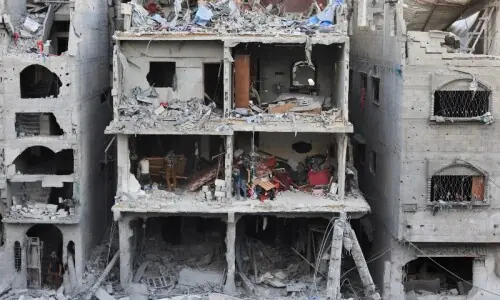
ANOTHER day, another few Baghdad suicide bombings, carefully coordinated though culling fewer victims than on Wednesday, which saw a record of 182 dead. But there is another frightening novelty in the ugly mix of bloodshed, fear, fury and despair that now passes for normal life in parts of Iraq.
Abu Musab al-Zarqawi, leader of Al Qaeda’s local franchise, has declared open war on the majority Shia Muslim population, denouncing them as “apostates and collaborators”. Fanatical jihadists have communications strategies too, and if words have meanings, these ones matter. They matter because the threat of civil war, lurking under the surface for months, is in danger of becoming an undeniable reality.
The public position of the Iraqi government is that these attacks are carried out by terrorists and criminals with no agenda beyond destructive violence. The biggest and cruelest of Wednesday’s atrocities involved a suicide car bombing in the predominantly Shia north Baghdad suburb of Kadhemiya, its 114 victims poor labourers waiting to earn a few dollars for a day’s casual work.
The driver of the vehicle was reported to have an Iraqi accent, apparent evidence that not all such outrages are the work of “foreign fighters”. There were no US or Iraqi military or police targets in the vicinity. Most of yesterday’s victims were policemen.
Zarqawi’s unfathomable extremism may be unpalatable to other elements of the insurgency. But his enunciation of an explicitly sectarian killing strategy will make it harder for those voices, such as Grand Ayatollah Ali al-Sistani, who have been urging Shia restraint in the face of provocation to destabilise the country to the point of outright civil war.
The kidnapping and execution of Sunnis by men in army uniform may mean that he is already losing the argument, or that death squads of insurgents masquerading as members of the security forces - a technique wildly used in Algeria — are now adding to Iraq’s terror and misery. One slight crumb of comfort is that such attacks so far remain geographically limited.
Zarqawi linked his declaration of war to this week’s big US-Iraqi offensive against an insurgent staging post at Tel al Afar, close to the Syrian border. But there are other implications: in exactly a month’s time Iraqis are scheduled to vote in a referendum on their new democratic constitution, though the same Sunnis who misguidedly boycotted last January’s elections still object to many of its provisions.
—The Guardian, London
| © DAWN Group of Newspapers, 2005 |