The shift in US policy
THERE has already been considerable comment in these columns on the recently announced Indo-US defence pact and the new US policy on nuclear collaboration with India. The main reason for revisiting these developments is to present a slightly different perspective.
There is an air of deja vu about the Pakistani concern that the sub-continental balance of power has once again been threatened by India’s greatly enhanced access to sophisticated military hardware and nuclear technology from the United States. The alarm bells are ringing partly because there was only a blurred focus on the process that led India and the United States to the present level of strategic cooperation. India was making steady progress in freeing its relations with Washington as, indeed, with other western states, from what George Perkovich, the author of ‘India’s Nuclear Bomb’, once described as that ‘infamous hyphen’ that had connected India and Pakistan in the calculations of outside powers since 1947. Indian diplomacy had increasingly challenged this hyphenated approach to South Asia.
The nuclear tests of 1998 gave a new lease of life to the traditional equation as strategic parity seemed to outweigh growing disparities in virtually all other fields. Perkovich had followed Kenneth Waltz’s criteria to determine if India was a major power and argued that a state’s power can be understood as a combination of its capacity to influence others to behave as it wants them to and, conversely, to resist the unwelcome influence of others. He was not convinced that India had already attained the status of a major power. India’s failure to browbeat Pakistan in the ten-month long military standoff reinforced this perception. India rightly concluded that its ongoing dialogue with the United States had to be intensified to upgrade its conventional as well as strategic capability.
Ever since the nuclear tests, the United States has maintained a continuous though clearly differentiated engagement with New Delhi and Islamabad. Experts like George Perkovich had assumed that India would not be able to radically alter the US stand on the nuclear issue because of the stringent US non-proliferation legislation. They are not exactly thrilled by the latest decision of President Bush.
But Washington Post’s Jim Hoagland has read the dynamics of the US policy in the era of neo-conservative dominance more accurately. Hailing the new “visionary bilateral agreement” on nuclear cooperation with India as “the first important accomplishment of George W. Bush presidency,” he considers the accord as a demonstration of a security strategy that “holds that the nature of regimes, rather than the nature of weapons they possess, will determine their relations with Washington.” Pakistan, he thinks, occupies a difficult and highly dangerous, middle ground for US interests. India now follows Israel in benefiting from this arbitrary interpretation of NPT and the US law.
There have been two dominant trends in the US policy towards South Asia since the Clinton era. In Pakistan’s case, the initial emphasis was on internal political and economic reforms, relations with the Taliban and pressure to get it to sign the Comprehensive Test Ban Treaty as well as accept a fissile material cut-off for future. Driven by the need to punish Afghanistan for the great atrocity of 9/11, President Bush enlisted Pakistan as the most committed ally in the war against terror.
The revised policy recognized the need to enhance Pakistan’s military capability — largely in the context of the anti-terrorist campaign. It also attached high priority to cultural and educational modernization to ensure that Pakistan does not become another Afghanistan. This was an intensive but essentially limited engagement with little relevance to the realignment of global power structure.
The decision to help transform India into a major global power had an altogether different context. The ideologues of the Bush era have tirelessly argued that the immense disparity in the military power of the United States and all other ‘major powers’ entitles it to pursue policies of unipolarity and unilateralism, be it the doctrine of pre-emptive intervention, Kyoto Protocols or the International Criminal Court.
It is, however, easy to talk about hegemonic doctrines but much more difficult to limit the dispersal of power, especially of the economic kind. The rise of other states and, more ominously, the increasing disruptive capability of non-state actors make for an unstable hegemony, an inconclusive imperium. Even the United States cannot dispense with the Bismarckian paradigm of the hub and spokes; it needs to ensure that emerging powers do not upset it. India’s self-image as a state that has outgrown the limitations of an Asian sub-region makes it a principal candidate for an alliance with a superpower asserting itself as the most powerful empire of human history.
Condoleeza Rice speaks of the United States’ relations with three major Asian powers—- Japan, South Korea and India as providing the “strategic context” in which Chinese ambitions could be restrained. This is an unfair view of China as it ensures its global eminence not by projecting military power but mostly by its spectacular economic success and its scrupulous adherence to the UN Charter. China’s unflagging commitment to export-led economic development gives it a great stake in international peace and stability.
Nevertheless, the new US policy towards India continues to be justified as an effort to build India as a countervailing power and a potential military ally of the United States in the inevitable confrontation with China. Obviously, the nuclear component of the new India policy would have a smoother passage through the Congress if China was painted as a potential foe.
The crystal ball that one can gaze into at this point of time shows intense competition and rivalry but no Sino-US or Sino-India military confrontation. Taiwan, perhaps the most contentious issue, will become a flashpoint only in the unlikely event of Washington encouraging it to declare independence. The recent Chinese formulation of ‘one country two shores’ strengthens the hands of Taiwanese opposed to severing links with the mainland. Furthermore, the economic interdependence between the US and China has now reached a level where conflict has become almost unaffordable.
Similarly, the Sino-Indian territorial dispute may take time for resolution but carries little risk of a resort to the use of force. Meanwhile, burgeoning trade, expected to increase from the present $12 billion to $ 100 billion, will always militate against India joining any military adventure against China. There is no gamble here on the part of the United States — only well calculated moves to ensure that India becomes an essential pillar of the American strategic architecture for Asia and not a member of a coalition of major powers prejudicial to American interests. The chances are that the US will protect its position by modulating its harsh unilateralism and settling for an acceptable global equilibrium propped up by India, China and other major powers. Pakistan’s real challenge is to find a place in this new order.
If it is a correct reading of unfolding events, it is not very difficult to work out Pakistan’s options. It is probably not open to Pakistan to seek a fundamental review of Washington’s strategic decision to assist India at the expense of India-Pakistan balance of power. Similarly, it is extremely unlikely that the US will extend comparable nuclear-related equipment or technology to Pakistan. It is time to recognize that Washington uses NPT and other international instruments in the nuclear arena selectively. But there is, at this point of time, no need to distrust American assurances that Pakistan’s conventional military needs will be considered sympathetically.
The present balance of power is rather fragile. The army is probably capable of playing a defensive role. When it comes to airpower, India has SU-30 Ks, Mirage 2000s, MiG-23s and MiG-27s strike aircraft and MiG-29 air defence fighters. Pakistan’s Mirage IIIs, Vs and Q-5s and around 30 aging F-16 aircraft cannot provide a balance without the induction of new F-16s and that too if they arrive with the required avionics. Pakistan Navy has not known the baptism of fire that the army and air force have gone through but it has used the limited funds available to it intelligently to maintain reasonable defensive capability with submarines and light guided missile ships.
Pakistan cannot match India’s defence expenditure, especially with open-ended Indian acquisitions from the United States, without accentuating existing distortions in Pakistan’s economy. But a carefully calculated ratio of forces will have to be ensured till India-Pakistan detente takes firmer roots.
Regrettably, there is still a crucial role for strategic deterrence. Pakistan has to free itself of any external veto on research and development on nuclear weapons and delivery system as India is not likely to accept a strategic restraint regime that compromises its major power status. China has countered the possible ABM capability in Taiwan and elsewhere in the Asia-Pacific region by R&D dedicated to the refinement of its nuclear forces without opting for Soviet style warhead parity. Meanwhile, we have to preserve our faith in the process aiming at neutralizing the historical animosity between the two nuclear-capable neighbours. The difficulties encountered en route should be an argument for re-doubled efforts and not for abandoning the journey.
Notwithstanding its close and somewhat domestically controversial ties with Washington, Islamabad has expended greater energy in diversifying its external relations than in a long time. Admittedly, not all the initiatives have borne fruit as yet. Russia, for one, has not responded adequately to Pakistani overtures. With Iran, where distrust of Pakistani establishment runs deep, there is still a long way to go. Pakistan has to demonstrate, whenever the occasion demands, that it would never be a part of the siege Iran is threatened with. Domestic compulsions of the Kabul authorities and visceral anti-Pakistan feelings of some elements of the erstwhile Northern Alliance will continue to create difficulties but Pakistan has to stay the course in pursuing cooperation with Kabul, and through Afghanistan further afield with Central Asian states.
The kingpin of a long-term policy designed to assure Pakistan’s due place in the eventual global equilibrium — a place defined by its intrinsic strategic importance —- continues to be China. It will be a mistake to take this vital relationship for granted. It too requires proper nurturing. History has shown that an exaggerated Washington-centric policy did not serve Pakistan well. This is the right time to persuade the United States that the high importance that Pakistan rightly attaches to relations with it does not obviate the need for developing ties with other countries some of which may not find favour with it at a particular moment of time.
The writer is a former foreign secretary.
The world is still round
ONE of the unheralded contrasts of our time is this: Everywhere we see the increasingly powerful effects of globalization, and yet the single most important reality for the economic well-being of most people is their nationality.
The idea that we’re all being swept along by the impersonal forces of globalization seems intuitively logical and instinctively menacing. The older and less-noticed truth is that nations usually remain, for better or worse, the decisive force in determining the economic condition of their citizens.
The United States, Europe and Japan offer an object lesson. All face, generally speaking, the same opportunities and threats from globalization. But results vary dramatically. Since 1995 American economic growth has averaged 3.3 per cent; Europe’s, 2 per cent; and Japan’s, 1.3 per cent. (Europe refers to the 12 countries using the euro.) Even in Europe, stark contrasts emerge. Ireland’s growth averaged 7.9 per cent over the decade; Germany’s, 1.3 per cent. Somehow national policies, culture and business overshadow globalization.
Why? It’s not because globalization is a myth. In his highly readable and informative book “The World Is Flat,” New York Times columnist Thomas Friedman describes an economic system of transnational supply chains, foreign “outsourcing” of services and intensifying international competition. He asks Dell to describe geographically how his laptop was made. Here’s the abbreviated answer: Engineers in Texas and Taiwan designed it; the microprocessor came from one of Intel’s factories in the Philippines, Costa Rica, Malaysia or China; memory came from Korean, German, Taiwanese or Japanese firms with factories in their countries; other components (keyboard, hard-disk drive, batteries, etc.) came from U.S., Japanese, Taiwanese, Irish, Israeli and British firms with factories mainly in Asia; and the laptop was assembled in Taiwan.
What Friedman means by “the world is flat” is that everyone increasingly competes with everyone else on everything. Adam Smith wrote that “the division of labour is limited by the extent of the market” — meaning that larger markets spawn more specialization. Now markets seem universal; national borders seem to crumble. The Internet is a global auction block.
Someone mistakes me for a business, so I receive occasional e-mails from Asian and US Web sites to buy industrial goods. Last week it was forklifts. But, of course, the world is not flat. Borders, though battered, survive and have economic meaning. National markets do exist. One big difference is their vigour in creating local demand and jobs. Europe’s sluggishness may reflect more than high taxes and restrictive regulations. Some Europeans blame attitudes: Because Europeans fear the future more than Americans, it’s said, they spend less and save more. Even if the argument is wrong — and who knows? — the larger point is right: National markets are defined by psychology as well as politics.
It’s easy to exaggerate globalization. Yes, some computer, software and engineering jobs have already moved to India, China and other low-cost countries. More will follow. But the process is limited. The McKinsey Global Institute says that 750,000 US service jobs have been “offshored” out of about 140 million total US jobs. Perhaps nine per cent of US service jobs might theoretically migrate abroad, McKinsey says, but “it is unlikely that all these ... jobs will move offshore over the next 30 years.”
There are practical obstacles: language differences, management resistance or computer incompatibilities. Similarly, it’s easy to overrate trade’s impact on factory jobs. A study by economists Martin Baily of McKinsey & Co. and Robert Lawrence of Harvard University attributes roughly 90 per cent of manufacturing’s recent job losses to domestic forces.
Localization usually trumps globalization, though countries seem to succeed more when they encourage globalization. In 1990 per capita incomes in Ireland were 28 per cent lower than in Germany, reports the Organization for Economic Cooperation and Development (OECD). In 2004 the Irish were 26 per cent higher. One reason that Ireland grew faster is that it eagerly welcomed foreign investment. Half of Ireland’s manufacturing employment comes from foreign multinationals, compared with Germany’s 6 per cent, says the OECD.
The real question about globalization is whether all these nations — each with its own psychology and each pursuing its self-interest — can fashion a system that works for everyone. If too many national economies are weak, then the global economy will be weak.
If too many countries try to manipulate the system to their advantage, then the global economy may become unstable or succumb to mutual suspicions. These threats already exist. Europe and Japan are weak; many Asian countries, including China, strive for permanent trade surpluses through undervalued currencies. (China’s small revaluation yesterday is a start in reversing that.)
Globalization is not preordained to advance inexorably, driven by constant improvements in communications and transportation. It’s vulnerable to economic and political setbacks. The irony is that its fate rests heavily on the behaviour of that supposed economic relic — the nation-state. — Dawn/Washington Post Service
Gas pipeline politics
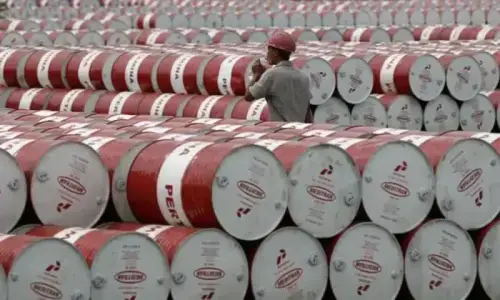
THE Iran-Pakistan-India gas pipeline project that was designed to supply Iran’s natural gas to Pakistan and India ran into trouble at the very outset as a result of mistrust among the three countries. As for Iran and Pakistan, they were both keen to lay the pipeline through the land but Iran understandably wanted to extend it further afield to India which offered a lucrative market for its natural gas.
The Iranians, who enjoyed cordial ties with India too, had been patiently persuading it to trust Pakistan regarding the safety of proposed pipeline, but it took two regimes in India to make up their mind about the trilateral project. The BJP government was averse to the very idea of the gas pipeline running through Pakistan territory into India lest Pakistan cut off the flow of the gas in certain situations to put pressure on New Delhi.
The opponents of this project, mostly right-wing Hindu nationalists, sought instead to circumvent the Pakistan territory and lay the pipeline across the Gulf-Arabian Sea. This would have raised its cost many times that of the original project. Moreover, Pakistan would not allow the under-sea pipeline to transit through its territorial waters. India also haggled with Iran over the price of the natural gas and it seemed as if the project might fall through.
India made yet another demand that China be involved in the project in some such way that would guarantee the uninterrupted flow of the gas despite the ups and downs in India-Pakistan relations. This was not feasible, so New Delhi had to rely on Tehran’s assurance that Islamabad would not like the gas pipeline to be disrupted in its own interest since it stood to gain an annual revenue of $ 600 million as transit fee. In addition, certain confidence-building measures taken by the two governments such as the Muzaffarabad-Srinagar bus service and agreement on cross-LoC trade in Kashmir reinforced the mutual trust somewhat between the two otherwise suspicious neighbours.
While the gas pipeline diplomacy was underway the Bush administration conveyed its concern over the proposed deal to New Delhi and Islamabad. The US invoked the Iran-Libya Sanctions Act, a domestic law that forbade any investment of $40 million or more in any oil enterprise in Iran and Libya. This is tantamount to exercising extra-territorial jurisdiction, especially when neither Iran nor Pakistan nor India had solicited any loan from the US for the pipeline project. The US threat did not work on Iran or India but it was bound to give Pakistan government anxious moments, given the nature of Pakistan-American relations.
It is now obvious that the main purpose of Condoleeza Rice’s visit to Islamabad was to dissuade President Musharraf from going ahead with the Iranian gas pipeline project and Mehmood Ali Kasuri’s trip to Washington was a continuation of the unfinished talks regarding the controversial project.
In vain did the Pakistan foreign minister plead with his American counterpart that the pipeline was the need of the hour since Pakistan’s gas reserves would be depleted by 2015 and the nation critically dependent on gas for domestic, agricultural and industrial purpose would be hard put to it to import it.
Besides, argued Kasuri, that Pakistan would earn $ 600 million annually by way of transit cess but all his pleadings fell on deaf ears as his Iranophobe counterpart reminded him of $700 million yearly US largess as part of the Bush administration’s three-billion dollar loan to his country. All that would be at stake should Islamabad clinch the forbidden deal. For even if the Bush administration chose to ignore it, there were powerful groups in the Senate, House of Representatives, media and academia who were opposed to it. All these forces could not only block the US loan but also impose sanctions against Pakistan.
The US secretary of state, however, was good enough to suggest that Pakistan could well lay the gas pipeline from Qatar. The Pakistan foreign minister then pointed out that in that case the cost of the project would be doubled. It is not known whether the US secretary of state gave any indication that the US would contribute towards the additional cost incurred on the alternative project.
Certain observers regard Musharraf’s visit to Doha as an attempt to figure out the possibility of laying the gas pipeline between Qatar and Pakistan. But even if Pakistan agrees under US pressure to abandon the Iran-Pakistan-India gas pipeline, the third party, India, may not. The reason is purely economic. The Iranian gas pipeline is cost-effective for all the three partners.
This was clear from the observation made by the Indian petroleum minister at Karachi Press Club in June that if Iran, India and Pakistan could arrange four billion dollars for the project, they need not pay heed to US threats. But the Indian prime minister during his US visit in July, either to please his host or to extort more concession from Tehran, said that no international consortium would finance the project. Though his petroleum minister later assured the parties that such difficulties would be overcome, the project seems to have run into snags.
Pakistan had gone so far on the Iran-Pakistan gas pipeline plan that it was prepared to implement it even without India’s participation. It will be a shame if it abandons it at a stage when all the parties are ready and willing to implement it in right earnest. Condoleeza Rice had also suggested to Kasuri to lay the gas pipeline from Turkmenistan via Afghanistan to Pakistan. She was told that the gas reserves in that country have not yet been explored.
The US secretary of state should have known that a territorial accord was signed between Turkmenistan, Afghanistan and Pakistan in May 2000 and negotiations with an American oil company were in progress for the construction of the proposed pipeline from Daulatabad gas field of that Central Asian state to Multan and from there to Gwadar. The Clinton administration opposed it since the Taliban then ruled Afghanistan.
Under intense US pressure the American company backed out but an Argentine company, Bridas, agreed to construct the pipeline and offered to contribute 46 per cent towards the cost of the project. The deal was finalized.
Meanwhile, the US and NATO allies decided to invade Afghanistan at a meeting of the NATO council of ministers in Berlin in July 2001, that is, one month before the September 11 incident. Condoleeza Rice’s proposal to revive the Turkmenistan- Pakistan gas pipeline idea is yet another example of blatant subjecting its economic policy to US strategic considerations. It is an unwarranted interference in the affairs of regional states. It is gratifying that Pakistan has decided to participate in the Iran-Pakistan-India gas pipeline project.
It is the inherent right of sovereign states to expand economic relations with one another. No state has the right to impede the legitimate inter-state commerce. The Bush administration is free to trade or not to trade with Iran but it has no right to impose its will on other states because they happen to trade with a country which America hates for one reason or another. Iran is a member of the United Nations and unless the Security Council imposes embargo against it, no power, however big, can prevent other states from establishing normal political and economic relations with it.
Iran, like Pakistan, is a member of Eco, which enjoins economic, cultural and technological cooperation among member states. The US attempt to force Pakistan to abandon the Iran-Pakistan gas pipeline project is aimed not only against Eco but also against the on-going India-Pakistan detente.
Water dispute with India
IF the recent years of drought, particularly in the south of Pakistan, underscored the importance of more dams to store water, the current floods emphasize the urgency for large dams to prevent such calamities and use the water saved for cultivation. Large dams in mountainous regions is the need of the hour and their construction can be delayed only at a high cost to the nation.
But the old notion that large dams are an unmixed blessing no longer holds good in our conditions. They have their minus and plus points. In our context, similarly the old notion that expanding industrialization can solve the unemployment problem altogether or provide employment to all along with the supplementary service sector, is no longer valid.
Industrial growth even in advanced countries depends less and less on labour. Higher productivity is often accompanied by falling employment rates. The costly machines do the most, and finally there is the robot to supplement human labour. The whole industrial exercise in the West is aimed at cutting cost and slashing export prices to stay globally competitive, particularly to meet the challenge from China with its very low export prices.
Hence in a largely populated country with a high population growth and often low industrial wages, particularly in the textile industry, like Pakistan, the farm areas have to be developed vigorously to provide employment. Farm employment has also the advantage of preventing the exodus of the rural mass to cities to cluster around Katchi Abadis and create a social problem.
And in a country like Pakistan the farm areas have to increase not only the traditional output like wheat, rice, cotton and sugarcane but also develop varied agro-industries, horticulture, dairy farming, livestock and inland fish farming.
Prime Minister Shaukat Aziz is committed to promote agro-industries, provide the essential infrastructure and bank credit at concessional rates. Development of livestock, dairy farming and inside fishing is essential for improving the nutritional level of people and increasing protein content of their meals and strengthening brain power.
While the government is committed to provide such assistance to people in the farm areas, they are getting ready to use it productively for themselves and the country but they have to be assured of a steady supply of water for the crops.
The fact is there is no real shortage of water in the country but there is a widespread misuse. The result is waterlogging and salinity where the water supply is plentiful, while other areas suffer from scarcity of water or drought. Lining the canal with cement or other protective materials can prevent seepage of water and eventual waterlogging. But it is a slow and costly process and hence the delay.
Influential farmers commanding the mouth of the canals divert much of the water for themselves while the poor farmers at the tail-end get too little and suffer grievously. Yousuf Talpur as the PPP food minister said the food problem in the country would end the day the tail-enders get enough water. That is a distant hope in our feudal order. But if, after the lining of the canal, the tail-enders may get more water, it is likely that the big farmers commanding the mouth of the canals may increase the areas of their crops and consume more water.
In 1984 I attended a tri-annual conference of the Society for International Development in Rome. Addressing the meeting the dynamic chief of the Canadian International Development Agency (CIDA) said water can be dangerous for the soil. There was a loud laughter. “You laugh. Go to Pakistan and see,” she said and silenced her audience. The Canadians who were then helping Pakistan a great deal were appalled by the extent of waterlogging and salinity in Pakistan — problems we are still grappling with.
There is also a major global reason why we should develop our agriculture. The efforts of the WTO or at the WTO is to reduce the heavy agricultural subsidy paid to the rich western farmers which total over a billion dollars a day. There is resistance from the rich farmers but gradually those subsidies would go down and the farmers of the developing countries would be able to export their agricultural products besides rice, mango, kinno, in case of Pakistan. Our farm products will then be internationally competitive and the farmers will benefit much.
Meanwhile, the Asian governments must help their farmers to improve their farming techniques, marketing tactics, packaging, shipping, storage etc. It is a long haul; but it is worthwhile trying. The farmers should produce not only more and better, quality products but also more of the value-added and capitalise on our specialities.
Provincial governments have left the choice of dams to President Musharraf. He says he would take a decision in the light to the Abbasi Committee recommendations. The objection to the Kalabagh dam proposal has been strong in Sindh and Abbasi himself is a top Sindh water expert. He has been delaying completion of the report and its submission to the President.
Now prime minister Shaukat Aziz says the construction of the major dams would be undertaken with the consensus of the provincial governments. He has also mentioned the Abbasi Committee. What is obvious is once the government takes a decision on the dams to be constructed it would speed up the work if there is no strong political obstruction.
The fact is that if the first choice is not to fall on Kalabagh he would not have delayed the final decision so long.
Large dams have many uses. They save a great deal of water and prevent floods. They are more economic than many small dams. They can be for production of hydropower which is cheap compared to thermal power. Aid for setting up such dams is often readily available.
The disadvantage of the large dams is that they bring large areas under water and displace population. In the mountain regions as, where Tarbela is located, they get filled up quick. Sludge, sand and stones flow in and fill it up. Displaced persons often do not get paid for long. The feasibility studies have been done by the World Bank, which spent the money on the study. It is larger, can be more secure than other dams and more economic. It can produce more power, and can be completed quicker than other large dams. Secondly, he argues, if Kalabagh is undertaken that does not mean other large dams will not be taken in hand.
But none of his arguments seem to convince Sindhi leaders and technical men that Sindh will not be wronged by Kalabagh and all that follows it. How to bridge the gulf politically, or partially politically and partially technically, is the question now?
If the current controversy over terrorism and its cure did not take up so much time of the president he might have taken a decision on Kalabagh or another large dam or dams by now. But his preoccupation with combating terrorism and international negotiations in this regard takes so much time and energy. And so he does not want to open a second front right at this moment.
If Sindh was not at the lower end of the Indus Water system and suffered drought frequently it might not have so much fears in regard to water. But now, as it is, it cannot take itself away from the southern part of Pakistan with the Indus coming from the north. Only a political settlement can overcome the problem for good. But that too has proved to be too elusive because of the usually weak Sindh political leadership.
To add insult to injury, Sindhis are being accused of letting so much of water flow down to the sea. While the fact is that if water did not go down the sea, it will become too saline, and ultimately a kind of Dead Sea. And the same saline water will come up to the Indus river and ruin the vegetation in the south of Sindh and its ecosystem.
And now to make matters far worse in the region, Pakistan is having a water problem with India over not a large dam but three small dams: Baglihar dam, Kishenganga, and Wullar Barrage.
Following prolonged India-Pakistan talks over a long period the Baglihar dispute has been referred to a Swiss expert chosen by the World Bank. And yet India wanted the bilateral discussions to be resumed and Pakistan agreed to that. The site of the dam has been visited by a Pakistan team of experts for three dams without any agreement.
India is now stated to be ready to share a part of the 450 MW of power it would produce from Baglihar dam with Pakistan. Pakistan does not agree to any change in the Indus Water Treaty of 1960. But India is reported to have said it could go ahead unilaterally with its power project although the Treaty does not provide for that. There are reports from India that it might scrap the treaty altogether. India is not eager to begin talks on Kishenganga either. Pakistan delegation to inspect Baglihar has been waiting in India to visit Kishenganga but without success. There is no progress in the talks on Wuller Barrage as well, which India wants to use for navigation.
Evidently India wants to put the water of the three rivers to other uses than irrigation as provided in the Indus Water Treaty, while Pakistan wants to abide by the treaty faithfully. The gap between the two are very wide. And that could be bridged only through talks at the political level at the top and not by technicians. If the composite talks are to make progress and the confidence building measures (CBMs) are to make headway the area of disagreement between the two countries should be reduced. It may be better for the leaders of the two countries to bridge the gulf before the experts widen that and dishearten the people eager to come closer.
Killing hope
AFTER the tempered optimism of last month’s Gleneagles summit come tragic reminders that Africa’s wounds are too deep to be easily balmed.
The sights and sounds of the famine in Niger, now encroaching upon neighbouring Mauritania and Burkina Faso, is one such reminder, as the disasters emergency committee yesterday launched an appeal on behalf of the UK’s major aid agencies. Another reminder came with the confirmation of the death of the southern Sudanese leader John Garang in a helicopter crash last weekend, one which could unravel a peace deal that had at last promised an end to the bloody civil war raging there since 1983.
The untimely death of Mr Garang — who struggled for two decades on behalf of the southern half of the country as leader of the Sudan People’s Liberation Army — sows the seeds of a disaster that demands rapid action by the international community.
The potential for disaster comes in two forms. First, it threatens to reignite the civil war between the northern-based military dictatorship and the secessionist forces in the south. Second, continuing unrest makes it much more difficult to tackle the roots of the atrocities still to this day being carried out in Darfur, the western province of Sudan suffering its own bitter fighting and accusations of genocide against government-backed Janjaweed gangs. For both of these reasons the United Nations and the African Union, along with the US and European Union, must take an active role in keeping all sides involved in continuing the peace process.
A trained economist and soldier, Mr Garang staked a huge degree of his personal prestige on entering into the agreement signed in January. While other sections of the SPLA wanted nothing less than an independent southern Sudan, Mr Garang was willing to settle for autonomy for the region as part of a unitary nation state.
As part of the deal he was appointed vice-president, a role he had filled for just three weeks before last weekend’s crash. Already his supporters see in his death a plot by the government, leading to violent riots. But the fact that Mr Garang was flying in a Ugandan military helicopter, returning from a meeting with that country’s president, discounts any wild speculation.
So far Mr Garang’s successor as SPLA leader and vice-president, Salva Kiir Mayardit, has called for January’s peace deal to be upheld. The world must do all it can to encourage that engagement, by continuing to press its carrot of aid and stick in the form of sanctions. The innocent of Darfur are still waiting to be saved. —The Guardian, London