US-Iran nuclear stand off
Ominous developments threatening the peace and security of our region are following an inexorable course. The denouement of these developments could be more sinister than the US invasion of Iraq. The main protagonist in the evolving drama is again the US. The script is also a familiar one, except that this time the villain of the piece is Iran.
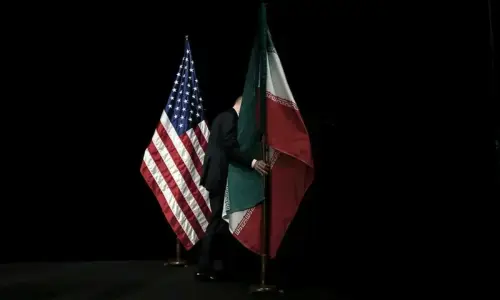
US-Iran relations, or rather their absence, since the 1979 Islamic revolution in Iran has always had the potential of reaching a flash point, with both countries seen as the arch villain to the other. While Iran regards the US as the "Great Satan", Washington has declared Iran as part of the 'axis of evil'.
President Bush's policies in the wake of 9/11 have been reminiscent of gunboat diplomacy with little regard for international law conventions or legality. In pursuit of its national interest, the Bush administration has launched military adventures in brazen defiance of international opinion and protests.
The invasion of Iraq is a classic example of this arrogance, when bypassing the UN and other peaceful options or intermediaries, America occupied Iraq and has remained unrepentant at the discovery that none of the factors cited as justification for the war, varying from presence of weapons of mass destruction to Saddam's support of Al Qaeda, had any validity.
Bush's re-election has buoyed the spirits of his hawkish advisers who interpret this as an endorsement of his policies in the previous term and are consequently keen to pursue their unfinished agenda with greater vigour. US policy towards Iran closely follows the Iraqi pattern.
Iran has been declared as one of the "outposts of tyranny". In her confirmation hearings at the US Senate, secretary of State Condoleezza Rice named six countries - Cuba, Myanmar, North Korea, Belarus, Zimbabwe and Iran - that would receive special attention in the second term of the Bush administration.
The nature of this special attention was fully demonstrated in the first state of the union address of Bush's second term. Bush branded Iran as "the world's primary state sponsor of terror - pursuing nuclear weapons while depriving its people of freedom they seek and deserve".
The condemnation of Iran was also on account of its alleged nuclear programme. Bush demanded that "Iran must give up its uranium enrichment programme and any plutonium reprocessing."
An open season has been declared and there is a concerted campaign to demonize Iran and project it as a threat to world peace and security. Condoleezza Rice, in an interview to BBC on February 6, developed this theme stating that Iran had become a major obstacle to peace and stability in the Middle East and must be prevented from developing nuclear weapons.
Vice President Dick Cheney echoed similar feelings in an interview with Fox News, "the Iranians know very well that we do not want them to acquire nuclear weapons. There are a number of steps here to be considered. We have not eliminated any alternatives at this point".
Iran's nuclear programme had evoked similar apprehensions in Europe, and the EU decided to seek clarifications and commitments from Iran regarding its intentions.
Britain, France and Germany, the major EU powers conducted negotiations with Iran and an agreement was reached last November under which Iran agreed to freeze all activity related to uranium enrichment, including making equipment and processing material, in return for talks on peaceful nuclear cooperation and resumed negotiations on a trade and aid package.
Iran has committed itself to maintaining its enrichment suspension while negotiations are in progress but is unwilling to see them drag on indefinitely, without any progress. President Khatami has warned the EU that "if Iran feels that there is no seriousness in the European negotiations, the process will change".
Iran has also maintained that as a signatory to NPT, it has the right to the fuel cycle and that its programme is solely for peaceful uses, particularly for energy generation.
The US disputes this and has frowned upon the EU-3 dialogue with Iran and its incentives to Iran which include a joint promise to provide Iran with nuclear technology including a light water nuclear reactor, if Iran complies with the demands of the IAEA, the atomic watchdog body.
Since November 4, when the agreement was reached with Iran, the US has been putting pressure on the EU and has opposed EU package. It appears that the pressure has worked and the EU has now declared that "nothing short of a full cessation and dismantling of Iran's fuel cycle efforts would give EU-3 the objective guarantees they need that Iran's nuclear programme is peaceful."
The hardening of the EU stance is a direct result of US pressure, which was brought about during recent visit of secretary of state Rice to EU-3 capitals. Dick Cheney has signalled the US position stating that "you look around the world at potential trouble spots.
Iran is right at the top of the list". Earlier, the US had wanted to include a socalled "trigger mechanism" that would refer the matter to the UN Security Council if Tehran broke its suspension. The EU and the IAEA, however, want the US to join the dialogue, instead of talking of military options.
However, such a policy does not sit well with the Bush doctrine, enunciated by the neocon hawks in the White House. Despite a categorical assertion by IAEA chief ElBaradei that "we have received access to every facility we asked for in Iran" and that it has found no evidence of nuclear weapon activity, US continues to accuse Iran of "seeking to adapt missiles to carry nuclear warheads".
The truth is that the neocons now in ascendancy in the White House are determined to pursue their agenda of neutralizing Muslim countries of any capability, financial or strategic, that could pose a threat to Israel.
Bush's state of the union address leaves one in no doubt of the thinking that guides the US policies. Instead of recognizing that the terrorist acts were in response to US policies of its total support for Israel, and its military presence in Saudi Arabia, or its invasion of Iraq and Afghanistan, the Islamic fundamentalists have been referred to as "the force of darkness" and "absolute evil" and it has been said that the US will never negotiate with 'evil'.
The position of Iran in the axis of evil further reveals the true intentions of US policymakers and their designs. Declaring that "no options are off the table" these hawks are not only intimidating the Iranians, but also preparing the international community for any extreme action.
Notwithstanding the US' belligerent attitude and its threats of military actions against Iran, it is highly unlikely that the US, for a variety of reasons, would yield to the temptation of a direct military action against Iran.
Should the current dialogue between EU-3 and Iran reach an impasse, the US, not content with UN Security Council sanctions against Iran, may instigate Israel to strike against Iran's nuclear installations as it did in 1981 against Iraq's Osirak nuclear reactor.
This is not a fanciful scenario. Dick Cheney has publicly hinted at the possibility that Israel might well decide to act first "to prevent Iran from obtaining nuclear weapons".
In a TV interview on January 22, he said "if the Israelis become convinced that the Iranians had a significant nuclear capability, given the fact that Iran has a stated policy that its objective is the destruction of Israel, the Israelis might well decide to act first and let the rest of the world worry about cleaning up the diplomatic mess afterwards".
Almost on cue from the US, Shimon Peres, Israeli deputy prime minister has called on the world to take action against Iran's nuclear ambitions, brazenly raising the possibility of the Israeli option of preventing Iran from getting the bomb.
Recently, seven former foreign ministers from Europe, Canada and the US, led by Madeline Albright in a joint article in Washington Post, urged the US to "put its full support behind the EU-3 diplomatic effort" but also recommended that while confrontation with Iran be avoided, "we must not fear one, if that is what is necessary to prevent the introduction of another nuclear weapon programme into the combustible Middle East".
The Bush administration has already under consideration a number of military options. Two neocon think-tanks - Committee on the Present Danger (CPD) and Iran Policy Committee (IPC) - have openly recommended military strikes against suspected nuclear and other weapon facilities, besides destabilizing Iran to achieve regime change, through active support to the Mujahideen-i-Khalq - a dissident Iranian group operating in Iraq that has vowed to fight against the Islamic republic.
According to reliable reports, the US special forces have been directing members of the Mujahideen-i-Khalq in carrying out reconnaissance and intelligence gathering to identify possible targets for military strikes.
The Washington Post recently reported that the US has been flying drones over Iran since April 2004, seeking evidence of nuclear weapons programme and probing vulnerability of Iran's air defence systems.
US antagonism is indeed a deep reflection of the vengeance it has nourished since 1979 when Iran humiliated the US by holding 52 of its diplomats as hostages for 444 days, and exposed the limits of US' power and global reach. The episode is deeply etched on the American psyche and any opportunity, however flimsy the provocation, would be availed of to settle the score and erase the scar.
The scenario outlined above is a serious challenge to Iran. While its leadership is handling the issue with a great sense of pragmatism and measured restraint, the issue also has an obvious and sinister Pakistan dimension about which we should be concerned.
The US, in the context of nuclear non-proliferation still has grave reservations and suspicions about Pakistan's nuclear programme, particularly the A.Q. Khan network. There has been discreet official pressure, even direct demands that Pakistan should hand over Dr Khan to US authorities for investigation.
Tendentious intelligence reports are periodically leaked to the media, designed to establish that the clandestine network has seriously jeopardized international security by the transfer of nuclear technology to Libya, Saudi Arabia and now Iran.
An obscure group, "national council for resistance in Iran" has claimed that Pakistan delivered weapons grade highly enriched uranium to Iran in 2001. The recent report in Time weekly and reports originating from think tanks like Carnegie's detailing A.Q.'s "proliferation Walmart" peddling the know how and material to make the most destructive weapons known, are part of this campaign to scare the international community and seek justification for their coercive diplomacy.
The US has declared that A.Q. Khan's case has not been closed. Any US success in the current crisis would unleash new and possibly unbearable pressures on Pakistan.
Bush's aggressive policies arrogantly pursued during the last three years confirm that Iran has been a candidate for US intervention long before Iraq was selected. Bill Clark, National Security Advisor under Clinton, in his book Against all Enemies exposes the designs of the neo-cons who have been key advisers of Bush.
"Iraq was portrayed as the most dangerous thing in national security. It was an idie fixe - a decision already made and one that no fact or event could derail. We invaded and occupied an oil rich Arab country that posed no threat to us".
There is every possibility that Bush may replicate its 2004 misadventure against Iraq, directly or through its proxy Israel, to improve Israel's strategic position and gain "another friendly source of oil".
The US-Iran nuclear stand off would have serious consequences for Pakistan, too, and hence Prime Minister Shaukat Aziz's offer in Davos that "Pakistan will be willing to be the intermediary, if so required by all parties in the current impasse over Iran's nuclear programme" should be pursued vigorously to defuse the situation.
Shaukat Aziz met Foreign Minister Kharazi and these contacts should be frequent, meaningful and at the highest level. Pakistan has a direct and enormous stake in the current crisis that needs no elaboration.
The writer is a former ambassador.
Making the country an Asian tiger
What is the difference between a lion and a tiger? The lion has always been known as the king of the jungle, a title that has never been disputed by the tiger. Then why do countries like Pakistan want to become a tiger and not a lion in progress and development? It must be seen as General Pervez Musharraf's credit that he has not expressed the ambition to make Pakistan the Tiger of Asia. Maybe, he knows he is already riding a tiger.
Everyone who has mattered in the destiny of this country during the last few years boasted of making it an Asian tiger. Of course former prime minister Nawaz Sharif saw this dream day and night without doing anything about it.
Even the normally staid President Farooq Leghari once talked about converting Pakistan into a tiger, although I'm sure he had never seen one from close quarters. Neither had Mian Sahib for that matter, but I suppose that is immaterial.
This "close quarters" thing takes me back 57 years. Just before partition I was serving in the Junagadh State Railway. Once we had a derailment right in the heart of the Gir forest, the only home in India of the lion. So we took a relief train there.
At night the lions came out, and there we were in a carriage with iron-barred windows and a giant lion peeping at us from a few feet away. When it roared any of us could have died of fright and resultant heart failure.
That is the only occasion I know of when men were in a cage and the lion was roaming free outside, probably musing contemptuously on our puny effort to invade its domain.
I admit that in this case it was not a tiger (which is the subject of this piece) but so what? As the British colonel said on sanctioning leave for Natha Singh when actually it was Prem Singh who had applied for it. "What's the difference, man? Natha Singh, Prem Singh, comes to the same thing."
Trying to find an answer to my own question, I guess the tiger is preferred in Pakistan so that there is no mix-up with well-known politicians claiming to be lions in their part of the country.
Mr Ghulam Mustafa Khar revelled for long in his title "Lion of Punjab" without having displayed his claws even once, while Sardar Abdul Qayyum proudly accepted the honorific "Lion of Azad Kashmir" at a public meeting some years ago.
I must say Sardar Sahib was realistic enough not to crib at the limitation without which he could have been confused with Sheikh abdullah, the lion of Kashmir, although the latter being dead he could have picked up the title.
But he chose to be modest. He continues to roar ineffectually at the Indian occupation of the valley, or whenever anyone in AK questions his claim to having fired the first shot in the Poonch revolt against the Dogra regime in 1947.
In Sindh every chief minister has been a lion but has not been able to make a mark as such in the provincial jungle because of the permanent presence of the MQM as a lion-tamer.
It was given only to the late, though unlamented, Jam Sadiq Ali to play the role with any degree of effectiveness and that was because he had succeeded in taming the lion-tamers to some extent.
The other two provinces, Balochistan and the Frontier, have singularly failed to produce any lion so far, in fact not even a tiger. Maybe that is why they are called backward.
I was talking of Asian countries wanting to become tigers in their part of the world. What surprises me is that no country in Africa, the home of lions and tigers, as well as elephants and rhinoceroses and hippos - not to speak of ostriches - desires to change itself into any of these wild beasts. Is it because some of them are already wild and are killing their own people as calmly as we kill flies?
What I would like to know from the leaders who want Pakistan to become an Asian tiger is this: which attribute of that ferocious animal do they think we need for this country? Is it the tiger's sleek looks or its predatory nature or its dart-like speed or its unsparing cruelty? And when they say tiger, do they mean the beast in the jungle or the one tamed to do tricks in a circus or the one stuffed by taxidermists and available as an item of decoration? But I don't think these leaders will be inclined to answer my questions.
By temperament I am unambitious to a fault. Instead of hankering after unattainable targets I am content with what I have. I don't want all Pakistanis to be like me.
They must learn to strive for greater heights. For instance there are a number of spheres of national activity in which we are already having a tiger's status but we tend to overlook them, ignore them, forget them, rather than take pride in them.
Some time ago we were described as the second dirtiest people in the world. I wonder if that qualifies us to call ourselves tiger in that respect, or do we fall a little lower in the feline hierarchy because of being second - at the level of, say a leopard? We must try to improve our rating.
Then, a European organisation called Transparency International awarded us the honour of being No. 2 among the most corrupt countries in the world. It is an achievement to reach even that rung on that sleazy ladder, but again we must make a determined effort to reach the top rung even if we have to bribe someone to get there.
Recently we have been emulating some of the African countries whose tribes endeavour to decimate other tribes. Only, instead of killing tribes we think we can do away with members of religious sects other than our own, and we are going at it with the zeal of crusaders.
In fact some people believe this is the only jihad we are good at. Here too, at whatever level of pride of performance we may be, we can aim still higher. Remember the stirring poem in our school days, "Excelsior!"
The point is that instead of putting all our energies into becoming an Asian tiger in respect of an ideal which no leader has so far been able to define, why not improve our act in things which we are really good at, and in which, with a little push (or pull or whatever) we can start looking like a tiger? Isn't this what is called sustainable development?
Learning from Hiroshima
The India-Pakistan dialogue has had many ups and downs since it was launched last year. The fact is that every time there is a "down" there are many who wait with bated breath and keep their fingers crossed.
Is there need for this over-reaction - if one may call it so? Yes, if one remembers that both India and Pakistan now have nuclear capability and could use nuclear weapons if war breaks out between them. They have threatened to do so, at least on one occasion.
A war fought with conventional weapons is bad enough. A nuclear war is a catastrophe. But the world - especially the leaders who decide the destiny of nations - seem to be blissfully unaware of the devastation and horrors atomic weapons can unleash. After all, 60 years have passed since the Hiroshima tragedy and people, most of whom were not even born then, feel they can put it all behind them and move on.
But not the people of Hiroshima who still carry the scars of that fateful day in August 1945 when nuclear terror rained down upon them from the skies killing 70,000 people instantaneously, injuring 140,000 and causing painful radiation effects on another 100,000.
Nearly two-thirds of the buildings in the city were destroyed. They remember it all and they want others who escaped that experience to remember it too, so that man never uses nuclear weapons ever again.
In anticipation of the 60th anniversary of the day "Little Boy" (the American atomic bomb) was dropped, the Hiroshima International Cultural Foundation, a non-profit organization established in 1977 to enhance peace awareness, created a new project.
This was the Hiroshima World Peace Mission. Since last year the mission has been dispatching small groups of representatives from Hiroshima to nuclear weapon states to share with the people their own experience of a nuclear attack.
Co-sponsored by two media companies and supported by the local bodies, peace organizations and the UN universities in Japan, the mission has already sent four delegations to the Middle East and Africa, Northeast Asia, Europe, and Russia.
The fifth delegation visited Pakistan and India recently to pass on its "A-bomb experiences and memories" to the people and governments of these countries as well. Later this year, a group will visit the United States and the UN.
While talking to these peace activists, one could vividly visualize the devastation nuclear weapons and wars can wrought and how their trauma runs through generations.
Since they had experienced these horrors first hand one could not dismiss them as a bunch of crazy peace campaigners who do not understand the intricacies of power politics. Emiko Okada, the 67-year-old hibakusha (survivor of the nuclear attack), spoke with deep emotions about what she had lived through.
When the bomb fell, she was eight-year-old and her entire family was exposed to the blast and the radiation that enveloped them. They were badly burnt and injured. Describing her own condition, she said, "Because I had breathed the radioactive gas, I was vomiting frequently and was very ill. I couldn't move for two days. I was bleeding from my gums and lost my hair. I often felt weak and had to lie down."
But worse was the shock of losing her 12-year-old sister who had left home in the morning saying, "See you later." She had gone to the building demolition work near the hypo centre where the students were helping. She never came home. Emiko recalled, "My mother would spend hours and hours searching through the rubble for Mieko.
My parents had believed till the end that my sister was alive and they died without submitting a notification of her death to the municipal office. We don't have her remains and belongings [those who died instantly from the blast simply vaporized never to be seen again].
All we have is this letter (which she wrote to her cousin looking forward to his return home from the army and excitedly telling him what a different city Hiroshima would be)."
It is not strange that Emiko hates nuclear weapons and fears for the countries which possess them. "Now I find that the threat of nuclear weapons is not going away. A-bombs are not things of the past. We must call for nuclear abolition, so that my sister may not have died in vain."
Even 22-year-old Takayuki Sasaki, a peace studies student at the university of Hiroshima, feels as strongly against nuclear weapons as Emiko. Though he belongs to the post-war generation and none in his family suffered from the nuclear attack on Hiroshima, he has heard a lot about the war.
Japanese society is now aware of the dangers of nuclear weapons because those who witnessed its horrors were determined not to let the lesson of Hiroshima die. The impact of the Hiroshima blast continued for decades.
Those who survived developed fevers, nausea, diarrhoea, keloids, leukaemia and other effects of radiation. The children born to those exposed suffered from deformities.
As if words were not enough, Akira Tashiro, 57, the director of the mission and a journalist working for Chugoku Shimbun, one of the co-sponsors of the mission, had with him pictures of Hiroshima after it had been bombed.
The paper, which was founded in 1892, lost 150 of its 350-strong staff on August 6, 1945. All its facilities were destroyed and only the frame of its building remained standing as a bizarre structure amidst a sea of ruins, located as it was only 900 metres from the hypo centre.
The Chugoku Shimbun photographer who had survived took those pictures. I looked at them and felt sick. There were pictures of a totally bombed out city, images of shadows of people which I was told were actually the men and women themselves who had vanished like thin air when the intense heat from the bomb burned them through leaving the dark marks on the ground, sombre photographs of the streets strewn with corpses with no clear ground for people to walk on, and bare bodied men and women whose nakedness was covered with the hanging strips of their own skin.
And then I looked out of the hotel room to see the bright neon signs and street lights of Karachi - a vibrant city full of life. I shut my eyes and imagined this city in ruins like Hiroshima.
No, we don't want nuclear weapons. We don't want a nuclear war. Yet we live in a make-believe world of our wishful thinking. Our nuclear weapons are only to maintain a power equilibrium, we are told.
They give us security and protection since they provide us with mutually assured destruction (the so-called MAD theory of yesteryear) and act as a deterrent to war, it is drummed into us. But is that so? If we don't resolve our disputes with India and continue to practise a policy of brinkmanship, war can actually break out. Were that to happen will the two sides refrain from using their nuclear arsenals? We don't even warn our children about the horrors of war. We build monuments of Chaghai, and erect missile-like structures. How many of our students will be like Takayuki after what they read in textbooks?
What we need is a peace culture. No army which wields political power in a country can be expected to promote that culture because it intrinsically goes against the raison d'etre of its existence. Hence it is the people - the civil society as we call them - who will have to promote this culture. Is any university teaching peace studies in Pakistan? We do have private universities now.
Do we persistently call for nuclear disarmament? Many occasions arise when we can. Did we protest when the nuclear explosions took place in 1998? Only a few people in Balochistan did.
It is time we started cultivating a peace culture in our society. We can do that on our own initiative without the government's intervention. Let all mothers decide to boycott toy guns and not give them to their boys.
Let every teacher speak of love and peace to his students even if the books do not do so. Let the singers sing of friendship and tolerance. Let us spread the message of peace far and wide and see how it will change the world.
Finding solutions for Afghan refugees
Today, February 16, the governments of Afghanistan, Iran and Pakistan will meet with donor governments in Brussels for talks on how they can best manage refugee and population movements to and from Afghanistan.
This meeting was convened jointly by the European Commission and the United Nations refugee agency (UNHCR), which has helped more than three million Afghan refugees return home in the past three years.
In the four years since I took office as United Nations High Commissioner for Refugees, I have been to Afghanistan six times. My first visit was in May 2001, when the Taliban were still in power. Afghanistan was a country in ruins and had ceased to function as a state.
I was in Kabul again in January when I met President Hamid Karzai, the first-ever democratically elected Afghan head of state. In four short years, Afghanistan has transformed itself almost beyond recognition.
New buildings are going up everywhere one looks, while mobile phones, internet cafes and traffic jams are now everyday features of city life. Many women are working or studying. A functioning democracy is slowly emerging.
Many challenges still lie ahead: security is a concern, the economy is weak, jobs and housing are in short supply. But for the first time in decades the future of the country lies in the hands of the Afghan people.
As an international organization, UNHCR's role now is to support the democratically appointed Afghan government carry out its job. The question is how we can best do that.
With more than five decades of experience in finding solutions for the world's refugees, UNHCR knows that repatriation is but the first step in a complex process of return, reintegration, rehabilitation and reconstruction.
In Afghanistan, we are well past the half-way point in our repatriation operation and can now see the day coming when everyone who wants to go home will have done so. We need to plan now for this new reality.
Much has already been accomplished. Since 2002, more than three and a half million Afghan refugees have returned to their homeland. This is by far the largest voluntary repatriation programme the United Nations refugee agency has ever undertaken.
The change has been felt well beyond the region: the number of asylum claims by Afghans in industrialized countries plummeted from over 52,000 in 2001 to 6,400 during the first nine months of 2004.
To date, the sustained commitment of the international community to Afghanistan's reconstruction has been very encouraging. We must keep this momentum going.
UNHCR will continue for now to assist the voluntary repatriation of many of the estimated two to three million Afghans remaining in Iran and Pakistan. A large number of these refugees will choose to repatriate, others will decide to stay outside their country or origin. Voluntary repatriation is the preferred solution but it is not the only choice available.
Pakistan and Iran have hosted Afghan refugees most generously for many years. But Afghans have also made a very positive contribution to the national economies of these two countries.
As neighbours, Iran and Pakistan have a crucial role to play in helping Afghanistan: building a strong regional framework, with economic links and good relations between people, will do much to promote stability.
After a quarter-century of crisis, today's population movements to and from Afghanistan are actually a healthy sign, reflecting an increasingly dynamic regional economy.
There could hardly be a better symbol of Afghanistan's progress than an end to one of the world's longest-lasting refugee crises. Today's meeting in Brussels will address the question of how population movements in the region can be managed within a broad migratory framework, within which refugee and other humanitarian concerns are only one facet of a complex phenomenon. As a first step, we need to identify what arrangements can be made for Afghans who will remain in neighbouring countries once the repatriation operation ends.
UNHCR's aim, everywhere in the world, is to find solutions for each refugee. All too often, this remains an elusive goal. In Afghanistan we have almost reached it.
Before long and with a bit more work, Afghans abroad no longer need be treated as victims but as productive expatriates from a stable nation fully integrated in an increasingly globalized economy.
The writer is the UN High Commissioner for Refugees.
A prison called Palestine
Cynicism springs eternal, in the Middle East. The recent peace summit between Israel's prime minister, Ariel Sharon, and the newly elected Palestinian president, Mahmoud Abbas, produced the usual giddy euphoria from US politicians and media.
Caution, however, is well advised. We have been down the same bumpy road many time before. The Bush administration, incessantly warned by its friends and allies that Palestine's agony is the primary generator of anti-American violence the west calls 'terrorism,' now believes it can impose a Mid east peace settlement that is favourable to Israel and the US.
The late Palestinian leader, Yasser Arafat, always refused to accept any deal that left Israel with 100 per cent of Jerusalem and large swathes of the West Bank. He insisted on a limited right of return to lost homes for at least a token number of Palestinian refugees and the creation of a viable, independent state on the West Bank and Gaza.
Worryingly, Abbas has remained mute about these vital questions, preferring to talk about peace and beam at the Americans rather than face the toughest problems.
When Israel and the US rejected Arafat's terms, and Israel kept gobbling up the West Bank's best land and water resources, Arafat winked at attacks against Israeli civilians and Jewish settlers by Palestinian militants. He believed, correctly, that Israel would only compromise when forced to by violence.
Arafat's convenient death removed a major obstacle to US/Israeli plans. This writer continues to suspect Arafat was murdered by an untraceable nerve or blood toxin originally developed for KGB and then passed on by emigre scientists to Israel's Mossad spy agency.
Arafat was being held prisoner by Israel in his Ramallah compound. Poisoning his food or water would have been relatively easy. Arafat's political successors have gone to great lengths to avoid looking into the likely murder of their late leader.
Ordinary Palestinians loved Arafat in spite of all his faults and failures. So far, they are only tolerating Mahmoud Abbas and his allies, who have uncomfortably close links to the US and Israel.
Abbas long urged Palestinians to end violence against Israel. He is right when he says Palestinians cannot oust Israel from the West Bank by armed resistance and must rely on negotiations. Though guerilla attacks may force Israel to withdraw from Gaza's packed slums, Israel's hold on the West Bank and Golan is unshakeable.
The Israeli-occupied West Bank won't become a second Lebanon. That's because in Lebanon Hezboullah guerillas who drove the Israelis out had strategic room to move and a supply of modern weapons from Iran. The West Bank and Gaza are totally cut off, surrounded, and under 24-hour Israeli surveillance.
Sharon demands Abbas crush Palestinian resistance groups and end political chaos before Israel will stop settlement building or cease its attacks, or release many of the 8,000 Palestinian political prisoners it holds.
The new US secretary of state, Condoleeza Rice, chimed in, urging Palestinians to end "violence," while only calling on Israel to cease "operations." She sounded as if the Palestinians had occupied Israel, and not the other way around.
Miss Rice simply ignored the fact that Israel's occupation remains a violation of international law. Israel's use of US weapons against Palestinian civilians violates American domestic law.
The West Bank and Gaza are a literally giant, open-air concentration camp seething with despair and violence, ringed by Israeli security forces. Israeli bulldozers have razed much of the infrastructure of Palestinian society: government offices, schools, workshops, olive groves, private homes.
While Sharon and Abbas talk about peace, Israel continues to expand settlements and expropriate Arab land. There are now 450,000 Jewish settlers on the West Bank, 200,00 of them in the illegally enlarged boundaries of Jerusalem.
This is what Sharon means when he talks about a Palestinian "entity:" three of four separate cantons, or apartheid-style bantustans, isolated from one another by Jewish-only security roads and fortified checkpoints, all surrounded by the notorious and quite illegal "security wall" that looks like it was plucked up from former East Germany.
Jewish settlements, according to Sharon's thinking, may occupy up to 58 per cent of the West Bank. Israeli troops will remain indefinitely along the Jordan Valley and atop the Golan Heights.
Palestine's air, land, sea, and telecommunications contacts with the outside world will be entirely controlled by Israel. This is not peace. It's a penitentiary.
Palestinian militants may give Abbas a brief chance to make peace. Even so, it's very hard to see how Palestinians will give up armed resistance, however hopeless, in exchange for a what amounts to a garbage dump for unwanted Arabs.
The basic reality is this: Israel already has what it wants, the most fertile or militarily important parts of the West Bank and Golan, which it continues to colonize at a furious pace. So it's stalling for time, while trying to drive out as many Palestinians as possible by making their daily lives unbearable.
Only two things will motivate Israel to relent: intolerable Palestinian violence, or enormous US pressure. So far, neither seems likely. Nor does a genuine, lasting peace, if Palestinians believe that nothing will change and Abbas is merely the latest US-imposed overseer in the Muslim world. In that case, Palestinian suicide bombers and Israeli death squads will soon resume their deadly cycle of violence. - Copyright Eric S. Margolis 2005.