0
0

Draft ordinance on jirga system
The news that the government plans to validate the jirga system comes as a blow to progressive forces, especially those involved in the efforts to uplift the status of women in society. The proposed draft ordinance called "Sindh Amicable Settlement of Disputes Ordinance, 2004" has been made effective from April 25 for the obvious reason that through a judgment, dated 24-4-2004 (one day earlier), the Sindh High Court in the case of Mst. Shazia vs. SHO & Others [SBLR 2004 Sindh, page 918] held the jirga system to be illegal and unlawful. The purpose of the ordinance is to nullify the effect of this judgment. It is pertinent to note that the governor has not signed the ordinance; therefore, it remains a draft.
The proposed draft ordinance is in violation of international law, the Constitution of Pakistan and also against the natural principles of justice. Principle 5 of the Basic Principles on the Independence of the Judiciary says: "Everyone has the right to be tried by ordinary courts or tribunals using established legal procedures. Tribunals that do not use established procedures of the legal process shall not be created to displace the jurisdiction belonging to the ordinary courts or judicial tribunal."
Article 8 of the Universal Declaration of Human rights states: "Everyone has the right to an effective remedy by the competent national tribunals for acts violating the fundamental rights granted him by the constitution or by law." Jirgas do not use established legal procedures nor can they be referred to as competent national tribunals.
Any law which is contrary to the Constitution is void and can be struck down by the courts. The proposed ordinance conflicts with many provisions of the Constitution. The ordinance ostensibly attempts to establish a parallel criminal judicial system which is not permissible under the Constitution. Under Article 247, clauses [4] & [5], perhaps jirga type of tribunals can be created but only for Tribunal Areas [FATA and PATA] through regulations made by the president or governor. But even such regulations have held to be unconstitutional by the Supreme Court (Refer: Government of NWFP vs. Muhammad Irshad PLD 1995 S.C 281].
Article 247 has no application to other areas of Pakistan, including Sindh, where no special regulations can be made and no jirga-type tribunals can be created. Regulations creating a jirga system of criminal justice have also been held to be violative of Articles 2A, 4,8, 25 and 175 of the Constitution.
The ordinance is vague with serious anomalies and self-contradictory provisions. It is a short ordinance comprising seven sections. Clause C of Section 3 defines 'naikmard' as "... a person or persons who command the respect and confidence of the people of the local area and is appointed as such by the parties with their consent to decide their dispute".
The question arises as to how such a person or persons will be identified and the area wherein they will have jurisdiction. The definition of 'nekmard' shows that for each dispute there will be a 'nekmard' only if he is "appointed as such by the parties with their consent to decide their dispute". But in Section 4 of the ordinance, 'nekmard' can take suo moto action or if any matter is brought to his notice. There is a clear contradiction between the two provisions.
The term "prescribed" has been defined in Section 3 [d] of the ordinance but this term does not appear in the ordinance at any place. This shows how badly the law has been drafted.
Section 5 places a total ban on legal presentation. If there is a question of "kari" who is of tender age, who will represent her? Even otherwise every party should have the right to legal representation. Another major flaw in the ordinance is that there will be no right to appeal against the decision of 'nekmard', which is against the recognized norms of civilized society.
Gen Zia introduced laws such as the Hudood ordinances in haste, which are still playing havoc with the lives of thousands of women. It is hoped that the Sindh governor will not sign this absurd piece of legislation, especially at a time when the president preaches "enlightened moderation".
ANIL KHAN LUNI
Karachi
End of an era
With the death of Yasser Arafat, the curtain falls on an era of liberation. He was triumphant in his efforts to promote the cause of a Palestine state but fell short of achieving it. He was considered by many a statesman, a true leader, a peacemaker and a "terrorist" at the same time.
I remember the news item "Israel planning to eliminate Arafat" (Dawn, July 13). It was unprecedented to hear the president of a country publicly threatened by a 'civilized' country's government and be "removed" or "eliminated" or, in more plain words, to be "killed".
Now the 'task' for Israel to remove Arafat is no more there and they can now concentrate on more 'constructive' options for their own well-being and safety. The irony is that we talk of freedom and the right of self-determination, but if we look around, we fail to see that happening.
Arafat fought the war of liberation, having at the same time more complex issues to tackle with internally and externally. The basic complexity of the main issue faced by him was the outright support of the United States to Israel, which was and is not based on reality.
The birth of a new face of terrorism can certainly be attributed to the Israel-Palestine conflict which took a violent route in the early 70s and with the start of the intifada. The difficulty in explaining and understanding the term "terrorism" is that it is somebody's just cause and somebody else's violation of his peace.
The need of the day, and which is every nation's responsibility, is prompt redressal of all outstanding issues to make the world a better place to live in.
ANAS A. KHAN
Edmonton, AB., Canada
(2)
Some consider Yasser Arafat a pioneer of international terror and for others he was the spirit of Palestine. No matter what people say about him, the fact is that he was a reason for hope for the Palestinians. Arafat is gone, but his work will be remembered by the whole world, particularly by future Palestinian generations.
Long live Arafat's fight for a just cause against the evils of humanity and long live the Palestinian struggle for freedom and dignity.
SARMAD PALIJO
Karachi
Diplomacy and poetry
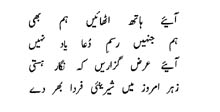
Your New Delhi correspondent had recently reported on an exchange of Urdu couplets between India's National Security Adviser J. N. Dixit and Pakistan National Security Council Secretary-General Tariq Aziz. This had inspired Mr Mehdi Masud, himself a consummate diplomat, to suggest Ghalib's couplets for the occasion (Dawn, Oct 9). This reminds me of the occasion when Mrs Indira Gandhi's special adviser D. P. Dhar had visited Islamabad in 1972 to prepare the ground for the Shimla conference. After talks with Pakistan's foreign minister Aziz Ahmed, he asked the journalists to join him in reading Faiz's poem Dua:
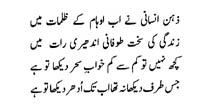
Recently, Kanwar Natwar Singh, India's Minister for External Affairs, after his talks with Pakistan's Minister for Foreign Affairs, Khurshid Mehmood Kasuri, recited before the journalists the following lines from Majaz's poem Khwab-i-sehr:
SYED AFZAAL HUSAIN ZAIDI
Former principal information officer, Government of Pakistan, Islamabad
PCB complimentary tickets
I refer to the article "PCB U-turn on complimentary tickets" (Dawn, Nov 3).
Administrative partners do not, as the report states, represent "a vague head" but are specific organizations who actually assist the board in the arrangements and organization of matches, such as city administration, police, security agencies, Wapda and PTCL. Contact partners fall in the same category as tickets were provided to them on the basis of contracts with sponsors, city administrations, etc. For example, we were contracted to provide a certain number of seats to Samsung and other sponsors, as also 315 seats a day to the city district government, Lahore, as per our existing contract for leasing the ground. Therefore, it is not "anybody's guess" as to who these people were. They were specific entities who cannot by any stretch of imagination be regarded as VIPs.
The five per cent tickets held back were bought by late coming VIPs and by a vast number of Indian fans who arrived for the two Lahore ODIs. It may be recalled that the government agreed to issue 8,000 visas but 20,000 Indians came for the ODIs and had to be accommodated. Holding back five per cent of the tickets saved the board huge embarrassment and led to the success of the series.
The special audit for the series is, in fact, being carried out by external auditors and not as an internal audit as stated in your report.
No complimentary tickets were printed for the recent triangular series and none given. The limited persons invited to the chairman's boxes are mentioned above.
Dawn is right, however, in stating that the VIP culture is an old habit that dies hard. The PCB will maintain its stand against VIP culture and feels encouraged by the example set by the president. As to the sarcastic remark that "the PCB boss claimed that the president would buy his ticket", the president actually paid for his own and his family's tickets.
ABBAS ZAIDI
Consultant Media/PR/Protocol, PCB, Lahore
'Jirga injustice'
Once again Mr Ardeshir Cowasjee has done a public service by writing about a pressing social issue, (Jirga injustice, Nov 7). However, I hope that the news about the pending ordinance on legalizing the jirga system is not correct. How can Dr Ishratul Ibad, governor of Sindh, issue such an ordinance when the leader of his party has repeatedly condemned the feudal system of Pakistan as the main cause of its backwardness? As a matter of fact Dawn of the same day reported that Mr Altaf Hussain had declared in India at an international conference that the MQM's immediate political objective was to change the corrupt mediaeval, feudal political system of Pakistan.
In spite of that, if such an ordinance is on the anvil, then I would like to join Mr Cowasjee in appealing to President Musharraf to use his legal, political and moral authority to stop it. The jirga system is nothing but a travesty of justice and so long it lasts, Pakistan will never progress towards enlightened moderation.
MANSOOR ALAM
Karachi
Military spending
Mr Humayun Zafar (letter, Nov 11) wonders why there is a "hue and cry" over military spending in Pakistan and advises the people to look into other countries' military spending before criticizing their own country.
There is a hue and cry because after looking into other countries' military expenditure, puzzling questions about level and transparency in military spending in Pakistan arise but are not answered. As for the level, selected statistics or camouflaging Rs34 billion of military pensions under the civil expenditure cannot hide the reality which is contained in the official "Debt Management and Reduction Committee Report". The report says: "While defence spending in constant prices more than doubled between 1980 and 2000, the development expenditure actually declined over that period."
This spiralling military spending in reaction to India's is fundamentally flawed. It is wrong to measure defence capability in terms of bullet for bullet, gun for gun and jet for jet. The nuclear armed former Soviet Union pursued such a policy and spent 14 per cent of its budget on military. But the knight collapsed in shining amour.
It is claimed that Pakistan's military machine is one of lowest cost. The claim is based on the argument that on an average Pakistan spends on its half million troops $5,000 per soldier a year as against $16,000 spent by India on each of its one million army. But the same can also be stated this way: India with a population of over a billion maintains a million strong army whereas Pakistan with a population of 150 million has half a million troops.
Transparency? There is no way to find or discuss even in parliament the division of resources among the army, navy and the air force or the allocations between salary and non-salary components.
If we have to compare our spending with that of India, we should also remember that details of India's military spending are available to the people but not in Pakistan, not even to parliament.
When military pensions were separated from the defence budget in 2000-01, the total pension bill of the federal government was over Rs33 billion. Of this civil pensions were worth a mere Rs5.4 billion and military pensions over Rs27 billion. As employment in the federal government and the armed forces is about the same (about 650,000), the vast disparity in the amounts of pensions raises some basic questions which need answers.
Our security strategists first justified nuclear deterrence on the ground that it provided security and would result in cutting down expenses on conventional weapons. Now it is claimed that conventional arms build-up is needed for obviating the incentive to use nuclear weapons in the event of a conflict.
But when civil society asks that theories of national security must be debated to expose the fallacies of such arguments or when they demand transparency in spending, they are dubbed a "security risk" and as less than patriotic. That is why there is a hue and cry.
SENATOR FARHATULLAH BABAR
Islamabad
Enigma of numbers
Mr Jawaid Bokhari's article "The roaring gross national income" (Economic and Business Review, Nov 8) stipulates two methods of calculating the gross national income: purchasing power parity (PPP method) and exchange rate-related World Bank Atlas (Atlas method). Pakistan's GNP for 2003 under the PPP method was $306 billion while under the Atlas method, it was $69 billion. The figure for the fiscal year 2004 under the Atlas method has been put at $98 billion while that under the PPP method has not been specified. However, based on the 2003 ratio, it works out to $434.6 billion.
The article quoting the State Bank governor states that measured by the PPP method, Pakistan has a strong middle class of 30 million people enjoying a per capita income of between $8,000 and $10,000. Thus, the income of the middle class works out to $240 billion ($8,000 per capita). The question arises: how can 30 million people get $240 billion when the GNP (under the Atlas method) is mere $98 million?
If we go by the PPP method, 30 million people get $240 billion while the balance of $194.6 billion ($434.6 billion - $240 billion) is shared by the remaining 119 million people (Economic Survey issued in June, 2004 puts the population at 149 million), meaning that per capita income of $1,635 is much higher than the international poverty level income of $1 per capita per day. Should that mean that Pakistan has totally alleviated poverty even though the government's own data puts the poverty level at over 33 per cent?
Will someone explain this enigma?
GHULAM MUHAMMAD
Karachi
Social edicts
Laws cannot make people pious, thrifty, etc. Get the police out of the business of enforcing religious and social edicts. It only gives them more ways to line their pockets. Arresting people for eating in public during Ramazan or prescribing how weddings should be catered only results in people finding detours while creating even more opportunities for bribery.
These issues should be left for society at large to handle through education, evolution and moral pressure rather than through criminalization. The government needs to use its meagre anti-crime resources wisely.
JAMAL H. KHAN
Charleston, WV., USA
Fallujah
What is happening in Fallujah makes me think that the interim Iraqi prime minister is nothing but a disciple of Ariel Sharon.
INSPECTOR QABACHA
Lahore
Missing gold bangles
I was travelling from New York to Karachi via Manchester and Lahore on PIA flight PK 0712 on Nov 6-8. At the John F. Kennedy Airport, just as I was about to board the plane, a PIA official stopped me and wouldn't let me take my suitcase as a carry-on bag, even though others intervened to tell him that the weight of the bag was okay. The suitcase was transported in the plane's hold. A set of 11 gold bangles, weighing 129.160 gms, was stolen from my luggage.
My suspicion is that the thief got his hands on the bangles at the John F. Kennedy Airport, NY. Even though the flight wasn't scheduled to leave before 9pm (Nov 6), boarding had started at 7.30pm. The thief had enough time to turn everything inside out in search of anything valuable.
Upon finding the bangles missing on arrival in Karachi, I rushed to the airport and filled a report with PIA officials at 5.30am on Nov 8. When I called them at around 9.30am (Nov 8), I was told to call later since an investigation was in progress. I called again on Nov 10 and was told that the bangles had not been stolen at Karachi airport and that the airlines authorities had asked officials in New York, Manchester and Lahore to investigate and were waiting for their answer.
I'm not at all satisfied with the steps the PIA officials have taken so far to retrieve my bangles. With a little more concerted effort, they could easily trace the culprit by identifying the fingerprints on the things inside my suitcase.
NADIA KHURRAM
Karachi
A question
Virtually every day, your newspaper carries articles and letters on Kashmir, and most writers seem to think that India will somehow give up a part of its territory to Pakistan for the sake of "stability in the subcontinent".
I am curious to know if there is any recorded instance in history when a geographically, economically and militarily stronger nation has ceded territory to a smaller adversary in order to avoid a war.
ANU SOMAN
Mumbai, India
Clarification
The second sentence of the second paragraph of my article "Kashmir: an impasse or denouement?" (Dawn, Nov 13) should be read as follows:
"The Pakistani people find insupportable the fact that a whole people in the region is under a military occupation.... And the military burden that we carry as a result...."
M. ABUL FAZL
Karachi