



 0
0

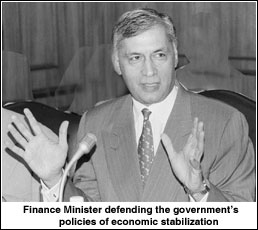 ISLAMABAD, July 20: Finance Minister Shaukat Aziz has rejected an allegation that the present government did not do anything for the common man during the last two-and-a-half years time.
“There is a perception in some quarters that the government has not done enough to improve the conditions of the common man over the last three years and that the lower and middle income groups are hit by rising inflation, which is not true,” the minister stated.
On the contrary, he told Dawn, a lot had been done by the government to improve the conditions of the people and protect the most vulnerable from adjustment costs.
He pointed out that relief to the common man is directly linked to the financial strength of the economy. “No government can provide relief to the people by printing notes or cutting prices of essential items, arbitrarily. Such measures would, at best, be regarded as political gimmickry and cannot be sustained,” he said.
For example, the finance minister said a reduction of Re1 per kg in flour price would cost the national exchequer Rs18 billion, and a similar cut in ghee price will cost Rs1.5 billion. Similarly, slashing gas price by 50 paisa per unit will cost Rs12.5 billion. These three measures alone would cost the exchequer Rs32 billion.
“Will the conditions of the common man improve by taking these three measures? Of course the answer is No. What would happen to the budget if these three measures are taken. Naturally, fiscal deficit would increase by Rs32 billion, and the country’s debt would rise accordingly. Is this a viable policy? and the answer is again No. The best way to provide relief or improve the conditions of the common man is to create employment opportunities; increase access to social services such as education, health, safe drinking water, sanitation etc.; and protect the poorest of the poor from adjustment costs,” he added.
Aziz questioned what has been the financial strength of the economy some three years ago. “Without indulging in the numbers game, it is a fact that economic growth was slowing, investment rates were decelerating, debt burden reaching alarming proportions, the country was on the verge of default on its external payments obligations, poverty was rising, and above all governance was deteriorating. The first and foremost task of the government was to stop the economic haemorrhage and dispel the gloom about Pakistan’s future. Over the last three years, Pakistan’s economy has made significant progress.”
The government, the minister pointed out, has succeeded, to a large extent, in restoring macroeconomic stability; the external balance of payments has never been in such a comfortable position; foreign exchange reserves are approaching $7 billion; exchange rate is stable; both external and domestic debts are falling; inflation is low and interest rate is declining; and above all, Pakistan has restored its credibility with the international financial institutions and the markets.
The common man has benefited from some of the government policies designed to stabilize the country’s macro-economic situation.
Maintaining low inflation, he said, had been the most important achievement of the government’s economic policies. Inflation is a regressive and arbitrary tax, the burden of which is typically borne disproportionately by those in fixed income groups and poor. Overall inflation averaged 3.6 per cent during the last three years as against 10.4 per cent during 1990-99. Most importantly, food inflation averaged 2.4 per cent as against 11 per cent during the same period. Keeping inflation at low level, is therefore, seen as a necessary part of the poverty alleviation strategy.
The government, Mr Aziz said, had substantially raised the salary of the government servants after eight years. Furthermore, the exemption limit of the income tax was raised form Rs40,000 to Rs80,000. With low inflation rate, rise in salary and increase in exemption limit, the real disposable income of the fixed income group has increased substantially.
Similarly, he said medical allowance and overtime of the low-paid government servants had also been increased in the budget 2002-03. Minimum wage for unskilled workers was raised from Rs1,500 per month to Rs2,500 per month after the gap of nine years. Pension for industrial workers was raised from Rs630 per month to Rs700 per month. Number of scholarship for workers’ children was raised form 3,550 to 5,000 per annum for education in FA/F.Sc, BA/B.Sc., MA/M.Sc, including professional colleges and institutions. The scholarship amount has also been raised from Rs700-Rs2,500 to Rs800-Rs2,800 per month per student.
The government, he said, had launched a credible programme for poverty reduction. There are approximately 21 million household in Pakistan and roughly one-third (7 million) is living below the poverty line.
The government has launched the following programmes for these seven million poor households.
* Under Khushhal Pakistan Programme, the government has released approximately Rs24 billion which has created more than three million temporary jobs.
* Under Food Support Programme, 1.2 million poorest households (with monthly income of up to Rs2,000) are receiving cash support. The government has spent so far Rs3 billion.
* About 2.0 million beneficiaries are receiving assistance form the Zakat Fund. Additional 1.5 million beneficiaries will be added soon. These beneficiaries will be receiving Rs10,000 to Rs50,000 each for starting up small business/trades.
* Khushhali Bank has been established to provide micro credit to poor communities. By end-March 2002, the bank had established branches in 26 districts of the country and had disbursed 28,495 loans amounting to more than Rs277 million.
* In addition to creating employment opportunities, access to social services has increased. For example, enrolment to primary school has increased from 71 per cent to 81 per cent. Literacy rate has increased from 45 per cent to 51 per cent. Access to safe drinking water increased from 65 per cent to 80 per cent in urban areas and from 45 per cent to 58 per cent in rural area. Coverage of Lady Health Worker has increased by 30 to 40 per cent in rural area. There are 70,000 Lady Health Workers are working at village level. Immunization coverage has increased substantially against childhood disease and maternal tetanus. Similarly, the coverage of TB Control Programme, Hepatitis B, and Malaria Control Programmes have been increased substantially. The government has spent Rs136 billion on poverty-related programmes last year. In the current fiscal year, this amount has been raised to Rs161 billion. Spending on education and health amounts to Rs90 billion.
“As I said earlier the relief to the common man is directly linked to the financial health of the economy”. Along with improvements in various sectors of the economy, the government has made efforts to improve the conditions of the common man. If the conditions of the lower and middle income groups have deteriorated then why the sale of motorcycles and bicycles have increased substantially, he asked. In the month of April, 2002 alone, the production of motorcycles and bicycles has increased by 35 per cent and 12 per cent, respectively. “Who buys motorcycles and bicycles? It is the lower and middle income groups and not the rich people. Why the production of cement is rising. In April 2002, alone, the production of cement has increased by 21 per cent. This suggests that the construction activity in the country is picking up. This is a highly labour-intensive sector and as such many skilled and unskilled workers will be getting employment,” he asserted.
“Imagine what would had happened if rupee depreciated to Rs70-75 to one US dollar from Rs64-67 per US dollar last year. What would had happened to the price of oil, gas, diesel, kerosene and electricity? Indeed, it would have been unbearable. By maintaining a stable exchange rate, the government has protected the common man from the adverse effects of exchange rate depreciation,” the finance minister said.
He said a lot of progress had been made but more needed to be done. The benefits of economic stabilization will trickle down gradually. “We need to have patience and continue with the process of structural reform. There are no gimmicks or shortcuts to achieving sustainable impact on the quality of life of the common man. This takes time, consistency and continuity of policies.
“Pakistan needs to stay the course to improve its macro-economic situation and follow the path of disengagement from the past poor governance and embark on a path of transparency, good governance and true public participation,” the finance minister added. — Ihtashamul Haque

























