0
0

 Pakistan’s economy is agriculture-based and requires rapid growth in production. In the backdrop of declining irrigation water availability in the country especially in Sindh, the production factor has assumed greater importance.
The crop production over the last two decades has not shown significant gain. The per acre yield of most of the crops is almost stagnant. However, induction of hybrid crops cultivation has proved an important measures to increase food production.
In Pakistan rice is the second most important staple food after wheat, grown over an area of 2 million hectares. It is chiefly grown in Punjab and Sindh followed by Balochistan and the NWFP.
The course IRRI varieties are grown in Sindh, while both Basmati and coarse rices are grown in Punjab. Since last couple of years growers of Sindh are not getting adequate price of their Irri rice. Reason attributed to stiff competition in the international market from the countries like China, Thailand, Vietnam, etc, that offer hybrid course rice that competes with the IRRI-6 variety grown in Sindh.
To overcome this situation rice growers of Sindh at their own level are desperately trying to grow some fine varieties viz:- Basmati-385, Shaheen, Basmati-2000, etc, of Punjab which could fetch profitable yield. But their efforts have not been rewarded so far. The main reason being probably soil and climatic factors.
However, during the Kharif-2001 season Guard Agricultural Research and Services Private Limited in collaboration with M/s Yuan Longpin High-Tech Agriculture Company Limited of China, a subsidiary company of the Hunan Rice Research Institute (HRRI) introduced “hybrid rice” in Districts Shikarpur, Jacobabad, and Larkana of upper Sindh.
For cultivation on trial basis seeds of coarse hybrid rice varieties GN-50 and GN-53 were distributed amongst some prominent rice growers of upper Sindh free of cost.
Besides, to provide technology for undertaking hybrid rice cultivation to the growers a Chinese expert (agronomist) was also stationed at the farm of a prominent politician-cum-grower of Jacobabad by M/s Guard & Hrri Pakistan.
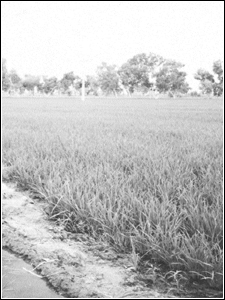
The hybrid rice grown over a plot of 5 acres at Deh Mangria in Taluka Garhiysin Dist Shikarpur, and 15 acres at Deh Delawarpur at Jacobabad was under regular inspection of the writer right from its transplanting in July to harvesting in October (Kharif-2001).
At Deh Mangria farm, yield obtained from the hybrid rice crop was 83 maunds per acre which was 17 to 22 maunds more than the IRRI-6 and 40 to 42 maunds per acre more of Basmati-385.
Moreover, the most significant merit of hybrid rice over Irri-6 was its 100 days crop period, from transplanting to harvesting, against 120 days of Irri. Here it would be proper to mention that up till now the growers of upper Sindh had only one early maturing rice variety DR-83 developed at the Rice Research Institute Dokri.
But unfortunately because of its low yield as compared to Irri-6 its cultivation remained restricted to chronic late sown rice area at the tail-end of irrigation canals. Since hybrid rice (GN-50 and GN-53) has been found both early maturing and high yielding it is quite likely that soon our old Irri-6 will face gradual replacement by the hybrid rice.
Some details of hybrid rice cultivation obtained from the farm at Deh Mangria in Shikarpur are: Seed rate applied — 7kg per acre for nursery raising; date of transplanting — July 17, 2001; date of harvesting — October 26, 2001; fertilizer applied — super phosphate 2 bags, urea 2 bags (split dose; pesticide applied — two sprays for WBPH control.
Since this year there was no rice stem-borer problem no granular pesticide was preferred by the growers.
Demerits: High fertilizer requirements of hybrid rice crop make it susceptible to insect pests, particularly whitebacked plant hopper (WBPH). With the induction of hybrid rice in the country farmers can no longer save seeds from their crop to grow the following season, a practice as old as farming it-self.
Suggestion: Rice crop in Sindh is given mostly granular pesticide application for its pest control, particularly rice stem borers. This practice did not affect the established predators and parasitoids equilibrium office crop ecosystem.
It is apprehended that following large scale cultivation of hybrid rice which is not tolerant to the WBPH infestation foliar spray of pesticides may become prevalent on rice crop like that of the cotton allowing resurgence of some secondary pest problem.
In the backdrop of this apprehension it is suggested that the Rice Research Institute at Dokri in Larkana district should find out some non-chemical tactics of management of the WBPH on hybrid rice.