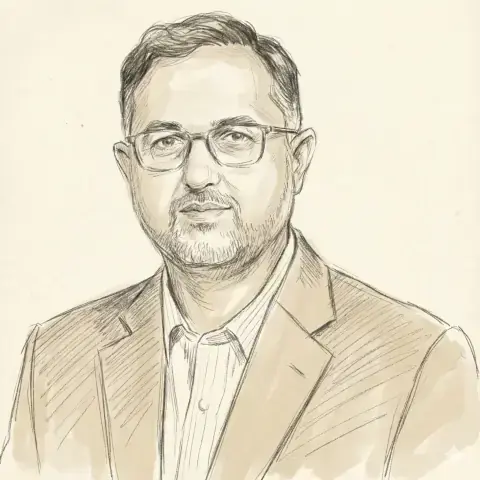
ISLAMABAD: A shake-up in the office of the secretary of Iran’s Supreme National Security Council (SNSC) has implications that extend beyond the country’s internal affairs.
The key appointment – coming amid the volatile situation in the Gulf and with the Oman-Iran talks on the future of the Strait of Hormuz yet to produce a final arrangement – signals a shift in the structure through which Tehran’s national security decisions are being processed.
The replacement of Bagher Zolghadr by veteran Islamic Revolutionary Guard Corps (IRGC) commander Mohsen Rezaei is significant because the SNSC brings together the country’s top civilian, military and judicial leadership for deliberation on defence and foreign policy, with its decisions requiring confirmation by the Supreme Leader.
Its secretary, however, is merely an administrative official controlling the Secretariat, setting the agenda, coordinating between state institutions, preparing policy options and implementing decisions.
Rezaei is not just the new secretary of the Supreme National Security Council, he is also the supreme leader’s representative, giving him far more sway and clout
But what makes Rezaei’s appointment particularly consequential is that he has also been appointed the supreme leader’s representative on the Council, giving him a more powerful dual-hatted role that Zolghadr did not have.
Rezaei will consequently have both control over the machinery through which national security policy is processed and a formal seat and vote on the Council as the leader’s representative, giving him a stronger institutional voice and a more direct channel to Supreme Leader Ayatollah Mojtaba Khamenei.
The shift importantly signals a rebalancing of the power-sharing arrangement that had emerged in Tehran after Ayatollah Ali Khamenei’s assassination.
However, reading the change simply as a triumph of what many see as ‘hardliners’ in Tehran over the ‘moderates’ does not convey the full picture. Zolghadr himself was an IRGC figure, and his position on the Strait of Hormuz was not fundamentally different from that of his successor.
Rezaei brings to the position a standing that Zolghadr simply did not possess. Having commanded the IRGC from 1981 to 1997, including through most of the Iran-Iraq war, and subsequently headed the Expediency Discernment Council for more than two decades, he is deeply embedded in the security establishment and has considerable political experience. More importantly, he has been publicly involved in the present confrontation, repeatedly linking military deterrence with diplomacy and describing Hormuz as a strategic red line.
That makes the appointment particularly relevant to the unresolved Hormuz question as the negotiations with Oman have increasingly moved towards technical issues, including routing, monitoring, maritime services, environmental cooperation and possible fees, with Iranian officials indicating that progress has been made on the broad geography of a future shipping arrangement.
Rezaei is likely to insist that any operational reopening of Hormuz should produce demonstrable gains for Iran and that the military dimension should remain available as leverage.
This should not be read either as Iran having chosen confrontation over diplomacy, rather that Tehran is willing to pursue both.
However, it has placed a stronger security establishment figure to make tactical adjustments along the course. Rezaei has been deeply sceptical of Washington’s intentions, accusing the US of using negotiations to buy time and demanding tangible confidence-building measures, including the release of frozen Iranian assets, before Tehran returns to substantive negotiations.
Therefore, this change could make diplomacy more difficult in the short term, but it could also make a future negotiation more structured. The Islamabad Memorandum of Understanding (MoU) had already demonstrated the difficulty of separating the immediate question of Hormuz from the larger US-Iran confrontation.
The path forward, therefore, is unlikely to be a single comprehensive breakthrough, but a plausible sequence would begin with an Iran-Oman technical arrangement on navigation, followed by reciprocal US steps concerning the blockade and Iranian commercial shipping, which could then create enough confidence for indirect or direct US-Iran negotiations to resume.
Published in Dawn, August 11th, 2026