



 0
0

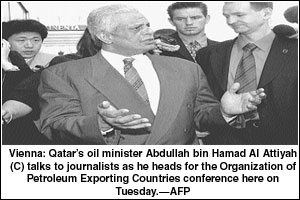 VIENNA, March 11: Opec has decided to leave oil production quotas unchanged, Saudi Oil Minister Ali al-Nuaimi said on Tuesday.
“It’s not a wait-and-see position. We remain committed to supply the market when needed,” he said, adding: “There is no shortage of oil right now.”
The president of the 11-country Organisation of Petroleum Exporting Countries, Abdullah al-Attiyah of Qatar, said Opec members had spare capacity that could be used to increase production at short notice when necessary.
“The near term is dominated by political factors on which Opec has no influence,” said the Qatari energy and oil ministers.
“Our members collectively still have spare capacities. We can bring this on stream on short term.
“We are ready to retract it, if there is an over-supply.”
Yet the group that controls 60 per cent of world crude exports dashed hopes among consumer nations for a formal suspension of its output limits should war break out.
Iran and others opposed any policy that implied support for a US attack against an Opec member country.
After a three-hour meeting ministers decided to leave unchanged official output limits of 24.5 million barrels a day, Algerian Oil Minister Chakib Khelil said.
With most in Opec already pumping to the limit, the cartel will be stretched to cover the loss of Baghdad’s 1.7 million barrels daily to the 77-million-bpd world market. Kuwait in addition may close up to 700,000 bpd near its northern border with Iraq, where US troops are poised for war.
Needing a recovery in the world economy to restore oil demand growth, Opec wants to prevent another spike in crude prices that already are near 1990-1991 Gulf War highs.
“I agree prices should be lower. I would like them to be in the band,” Naimi said.
In a major development, US Energy Secretary Spencer Abraham said the United States would tap its oil reserves if a “severe supply disruption” were to occur.
“We’re prepared to act very quickly,” Abraham said. “Our decision... will be based on an estimation of whether or not we believe a severe supply disruption exists... (this is) the condition under which we will draw from our reserve,” Abraham told reporters.
He refused to be drawn on whether the United States would make such a decision in case of a potential war on Iraq, saying: “Our decision is unrelated to any specific action, or trigger.”
“That decision is one that we would make only if we believe that a severe disruption in supply exists,” he said.
“It would be a decision that would be consultative in nature. We would expect to talk to others who are part of the IEA (International Energy Agency)... a decision would be based on our conclusion that a severe supply disruption exists,” he said.
The Paris-based IEA is a grouping of 26 states, mostly industrialised powers, committed to taking joint action to meet oil supply emergencies.
Abraham was in Vienna Tuesday to attend a two-day conference on tackling the threat of “dirty bombs” — such as radiological devices, organized by the International Atomic Energy Agency, a UN body.
The United States and other major importing countries want Opec to maximize production if a war threatens supplies and causes prices to spike.
Meanwhile, in London, the price of benchmark Brent North Sea crude oil for April delivery traded at 33.37 dollars per barrel, down 32 cents on the day but little changed from before Opec ministers announced the outcome of their Vienna meeting.
In New York, the reference light sweet crude April-dated futures contract was down 57 cents at 36.70 dollars a barrel in early deals.—Agencies






























