0
0

KARACHI, March 7: Women in Pakistan, like other parts of the world, do not enjoy all the rights as provided in the Constitution and Islam.
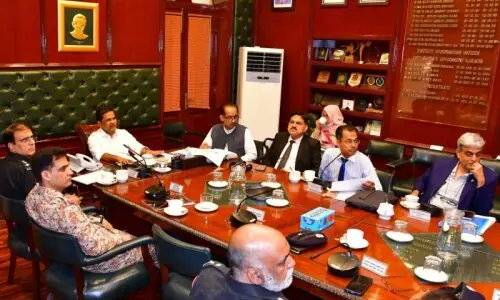
This was observed at a seminar on Women’s Poverty: Causes and Solution held here on Friday on the eve of International Women’s Day being observed on Saturday. The seminar was organized by the Working Women Organization Trust.
The speakers pointed out that the Constitution and religion guaranteed all the due rights to the weaker section of the society. However, they added, social and cultural traditions never enabled the women to get all these rights.
They said that western society, where women enjoyed the highest level of liberty, was not a model for women in Pakistan. Rather, a Muslim woman enjoys far more liberty, protection and security under her religion. The only question is how many and how strictly the Islamic decrees were implemented and practised by the rulers as well as the society.
The speakers maintained that women usually come out of their homes in search of jobs under pressing conditions. Most of them, they said, had to face gender-based discrimination, harassment, inequality, insult, misbehaviour and countless other problems while on the way and at workplaces. At the same time, they added, they face a similar attitude in the narrow-minded society.
Enlisting some of the major and common problems, the speakers said that majority of working women were offered jobs on contract basis and curtailed benefits and having no job security. Most of the companies did not comply with the International Labour Organization’s conventions pertaining to working women.
“Sexual harassment is rampant at workplaces and male colleagues as well as employers in many cases force them to come to their terms. They are fully exposed to this unethical behaviour only due to their weak financial position,” some of the speakers claimed. They said that the women who surrender to their pressure got better package while others would have to lose the jobs.
Stressing the need for the implementation of ILO conventions, the speakers demanded that skill development programmes be launched exclusively for women and economic assistance be made available so that they could run their own business. They said that such measures would not only ensure the women’s self-respect and security but also enable them to accommodate other women in their business concerns.
Aisha Munawwar, MNA, speaking on the occasion pointed out that political stability was very important in ensuring sustainability of any system. Unfortunately, she said, governments in our country survived only for a couple or so years. She said that it had become a routine that every successive government suspended or shelved the previous one’s projects and programmes. She pointed out that women welfare programmes were also among them.
Ms Munawwar said that this routine not only pushed the achievements away but also led to the waste of huge budgetary allocations and other funds. She was of the view that the situation would have been different had governments been allowed to complete their terms.
Kulsoom Nizamani, MPA, regretted that though seminars, symposia, walks and other such programmes for the rights of urban women used to be held in the past, nothing concrete had been done for the real welfare of the weaker section. She observed that urban women were still financially poor and the rural women’s condition was pathetic.
Akram Khatoon, former chief of the First Women Bank, said that the bank was not only carrying out skill development programmes but also providing financial assistance to the women without any collateral.
Parveen Shaikh told the participants that the government had evolved National Plan of Action for the women which, after implementation, would gradually improve the condition and status of woman folk.
Others who spoke on the occasion were Musarrat Akram, Shamsunnisa, Humaira Qureshi and Musfara Jamal.
HONOUR KILLING: Humera Alwani, MPA, in her message on the eve of International Women’s Day, expressed grave concern over the rising trend of honour killing in Sindh and other parts of the country.
She deplored that people, especially women, were being eliminated under the inhuman custom of ‘karo-kari’ for long. She said that PPP would table a bill against the custom in the assembly and do its best to get the bill approved.
TELE TALK: At a ‘tele talk’ organized by Pasban to mark the occasion, women leaders and intellectuals from different walks of life urged women to play their vital role in upbringing their children in accordance with the teachings of Islam, agencies add.
Begum Zahid, wife of Justice (r) Nasir Aslam Zahid, said that the western methods and style of education diverted the new generation from their traditional Islamic culture. She regretted that the new generation knew about Basant and valentine’s day but not the history of the glory of Islam.
Those who participated in the tele talk included prominent figures like Fatima Suraiyya Bajya, Haseena Moin, Begum Bilqees Edhi, Huma Mir and Prof Ferhat Azeem. Sindh President of Unicef, Zeba Bukhari and the Nazima of Jamaat-i-Islami, Rabia Aalam, also spoke on the occasion.
PLANS: The government is chalking out a comprehensive programme for the betterment of the woman folk. The programme includes provision of jobs, education opportunities and ensuring women’s legitimate rights.
This was stated by the provincial Minister for Women Development, Dr Saeeda Malik, while speaking as chief guest at a seminar organized here on Friday in connection with the Women’s Day.