0
0


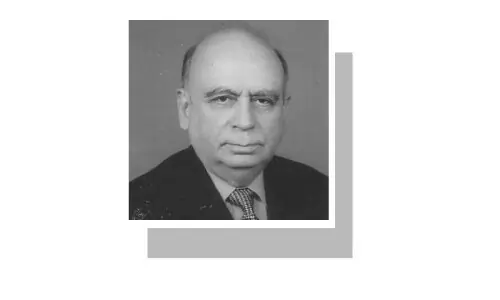
DR Shah Muhammad Marri has a precise description for his literary passion. 'It is a kind of madness' he pronounces with clinical precision, and laughs when he looks at my shocked expression. 'You must understand this,' he says and goes on to explain that all this is done without consideration of any immediate benefit and it is like a movement by itself which does not reach the streets.
The Quetta-based scholar and writer was encountered in Islamabad and not having a minute to lose, we talked about books while browsing at bookstores, waiting for a taxi, and lounging in the hotel lobby.
Dr Marri speaks of not having enough time but has several projects in hand, none of which can be described as less than ambitious. Ushaq Kay Qafilay will be a series of 12 books, out of which five have been completed so far. 'It as series of the lives of the great,' he says and goes on to explain that the 'great' are the valiant fighters who struggled against overwhelming forces and were anti-imperialist or pro-people.'
History and socio-political analysis come up as his forte in the monumental Baluch Qaum Ehd-i-Qadeem Say Asr-i- Jadeed Tak, but he is a working on a new edition for which the book is being completely recast and rewritten. 'It may now stretch to three volumes,' he says and explains that he has shifted his position on a number of conclusions in the published form of the book, especially on the ancient history of the terrain. 'Since the publication of this book I am convinced that some portions had to be rewritten. After all, Mehr Garh has been discovered. I will take the narrative up to the post-Soviet era and the implications for Balochistan.'
Literature follows history closely and Dr Marri is also working on a history of the Balochi language and literature. He was asked to write a book of average size, but he thinks that it may comprise more than 1,000 pages when completed. It is with great enthusiasm that he describes the riches of classical Balochi poetry and the 19 ancient dastaans that deal with the theme of love.
He makes no secret of his work habits while writing. He writes in longhand in the old-fashioned way and does not use the computer. 'I steal time,' he says with a smile, 'a bit from here and a little from there, is how I manage time. I have no set working habits. When the college is open, it takes up a big chunk of my time, and then I have my practice, clinical work and teaching,' he says of his association with Bolan Medical College.
And if that is not enough, he also edits the journal Sangat, published from Quetta. Among his new books are a highly readable travelogue of China and the translation of a British account of the Marri-Bughti skirmishes, published from Lahore.
Given his convictions, it should not come as a surprise that Dr Marri's books have mostly been self-published, apart from the two mentioned above. 'There are three or four books which are still in manuscript form because the money was all gone and I could not find any publisher,' he says. 'I do have complaints and grievances against publishers, but these will be different from the kind of complaints other writers may have. Any publisher who wants my books must have the same kind of beliefs and convictions as I do, but it becomes a problem when they take me for granted, thinking that I need not be given due payment and that I would not be bothered to see the published book look appealing. Yeh bhi comrade hey is liye khair khairiat hay', is how he sums up their attitude.
Talking about the state of affairs in publishing, he offers a clear diagnosis 'What capitalism has done to the other institutions in the country, the same has happened with publishing too. The most exploited person in this entire scenario is nobody else but the writer. Just like the labourer in a capitalist society. Booksellers have become a mafia. They do not allow even a small opening for others to enter the field,' he says.
What he is most unhappy about is the new development among publishing houses in Pakistan whereby 'they have started determining the taste of the readers'.
He points to a shelf full of glitzy titles and summarises their contents 'Islami ghiza. Islamic libas. Islamic method for washing hands. The love life of a former cricketer. This is the stuff they are providing for readers. All this is light reading and in such a situation very few care about my bakwasiat!' All this notwithstanding, Dr Marri is determined to go on with the books he is working on and it will take more than unwilling publishers to stop him from writing.