



 0
0

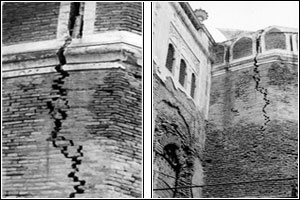 LAHORE, Feb 17: The Lohari Gates’ walls have developed cracks, which reflect apathy of the provincial government towards historic monuments.
A major crack in the wall can be seen from a distance whereas many small cracks, which one can see through a close examination, are widening day by day. The government’s indifference can also be seen in these cracks.
Many traders have set up their businesses under the gate by building kiosks on its both sides.
Muhammad Riaz, who runs a kiosk, told Dawn on Monday that the walls had been repaired about three years ago. He added these traders pooled money to repair the gate’s inner portion.
The Lohari Gate is one of the six Walled City gates declared protected in 1966.
When contacted, Director Archaeology (North Circle) Saleemul Haq said although the gates were protected monuments, the archaeology department had nothing to with these, as the provincial government was responsible for their upkeep.
He said the Antiquities Act 1975 was applicable to the gates and no construction was allowed around 200 feet of a monument. A number of shops had, however, been built under the Lohari Gate in violation of the Act, he added.
According to a senior city district government official, the responsibility for the upkeep of the gates rested with their occupants.
The Bhati and Masti gates have been occupied by the respective police stations, the Delhi Gate by corporation’s computer centre and offices, shabby shops and kiosks and the Sheranwala Gate by a government school, mosque and a timber shop. The city district government and individuals have set up their shops and houses at the Chitta Gate.
The shopkeepers running businesses under these gates said they spent a little on repairs when unavoidable.
The British government, after taking over the Punjab, demolished 12 gates of the Walled City. Six of those were rebuilt and declared protected.
The other six are Kashmiri Gate, Mochi Gate, Shah Alam Gate, Taxali Gate, Zaki (Yaki) Gate and Roshni Gate. The 13th gate is a mori known as the Mori Gate. — Zulqernain Tahir


























