0
0

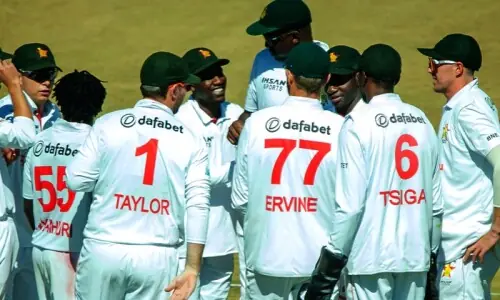
 Cricket. It is a veritable microcosm of Pakistan.
On the one hand, it embodies the nation’s successes (who will ever forget the World Cup triumph of 1992, or the more recent victory across the border?). On the other hand, it reflects Pakistan’s failings (recall those ugly scandals).
It is also a rare unifying force in a deeply divided country, and even a potential catalyst for peace with a long-time nemesis.
In other words, cricket is a game that any credible Pakistan analyst should strive to understand.
And yet I confess I’m completely clueless about how it’s played. When it comes to cricket, I’m the quintessential ugly American.
Certainly I’m familiar with the broad contours. Years ago, while living in Brussels, I spent hours scrutinising game coverage on Eurosport. An Australian friend even convinced me to play several times (I quickly learned that the necessary skill set is quite different from that of baseball, a game I began playing at a young age).
Yet, these experiences have done little to make me conversant in cricket parlance. It’s easy enough for me to know when a match is underway; I log on to Twitter and am barraged by 140-character staccato bursts of Urdu utterances punctuated by English profanity and exuberant (or angry) references to Misbah, Hafeez and friends. Yet that’s about all I can follow.
The other day I decided enough was enough; it was time to learn more. So I did as any resourceful 21st century scholar would do: I turned to Google and Wikipedia. This research was somewhat helpful. I learned, for example, that Shahid Afridi is not the doctor who helped the CIA find Osama Bin Laden — though he appears to be nearly as controversial.
I then consulted an article called “A Beginner’s Guide to Cricket” described by its author, Justine Larbalestier, as a “pared-down, embarrassingly easy introduction to the world’s holiest game.” Well, perhaps for her it is; I came away from the article thoroughly befuddled. I found Larbalestier’s trenchant talk about “sundries” and “double centuries” more confusing than the speculation surrounding Tahirul Qadri’s Long March.
My next — and much wiser — step was to reach out to Afia Salam. The Pakistani cricket journalist extraordinaire minced no words. “There is consensus,” she told me, “that any attempt to understand cricket by an American would be futile.”
Initially, I wasn’t sure how to respond. But then she said something that prompted me to nod in grudging agreement. Test cricket lasts five days and often ends in a draw, Salam explained. “Now show me an American who can understand [that] and I shall show you an imposter deserving of deportation!”
Indeed, the notion of baseball’s World Series or the National Basketball Association Finals — American equivalents of marquee-level, multi-day sports competition — ending with such an inconclusive outcome does seem utterly unfathomable to me.
Yet as I reflected on all this, trying to make sense of the sport’s intricacies and how they fit in with the realities of today’s Pakistan, I had a revelation. I was falling into a trap that so often ensnares analysts: I was thinking too much. I was gazing at too many trees without realising the supreme significance of the forest. And the forest is epitomised by the Pakistan Super League.
The facts are well known. This new Twenty20 league, scheduled to begin play in March, hopes to showcase cricket’s premier talents, both domestic and foreign. However, the Federation of International Cricketers Associations has warned foreign players not to participate because of security concerns.
In an effort to lure international participants, Pakistan’s Cricket Board has taken the extraordinary step of offering insurance policies valued at up to $2 million.
That’s a lot of value. If 11 foreign players accept that offer (enough to field a full team, I’ve learned), Pakistan would be insuring as much money as the World Bank recently committed to spending on polio eradication efforts in the country.
Yet the PCB’s generous gesture is instructive. The Super League provides a special opportunity for Pakistan to alter the most-dangerous-nation-in-the-world global narrative — and the country is willing to take bold measures to benefit from this opportunity. If foreigners come to play in Pakistan, and all goes smoothly, then a major victory will be scored not just for cricket, but for Pakistan’s bruised and battered image abroad.
It’s a great risk, both for foreign cricketers and for Pakistan itself. Yet as Salam told me, the Twenty20 league is the “life blood” of Pakistani cricket: It draws the crowds, sponsors, and money needed to sustain the country’s unifying, wildly popular national treasure. There’s clearly much riding on the Super League, and Pakistan is keen to infuse it with as much prestige as possible.
And that, unlike discussions of, say, stumps and tailenders, is something I can truly understand.
————————————————————————————————————————————————

The author is the Senior Program Associate for South Asia at the Woodrow Wilson International Center for Scholars in Washington, DC. You can reach him at michael.kugelman@wilsoncenter.org ———————————————————————————————————————————————— The views expressed by this blogger and in the following reader comments do not necessarily reflect the views and policies of the Dawn Media Group.