0
0

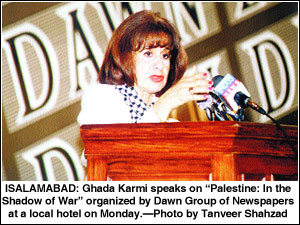 ISLAMABAD, Feb 3: Attack on Iraq would be another injustice committed in this region.
This view was expressed by Ghada Karmi, the internationally acclaimed Palestinian author and activist while delivering her lecture on “Palestine: In the Shadow of War” organized by Dawn Group of Newspapers at a local hotel on Monday.
She urged Pakistanis to raise their voice against the impending danger forcefully to strengthen the hands of the government to say no to the kind of resolution that may be tabled at the Security Council on this issue.
The author of the internationally acclaimed book, In search of Fatima , Dr Karmi said she was delighted by what she had already heard about the effort of the intelligentsia in Pakistan in this connection.
Raising her voice against injustices anywhere in the world, be it Palestine or Kashmir, she spoke of the “shameless arm-twisting” that goes on to build up pressure for attack in the region. She said she was appalled at the manner in which resolutions were passed by a “toothless” UN at the behest of one power.
She said the impending attack on Iraq was the kind of tragedy that was unfortunately already known to everybody, and some famous American journalist had even revealed the statement of a former CIA director that it had already been decided on September 17, 2001 to attack Iraq. It would be ‘completely cynical exercise’ to pretend that the decision of war is yet to be taken.
Whatever be the date, Dr Karmi maintained, that a decision had already been taken. She also pointed out to strong sentiments against the war in Britain and Europe and even in the USA.
Dr Karmi reminded the audience that people in Britain were already recalling of the attack on Suez canal which ultimately lead to the fall of the Prime Minister in Britain. She said that one- third of the MPs in Britain were against it, and 81 per cent of the people in a poll have opposed the idea. She said that Tony Ben an eminent MP was in Iraq talking to Saddam.
Dr Karmi pleaded for joining in demonstrations against this horrifying possibility of setting a precedent that the US could strike at any power at will that it did not like. “The tragedy of the situation is that the Arab countries are allowing this to happen,” maintained Dr Karmi and thought it strange that the Arab League foreign ministers are taking it so casually that they have decided to meet about this urgent matter at a far off date of February 16.
She thought that it was tragic that the Gulf states had joined to facilitate the attack by providing bases to the US and its allies.
“This should never have been allowed to happen”, she stressed. She said by conservatives estimates in Iraq 48,000 having being killed in the first round of attack, the causalities would rise by quarter of a million later. More deaths will occur because of the collapse of infrastructure. She said she was horrified over reports that the US President had signed an order authorizing the use of tactical nuclear weapons in case Iraq used chemical or biological weapons on American or allied forces.
Speaking of the plight and trauma of displacement of the Palestinians since 1948 she read extracts from her latest book In Search of Fatima , which in its autobiographical narration brought out the psychological anguish of the Palestinian refugees as a result of the forced exile. She said she came to England where her father got a job in the Arabic service of the BBC. She also talked of her father who, when about to be awarded an MBE by the Queen, was persuaded by her mother not accept it.
Speaking of her childhood days in Britain, she explained that she was initially totally unaware of the language, and she attended private classes to learn it. She remembered that when she went to the class for the first time she thought that she had learned the English pronunciation perfectly but when she pronounced Union jack as “onion” jack the whole class laughed at her. She then made all out efforts to learn the foreign ways and tried even to dissociate herself from her Palestinian identity.
However, she often felt surprised that people of a country that drafted the Balfour Declaration, and ruled Palestine as mandated territory did not at all seem to know about Palestine in the early fifties.
She said that she was greatly disillusioned when after the 1967 War she saw the way her friends and acquaintances in Britain felt happy over Israel’s victories and did not care at all for the sentiments of a Palestinian, who had adopted their ways and was living among them. “Even my British husband did not appreciate the anguish,” she said. Now she felt was the time to take the Palestinian cause into her hands, and she thought, it could be done not through dishing out plain statistics or by appealing to the norms of justice and fair play but by portraying the human suffering arising out of the injustice done to the people of Palestine. In this connection she mentioned the sympathy for the Jews that arose out of the narration into English of the holocaust stories, the translations of the book of Anne Franks Dairy and the film the Schindler’s List. She said that she wrote the book that explained her tragedy, and in turn that of her people.
She said that the book received favourable reviews. She said she became an activist for the Palestinian cause when she set up an organization in 1970, at a period when even the PLO was not represented at the UN. She said that she was horrified to find that nobody bothered when napalm bombs were dropped in the Lebanon on the children in 1982. The children were simply burnt, she said. Dr Karmi said Muslims all over the world were targets today not because of any clash of civilizations but because of their weakness.
Replying to a question about Al Qaida, she felt that the organization could have been made irrelevant by grappling with the issues that give rise to such underground movements, rather than striking them with force. She thought many people might enlist in such movements as a consequence of the attack on Iraq. In reply to another question on suicide bombings she said it was the only way left for the Palestinian people because of lack of effective resistance to counter attack in the face of the daily organized Israeli armed atrocities. She said it was Sharon’s idea to marginalize a person like Yasser Arafat who had been elected by his people.
To a question about Saddam Husain she said that it was not a question of Saddam but it were the Iraqi people who had already suffered the severest of sanctions since 1991, and any further attack will multiply their sufferings.
She said she did not believe that any kind of partial agreement will solve the Palestinian problem, which does not lie in a two state solution. In reply to another question she said that “Arabs may not have been very good but nothing is as bad as the Zionist project that has destroyed a whole society. Not a single good thing has come out of Israel”.
Earlier Aslam Azhar, a former PTV managing-director said that in the struggle against New Imperialism, all the nations of the Third World were united with the Palestinians. “This is now a shared struggle, and there are Palestines on all the continents. Saying that the Palestinians - wherever they be, whether as captives in their own homeland or in exile, are thirsty for the waters of their homeland, and quoted from Maulana Roum: If the thirsty look for water around, the water also looks for them.
He also quoted a couplet from Faiz: Terey a’adaa nay kia aik Falasteen barbad Mery zukhmon ney kiyey kitney Falasteen Azad, (One Palestine have your enemies wrought to perish; Many more Palestines will my wounds nourish!).
Amber Saigal, the director, Dawn publications, thanked the Palestinian activist and scholar, Aslam Azhar and all other guests.
Saleem Asmi, Editor Dawn UK and Europe presented gifts to speakers, while Assistant Editor Dawn and in-charge of Books and Authors, Zubeida Mustafa introduced the speaker and conducted the proceedings, that were listened to by a galaxy of intellectuals, scholars and writers.
Having lived her life since 1948 in Britain, Karmi is a doctor by profession. Se has written two other books on the Palestine-Israeli conflict. She writes for the Guardian and a variety of Arab newspapers. She has worked as doctor in refugee camps in the Lebanon and has also worked on a reconciliation project for the conflict during her time as an Associate Fellow at the Royal Institute of International Affairs London.
—Mufti Jamiluddin Ahmad