0
0

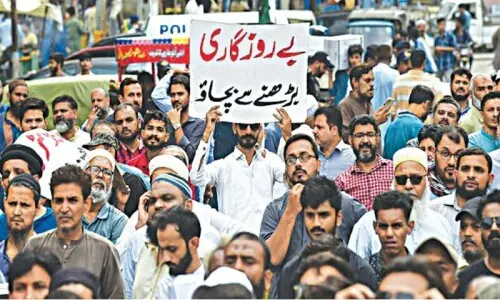
KARACHI, April 30: Pakistani labourers today brave worse conditions than the Chicago workers of 1886, says a prominent labour leader on the eve of May Day.
Nasir Mansoor, deputy general secretary of National Trade Union Federation, said as the world observed the 127th May Day this year amid a global capitalist crisis and social turmoil, Pakistan’s industrial workers and farm labourers were facing even worse conditions as compared to Chicago workers of the yore.
He said there were no fixed working hours for the workers and industrial and commercial organisations not only usurped their economic rights but also their political and constitutional rights.
Today in Pakistan, hardly three per cent workers enjoyed right to union making and just five per cent were registered with the state’s social security institutions, he said.
He said that only four per cent workers possessed written appointment orders and just five per cent workforce drew minimum wages as announced by the government, while 95 per cent factories were not registered under the Factory Act of 1934.
The labour leader’s views were endorsed by a statement issued by the Pakistan Institute of Labour Education and Research (PILER) on Tuesday, which said this year’s May Day had special significance for Pakistan as the country was moving to a fresh round of elections.
It said that all mainstream parties contesting polls had announced their manifestos which were unfortunately devoid of a genuine representation of workers interests.
Nearly all manifestos promised to raise wages, expand social security, and facilitate employment creation through privatisation, which suggested the dominant thought among ruling elites was that they saw workers as charity seekers, it said.
It also implied an agreement with the neo-liberal line that gave the charge of workers welfare to the private sector. Today workers battled an indifferent state, the might of a deregulated and unregulated market system and an unaccountable employer. This had been the result of the neo-liberal policy pursued by the state gradually since independence, and more fiercely after entering the structural adjustment agreement with the IMF in 1988.
Majority of workers today were disenfranchised with no access to any of the constitutional provisions on workers’ rights, including freedom of association (Article 17), prohibition of forced and child labour (Article 11), right to equality (Article 25), and (provision of) secure and humane work conditions (Article 37).
Less than three per cent of the workforce was unionised, the bonded labour force comprised over 1.3 million of the population, over three million child labour worked in the country, and 45 per cent of the working population i.e. the agriculture workers earned an average monthly wage of Rs5,649, much less than the minimum wage of Rs8,000, it said.
Piler said the biggest cause behind the powerless status of the 58 million strong workers remained widening informality and an exclusionary institutional regime towards workers rights.
Though officially 73 per cent workforce was working under informal arrangements, informed academic analysis suggested over 90 per cent of workers worked for and as informal workers. This informality restricted the application of fundamental labour rights on workers since they were not registered with state institutions regulating labour.
It added the Trade Unions Act of 1926 freely allowed union formation to all except those in the armed forces but this Act was replaced by a regressive IRO 1969 which was replicated in later years.
There were no labour laws to cover agriculture labour which made up 45 per cent of the workforce. Agriculture and home-based workers were never covered nor the government made any effort for their coverage under social security, it said.
The welfare and security of labour had been transferred to contractors who remained unaccountable for their actions, said the Piler.
The social security regime was neither universal nor efficient in terms of delivery. Less than five per cent of the workforce was covered by social security schemes such as the EOBI, PESSI and others.
Employers evaded registration of workers to avoid the compulsory monthly social security payments.
Provision of health and education services, presented a dismal picture. Twenty five million children struggled for access to school (primary and secondary both), while majority of public turned to private sector for healthcare. Access to shelter remained compromised in urban areas as 48 per cent of urban population lives in slums, it said.
Piler demanded the new government must address deficits in state’s laws for labour rights, particularly the right to forming unions.—PPI