0
0

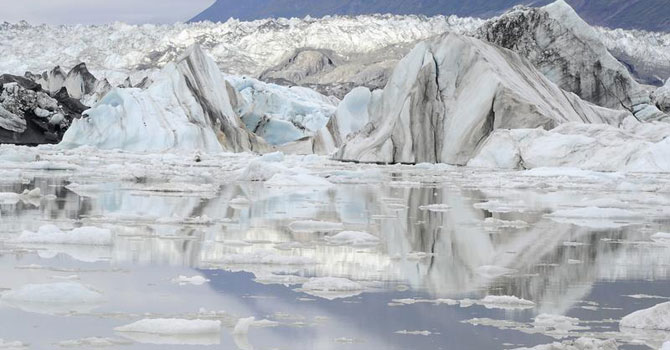
WASHINGTON: A fifth of Canada's glaciers could be gone by the end of the century, a casualty of global warming that would drive a 1.4-inch (3.5-centimeter) rise in sea levels, a study found on Thursday.
“Even if we only assume moderate global warming, it is still highly likely that the ice is going to melt at an alarming rate,” lead author Jan Lenaerts said in a statement. And “the chances of it growing back are very slim,” emphasized the meteorologist at Utrecht University in the Netherlands.
He said the process was both irreversible and self-reinforcing - because the snow and ice in the tundra and in the waters of northern Canada currently help reflect away some of the sun's heat.
As they disappear, a larger portion of the sun’s rays will be absorbed by the water and land, which will cause temperatures to soar.
If Canada's glaciers shrink by 20 per cent, as under this scenario, that would correspond to an average global temperature rise of three degrees Celsius (5.4 Fahrenheit).
But the temperature jump in the glacial regions of northern Canada would be far higher: eight degrees, according to estimates by Lenaerts, who emphasized that this is not even a worst-case scenario.
Should they disappear entirely, Canada's glaciers, the third largest ice body in the world, would cause a 7.9-inch rise in sea level.
The scientists urged policymakers to consider the prospect, noting that since 2000, the temperature in Canada's Arctic Archipelago has risen by one to two degrees Celsius, and the volume of ice has significantly diminished.
“Most attention goes out to Greenland and Antarctica, which is understandable, because they are the two largest ice bodies in the world,” said co-author Michiel van den Broeke, also of the University of Utrecht.
“However, with this research, we want to show that the Canadian glaciers should be included in the calculations for the sea level rise.”
The study was published in Geophysical Research Letters, a US scientific journal.
Over the least 20 years, sea level has risen on average by more than 2.1 inches, or 0.12 inches a year.
Most of that increase has been attributed to the thermal expansion of water, with just a fifth coming from the melting of the polar ice caps, according to an international study published in November in the US journal Science.
Around two thirds of the melted ice is in Greenland, with the rest in Antarctica, according to the estimates based on satellite images from the US space agency NASA and the European Space Agency.