23
23


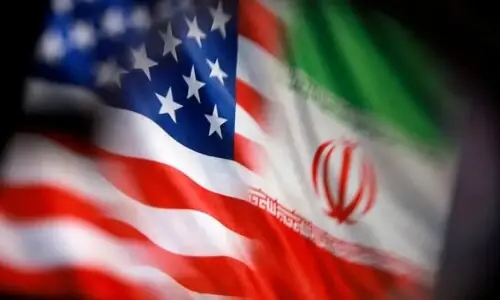
Ninety-two per cent of Pakistanis disapprove of US leadership and 55pc of them fear greater interaction between Muslim and western societies could be harmful.
“The public’s confidence in the Pakistani national government — sometimes seen by Pakistanis as too cosy to the US government — has nosedived, reaching a low of 23 per cent in March and October 2012,” says the survey report.
This is down from 54pc in December 2008, shortly after the beginning of democratically elected President Asif Ali Zardari’s administration.
The trust in civilian government in recent years was the highest in 2006, 58pc, dropped slightly to 54pc in 2008, almost halved to 31pc in 2010 and fell to 23pc in 2012.
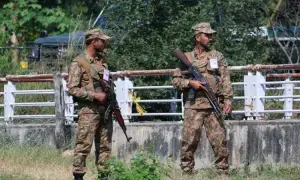
Conversely, confidence in the interventionist military — the organisation that has ruled the nation for over half of its post-independence history — climbed to 88pc in October 2012.
The confidence in the military stood at 84pc in 2006, came down to 76pc — the lowest in recent years — by the end of 2008, climbed to 80pc by mid-2012 and peaked to 88pc in 2012.
Gallup, one of the most prominent US surveyors, based these findings on a survey conducted from Sept 30-Oct 16, 2012, in Pakistan. The survey directly followed massive demonstrations against the release of an anti-Muslim film made in the US.
The surveyors predict that the upcoming May elections in Pakistan will be of “seismic importance for the future direction of the country and for US-Pakistan relations”.
The elections will mark the first time in the country’s history that a civilian government peacefully transfers power to a new civilian government.
“Insomuch as the role of the US in Pakistan weighs on the campaign dialogue, the perceived failures of the current regime might translate into the election of political actors that are more hostile or confrontational towards US interests,” the survey warns.
“The degree to which the US-conducted operations within Pakistan have weakened the political position of the existing Pakistani government is an open question,” the surveyors argue, “but the concomitant erosion of approval of US and Pakistani leadership on the Pakistani public’s part is impossible not to notice.”
Instead, Pakistanis put their trust in the military, despite its “meddlesome history in national governing affairs”, the surveyors add.
“What these trends mean for the coming election is unclear, but they suggest that the next few months could be of vital importance for the stability of the Pakistani government and the US-Pakistani relationship.”
The survey pointed out that President Barack Obama’s first term was characterised by strained relations between Pakistan and the US. Consequently, more than nine in 10 Pakistanis (92pc) disapprove of US leadership and 4pc approve, the lowest approval rating ever.
Pakistanis’ approval of the leadership of their ostensible ally, the United States, has historically been quite low. However, perceptions began to change, albeit modestly, through much of President Obama’s first term. As recently as May 2011, 27pc of Pakistanis approved of US leadership, the apex of support.
Noticeably, approval declined after the May 2011 killing of Osama bin Laden, an event that many Pakistanis viewed as a blatant disregard for Pakistani sovereignty.
Concurrently, Pakistanis now more than at any other time in the past three years feel threatened by interaction with the West, according to a May 12-June 6, 2012, survey.
A majority (55pc) say interaction between Muslim and western societies is “more of a threat”, up significantly from 39pc in 2011.
This sharp increase is observed at a time of heightened Pakistani concerns regarding US encroachment on Pakistani sovereignty, including an intensified number of US drone strikes in Pakistan.
Nearly half of the Pakistani population (49pc) is between the ages of 15 and 29. The largely anti-western sentiment among these young Pakistanis suggests that, even as this sizable group ages and begins to have a larger role in Pakistani governance, relations between the US and Pakistan may continue to be fraught with challenges.