0
0

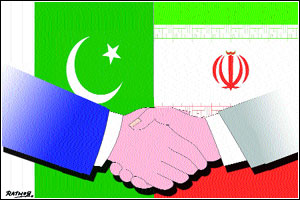 Will Iran-Pakistan business now really expand this time around after a decade of talks? Will it benefit their people as well as the Gulf-South Asia region? Can energy, telecom, IT, trans-Asian Railway and industry cosy up their relations?
There are, apparently,strong plus signs.The start-up of a $3.5 billion Iran-Pakistan-India (IPI) natural gas pipeline heads the list to promote larger business and peace in the region. President Mohammad Khatami of Iran said he sought, and President Pervez Musharraf and Prime Minister Mir Zafarullah Jamali have extended assurances of, a smooth and uninterrupted energy flow from Iran to India via Pakistan. When the pipeline goes on stream Pakistan will be receiving a royalty of $350 to 400 million annually, besides using abundant energy.
President Khatami said, “I have discussed the completion of the gas pipeline with President Mushrraf and Prime Minister Jamali, and I am happy to tell you that Pakistan and Iran are ready for this project. I hope India, too, will be taken along to start the project as early as possible.” “We have held out assurances for security of the pipeline and my government will continue to extend cooperation to Iran over this project,” Jamali confirmed Khatami at their joint news conference.
Khatami’s visit to Pakistan and the trilateral summit at Ashkabad between Turkmenistan, Afghanistan and Pakistan seem to become a landmark in the regional cooperation. Alongside the IPI gas pipeline, arrangements to build a second project— Turkmenistan-Afghanistan-Pakistan (TAP) oil and gas pipeline, are moving to become a reality.
The trilateral summit between President Saparmurad Niyazov of Turkmenistan, President Hamid Karzai of Afghanistan and Prime Minister Zafarullah Jamali of Pakistan on December 26/27 gave TAP a go ahead. The three countries will firm up the remaining arrangements, and come out with estimates of their energy requirements and financing, by September 30 this year. The feasibility study will be completed by July this year, to be followed by formation of a consortium of international companies to undertake the project. The pipeline will supply Turkmen energy from its Dauletabad fields, across Afghanistan, and into Pakistan and beyond.
Although stability is coming only slowly to Afghanistan, the improved situation has pushed the $3.2 billion TAP project up. This 1,500 km long pipeline is to be completed by 2005. The TAP project, in turn, has spurred Iran to speed up arrangements for IPI gas pipeline, and iron out difficulties that poor political relations between Islamabad and New Delhi were confronting it.But, the proposal for a third gas pipeline from Qatar to Pakistan and beyond, seems to be a slow moving proposition because of a lack of potential financiers. However, the latest reports are that the original project may be modified to include Iran in it.
But, even now when Iran-Pakistan business prospects have started looking up, will President Khatami, President Musharraf and Prime Minister Jamali succeed where the likes of Shah Reza Pehlavi of Iran and President Ayub of Pakistan had failed four decades ago and several other leaders thereafter?
Skepticism is real. Several past efforts to institutionalise their cooperation have faltered. These ranged from the creation of the US-led cold-war era Central Treaty Organisation (Cento) of early 1950s— part of a chain of bulwark to fight the Communist Soviet Union, and partly to provide American dollars for economic development of Turkey, Iran and Pakistan. It was followed by the Regional Cooperation for Development (RCD) of early 1960s, that President Ayub Khan and Shah of Iran Reza Shah Pehlavi had signed. Imam Khomeini’s followers scrapped RCD and re-engineered it into Economic Cooperation Organisation (ECO) that now, besides Iran, included Turkey, Pakistan and Central Asian Muslim states. But what is its performance? Hardly anything big to write home about. The 1979 Soviet invasion of Afghanistan, pushed Pakistan into the camp of what Iran still calls “shaitan-e-buzurg”—the Great Satan. Iran-led Shi’ites in the “liberated” Afghanistan had hardly any role in that war-torn country, bolstering Tehran’s displeasures for Islamabad. These suspicions even now linger in Iranian minds as one veiled woman-journalist asked President Khatami whether he can still depend on a Pakistan whose friendship has frequently fluctuated?”
Is there anything new now? Can anything warm up the relations between Iran and Pakistan on the one hand, and Central Asian Republics, with India thrown-in, on the other.This time it is energy.
Khatami, the first Iranian President to visit Pakistan in ten years, sounds upbeat. “We consider our commercial and economic relations with Pakistan as being of top priority, and we sincerely hope for the extension of these relations, both quantitatively and qualitatively,” he said. Iran, domestically, is putting its best foot forward to do more business in the Gulf- Asia region, in particular. The Iran’s economic reforms, its efforts in the industrial and economic fields, after several pitfalls and isolation that followed the 1979 overthrow of the Shah, and the new, important role assigned to the private sector, have prepared the ground for enhancing its cooperation in these sectors. Khatamai substantiates it by pointing out: “Iran has been encouraging its private sector to do more business with our neighbouring countries. We are going to provide the private sector certain facilities that it will find economically beneficial.”
The Pakistan-Iran Mutual Economic Cooperation Commission, meeting in Islamabad, has just finalised several proposals and projects including those relating to industries, trade, R & D, technology,oil and gas, setting up oil refineries, electricity, joint ventures, trade diversification, establishment of free trade zones, software technology, auto parts, agriculture and education.
They also plan to push cooperation in the field of telecom and transportations, including completion of an optic fibre telecom link that will be completed in three months to connect Iran with Central Asia, Turkey and the Gulf, connection of Pakistani and Iranian railways, and road transportation.
A high-interest project, stressed by Ahmad Khurram, Iran’s Minister for Transport and Shaukat Aziz, Advisor on Finance to Prime Minister Jamali, is the completion of Trans-Asian Railway (TAR) to connect South Asia, Pakistan, Iran and the Gulf with Europe.The two ministers agreed “the communications and transport sector is to be given priority to link Iran and Pakistan with Central Asia and Europe,” a official spokesman said after Khurram-Aziz meeting. The TAR project was agreed in 1995 to augument passenger and freight flows between Europe, Gulf, Central Asia and South Asia. The project covers a total railway length of 27,700 kilometres. It includes up-gradation or completion of 4,053 km track in Turkey, 6,179 km in Iran, 3,279 km in Pakistan, 9,107 km in India, 990 km in China, 1,358 km in Bangladesh, 531 km in Sri Lanka, and 153 km in Thailand at the farthest point.
In contrast to the decades generally wasted by official level efforts for economic cooperation, there is now a new element. It is the likely role of the private sector of the two countries. Private businessmen hope to contribute significantly to industry and trade. Aliaghi Khamoosh, President of the Iranian Chamber of Commerce who headed a business delegation accompanying President Khatami, says: “ we are looking for long-term economic cooperation and relations with Pakistani investors.”
“We plan to establish joint venture companies with Pakistan, to increase industrial production and trade,” he proposed to Pakistani Commerce Minister Humayun Akhtar. Akhtar stressed the need to establish “strong trade relations between Pakistan and Iran.” Khamoosh requested Pakistani help for Iran’s entry into World Trade Organisation and to benefit from Islamabad’s longtime association with WTO. Khamoosh also asked for a reduction of tariff to increase trade flows, cooperation in banking, and setting up of a joint Iran-Pakistan chamber.
The two sides have agreed to expand the two-way trade that declined to $ 166.5 million in fiscal 2002 from $ 394.5 million in 2001. Khatami personally noted this dismal decline of business while talking to the Lahore session of the Federation of Pakistan Chambers of Commerce and Industry, where he urged the private sector to play a major role.
All said and done, Tehran still does not feel fully comfortable with current, growing Islamabad-Washington relations at government level. But after Taliban are gone from the Afghan scene, Khatami says “distrust” between Tehran and Islamabad has been removed. Add to that Pakistani assurances to Iran and India over the gas pipeline. Putting these elements together, it should generates signals for the business in the region to grow, besides Iran and Pakistan.