0
0

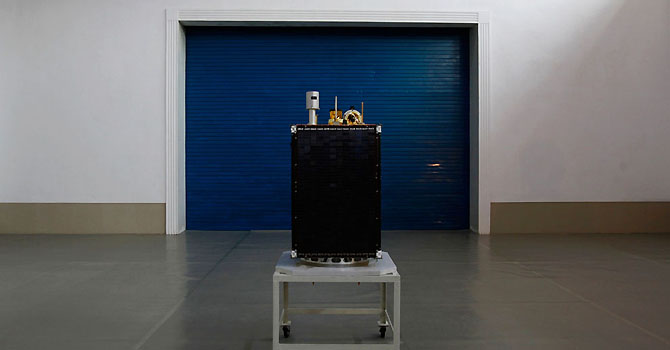
WASHINGTON: A satellite launched with fanfare last week by a defiant North Korea appears to be dead as no signal can be detected, a US-based astrophysicist who monitors spaceflights said Monday.
The United States and its Asian allies have acknowledged that North Korea succeeded Wednesday in putting an object into orbit that the communist state said was observing the Earth and airing patriotic songs.
Jonathan McDowell of the Harvard-Smithsonian Center for Astrophysics said that the satellite was clearly in orbit but that no songs could be heard.
“To the best of our knowledge, the satellite isn't operating,” he said. “It's definitely up there and it's whizzing around, but it's just not feeling very well.”
McDowell said it was unclear whether the satellite, called the Kwangmyongsong-3, worked initially and that it remained possible that it was transmitting at a level too faint for detection.
But in another sign of trouble, McDowell said that the satellite was fluctuating in brightness. That means that the sun is shining at different angles and the satellite is not pointing down at the Earth as it should.
Even if not functioning, the satellite remains in orbit. The commercial site www.n2yo.com on Monday tracked the satellite as orbiting at least 505 kilometers above Earth, in line with North Korean statements.
“These things are hard to calculate, but roughly speaking, an object of that density at that height is going to stay up for a few years,” McDowell said.
The state-run Korean Central News Agency last week quoted a scientist saying that the technology was “flawless” and that the satellite was broadcasting “Song of General Kim Il-Sung” and “Song of General Kim Jong-Il,”references to the state's first two leaders.
The launch came days before the anniversary of Kim Jong-Il's death. His young son, Kim Jong-Un, succeeded him as leader of the regime, which conceded that an attempted launch in April malfunctioned.
The United States, South Korea and Japan all condemned the latest launch.
Officials feared it was a veiled test for a long-range ballistic missile.
Pentagon spokesman George Little said that the United States was “still assessing” the North Korean object and that he was unaware of any danger posed.