3
3

THIS is apropos of the letter ‘Does feudalism exist in Sindh?’ by Dr Muzaffar A. Isani in which he put some reservations about the Pakistan Institute of Labour Education and Research (PILER) approach towards the land agenda. He also put a big question mark on the existence of feudalism in Sindh. Arguments can be made both on observations and factual grounds.
According to the Economic Survey 2011-12, about 63 per cent Pakistani population resides in rural areas, while 65.85 per cent of the labour force exists in rural areas. The employed labour force is 58.68 million, out of which 45 per cent is engaged in agriculture, 13.8 per cent in mining and manufacturing, 6.94 per cent in construction, 0.47 per cent in electricity and gas distribution, 5.1 per cent in transport, 14.8 per cent in trade and 13.75 per cent in other services.
It shows that the rural area is bigger than the urban area in terms of population and labour absorption (disguised unemployment or overemployment is a point of debate).
Those who argue that Pakistan is not a feudal society usually rely on agricultural census data, but across Pakistan the land ownership and land control are two different phenomena. Whatever is reported does not reflect the exact conditions. How water control of upstream landlords is used as a tool against small landholders?
Coming to the social and political setup of the agricultural sector, the feudal lords and their allies constitute only five per cent of our agricultural households and own 64 per cent of our farmland. The remaining 95 per cent are only their political vote bank.
According to a PILER study, a median landlord in Sindh owns 28 acres whereas nearly 80 per cent of share tenants are landless farmers. Big landlords often employ kamdars to manage their tenants.
Even after three waves of land reforms, 3,529 zamindars have 513,114 holdings of more than 100 acres in the irrigated areas, and 332,273 holdings exceeding 100 acres in areas which are not irrigated.
Some 794,774 khatedars have 5,464,771 land holdings of less than 12 acres in irrigated areas. In areas which are not irrigated, 144,098 are reported to have 16,28,826 holdings of less than 24 acres.
Feudalism, in the form of large landholders, has social, political and often local legal and religious power.
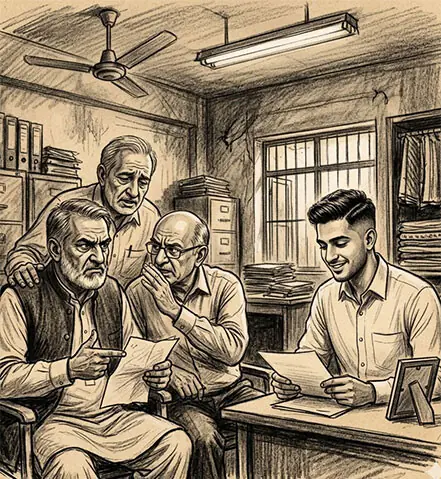
Rural setup does not rely on the police/judiciary, and the jirga/panchayat system prevails, decisions are made by feudal being head of the jirga, and innocent people are killed to only ‘equal’ the score in conflict settlements.
District management officials are appointed directly on the recommendation of tribal chiefs, instead on merit and according to legal procedures.
Landlords still maintain private armies and prisons. Agriculture has been the main location of debt bondage. Bonded labour in agriculture is over 1.7 million. The majority of them are landless tillers (‘haris’) in Sindh.
Moreover, infrastructure is designed to cater the needs of influential people. Some villages are like a trap. There is a single way to enter and exit with narrow connected lanes that do not allow anybody to run away.
Large land holders across Pakistan are in national and provincial assemblies controlling both property and people. Democracy provides landlords the opportunity to practice feudal values in a broader field.
Hence, not surprisingly, landlords have been in the forefront of the movement for democracy in Pakistan. Waheeda Shah is a slap by the feudal democracy on the face of the people of Pakistan.
HIRA HABIB Research Associate Pakistan Institute of Labour Education and Research Karachi