0
0

PAKISTAN’S rural areas, which became highly active with the arrival of cotton crop in August, have become livelier now with the beginning of paddy harvesting and trading of sacrificial animals.
Cotton picking and ginning remain in full swing even after Baqra-Eid is over by the end of this month and paddy harvesting would accelerate. Then sugarcane harvest would begin sometime in November or December, depending upon how soon the recent cane support price issue is resolved. Rural workers will remain busy throughout the winter season. Millions of men, women and children will make billions of rupees in daily wages during next few months even though their wages remain very low, in some cases less than Rs100 per day.
Information gathered from growers suggests that all seasonal rural jobs are broadly divided into two categories: In the first category fall members of extended families who help each other in raising and harvesting of crops and in post-harvest daily chores. In the second category fall hired hands who do anything and everything for the employers —from cotton picking and rice and sugarcane harvesting to taking care of sacrificial animals to transporting crop yields from farms to silos or to ginneries, rice mills or sugar mills etc.
There is a third category as well. And that is growing in size. In this category come those workers who are employed by contractors and middlemen of big landlords or factory owners. They are hired for specific project like picking cotton from a certain field or for rice thrashing and husking or for chopping sugar canes in the fields and bundling the chopped canes. Contractors and middlemen generally have yearly agreements with large farm owners or millers and they get a lump sum amount for getting something done. The contractors and middlemen get the lion’s share of the income and share only a part of that with the workers.
Labour Force Survey of 2008-09 says 51 per cent of all rural employees of Sindh are unpaid family helpers. In Punjab the percentage is far lower—about 34 per cent. But growers and leaders of farmers lobby groups say these numbers do not reflect ground realities. They say that most members of an extended family or a clan are paid for their services.
“Nobody except for immediate family members work for nothing,” insists Muhammad Sharif, a 50-something junk dealer in North Karachi, who spends time along with his wife, sons and daughters, on his relatives’ cotton farms in Sadiqabad for cotton picking on contract. “We are paid a lump sum amount for cotton picking per acre. Thousands of people like me, particularly womenfolk do the same year after year. Muhammad Omar, a driver working with a Karachi-based company says he also visits his native village in Badin every year to join the huge workforce his maternal uncle cobbles together for paddy harvesting. “I have also worked in the past several years with a contractor who does paddy thrashing and husking for a rice mill.”
When cotton picking picks up pace factories of Sindh and Punjab, hire a large number of workers who work on ginning machines or do odd jobs like staking of cotton bales or loading them onto trucks. Otherwise, only a small number of workers remain employed in these factories when ginning process of a crop is over by the end of May. Since this year’s crop is going to be fairly larger than that of the last year, more rural workers are estimated to have been employed. Female workers are mostly engaged in picking up of cotton whereas men and boys are doing heavier jobs in ginneries.
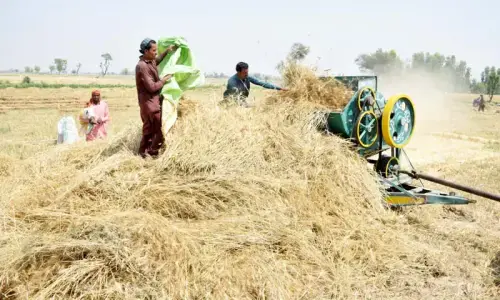
In parts of Sindh, harvesting of paddy, particularly of non-Basmati varieties has begun and additional working hands have been employed on paddy fields and at rice mills. “Not all rice mills have mechanised system of boiling paddy to obtain par-boiled rice. We do it for them and I, as contractor of a few rice mills, hire hundreds of workers, men and women, who boil paddy the traditional way,” says Namal Das, a rice dealer based in Ghotki.
“This year’s hiring has started and workers are busy thrashing, boiling and husking paddy throughout my district. In other districts, other contractors are engaged by rice millers. The same is true for mills in Punjab,” he told Dawn.
By the time this write-up is published, Baqra Eid will be over. Whereas the end of the festival of holy sacrifice would mean winding up of many temporary businesses in Karachi and other big cities, in villages the situation would be different. “When traders of sacrificial animals would return to their villages they would spend a few days in resettling the unsold animals. Afterwards, many of them would probably be working on paddy fields and, when cane harvesting begins, on sugarcane fields or at sugar mills.”
Like rice mills, sugar mills also induct additional workforce when cane crushing begins in October-November in Sindh and Punjab. Since the crushing is being delayed this year, hiring of helping hands may start in November and December or in December and January.
“Our regular workers in sugar mills are not many in number. They are either technical staff or office workers or security personnel,” says a Karachi-based businessman who owns a sugar mill in the interior of Sindh. “But when cane crushing begins we get supply of temporary workers through our contractors or directly induct them for a few months. These guys work on sugar manufacturing plants. Some are used in moving sugarcane trolleys within the sugar mills or at factory areas where sugar bags are stacked in bulk.”
Pakistan’s agriculture sector provides more opportunities for jobs to both men and women even though services sector contributes far more to GDP. Employment trends of FY11 compiled by Pakistan Bureau of Statistics shows that 43 people out of every 100 (of 15 years and above and defined as employed) were employed in the agriculture sector. Against this, services sector employed 35 persons out of every 100. More importantly, 74 out of every 100 women (of 15 years and above and categorised as employed) earned their livelihood in agriculture sector against only 14 out of 100 in the services sector.
However, a large number of agricultural sector jobs are seasonal in nature depending upon the sowing and harvesting of major crops. This is a disadvantage of being a rural worker. Even those farm and factory owners or their contractors, who put people to work, for as long as six months or more per year, treat them as daily wagers. If rural workers are treated a bit more fairly, their productivity would increase thereby pushing up growth in farm sector.—Mohiuddin Aazim