0
0

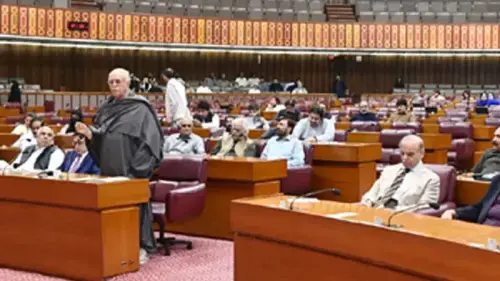
AT last, the Intellectual Property Organisation has become a legal entity following passage of the related bill by the National Assembly a few days back after surviving on ordinances for seven years.
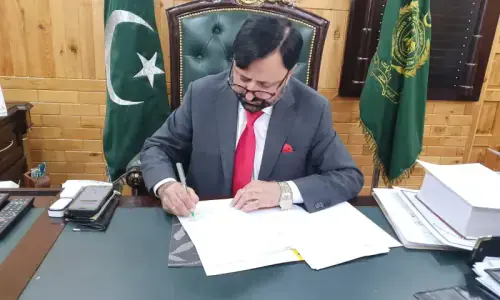
Its chairman, Hameedullah Jan Afridi, known for his passion for enforcement of intellectual property rights in Pakistan, has called the development a landmark in the country’s IPRs history.
The passage of the bill will formally put Pakistan among the comity of the member nations, now 185, of the World Intellectual Property Organisation (WIPO). Although the IPO did exist and functioned since 2005 and carried out its duties, what difference would the conferment of legal status make in real terms when Pakistan is already on the US priority watch list, which means the worst case as far as protection of intellectual property rights is concerned.
It may not make much difference immediately but things can change if the IPO is reorganised in a manner that strengthens the enforcement mechanism and the IP tribunals are enabled to exercise new powers effectively to punish IPRs violators.
The fact remains that lack of protection of foreign investors’ intellectual property rights has emerged as one of the impediments in smooth flow of trade and investment in the Third World countries.
And, under the globalised setting, developing world’s IPR regime will always be inadequate for the West’s corporate sector for it is the latter which sets the standards for the IPRs and which are usually pro-investor.
Speaking at a conference last year, the Sindh minister for information technology was not apologetic for the IPO’s poor performance.
He argued that the government alone could not stop IPR violations as it was more a ‘culture-related’ issue than a legal or administrative one.
“We need to look at how quickly we adopt counterfeit products,” he said.
So far, not all has been well in the IPO establishment and extraordinary measures are required to put the house in order. On occasions, its senior functionaries were found not displaying the right approach.
When the IPO ordinance had lapsed last year and a fresh legislation was required, its director general and the outgoing chairman had sent two different drafts to the ministry of law, seeking more powers for themselves. Later, both the drafts were withdrawn by Afridi after he took over. Even the International Intellectual Property Alliance (which works with the USTR) had made a reference to this infighting in its report with a remark “unfortunately, no concrete outcomes or results have been achieved by the IPO, due perhaps to power struggles within the organisation.”
Then, the grant of copyright by IPO-Pakistan has been a sorry affair. No investigation was done into the work applied for registration.
No steps were taken to ensure that the work in question was original. If there was some discrepancy, the applicant was asked to remove it. The affidavit submitted by him was enough to prove his claim.
Deputy registrar at the copyrights registry said that there had been few, if any, objections on the works seeking registration. The reason is that in the past applications for registration were published in the Trade Marks Journal and now they are published in less known newspapers.
According to the IPO website, the reg-istration of the original work was a legal formality but not a condition for obtaining a copyright, meaning it can be granted without it.
The only advantage of registration is that it establishes prima facie evidence in a court of the validity of the copyright and of the facts stated in the certificate. One reason for this chaos has been an acute shortage of staff at IPO. Reports say there were only 20 staff members out of the sanctioned strength of 75 in 2008 although it spent Rs503 million during 2005-08.
How bureaucracy viewed the IPRs can be construed from the in-fighting that took place when the World Intellectual Property Organisation suggested that the three IP offices should be merged into one.
The commerce ministry, responsible for the trademarks registry, the education ministry, incharge of the copyright office, and the industries ministry responsible for the Patent office were all daggers drawn against each other until the Establishment Division intervened and took over the newly-established IP organisation.
Even IPO chairman Afridi exhibits poor understanding of important facts on some occasions.
On April 25, he said that Pakistan could ‘face economic sanctions’ if the government failed to check violations of IPRs. What he failed to notice was that no country has ever faced sanctions on this count nor the countries whose IPRs are infringed have ever talked in such terms.
On April 18, Afridi said naively, “We had sent to the United States Trade Representative (USTR) our plans about the enforcement of the IPRs and our administration’s resolve to maintain and encourage effective IPR protection and we hope that Pakistan will come out of this red zone [priority watch list].”
On the other hand the USTR report simply ‘deplored’ the continued copyright piracy in Pakistan but also ‘appreciated’ the progress made in the enforcement level.
Similarly, the IIPA stated in last year’s report that piracy situation in Pakistan’s Urdu Bazars has improved slightly, and appreciated the ongoing work of the FIA whose officers have been instrumental in bringing some improvements in some copyright sectors.
However, the IIPA was adamant that the country remained principally a pirate market for books. In the earlier days, the intellectual property regime was based on old laws and worked well. The country had inherited the British laws such as the 1940 Trademarks Act and Patents Act of 1911.
But things began changing when the industry expanded and foreign investment started pouring in.
Pakistan adopted its Patent law in 2000, replaced by another ordinance in 2002, and Trademarks ordinance in 2000.
In 2004, the cabinet approved a legislation which created the PIPRO, later renamed IPO.
One reason for the poor state of enforcement of the IPRs is the general lack of understanding about these rights among the parliamentarians and bureaucrats who took seven years to pass the IPO law.—Ashfak Bokhari