0
0


ISLAMABAD: The decision taken by Pakistan and India to scale down tariff to a maximum of five per cent and remove all non-tariff barriers (NTBs) by 2020 will lead to regional integration, according to an official of the Geneva-based World Trade Organisation (WTO).
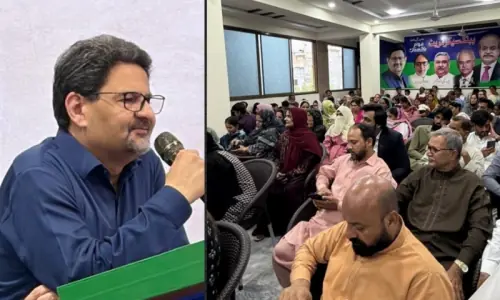
“The current progressive dialogue on trade between Pakistan and India will not only benefit the two economies but will also serve to increase trade among Saarc countries,” Pradeep S. Mehta, a member of the WTO’s high-level stakeholders’ panel for defining the future of trade in 21st century, told Dawn on the sidelines of the talks between Pakistani and Indian officials.
The two countries have linked progress on bilateral trade to a reduction in the number of items on the ‘sensitive list’ of the South Asian Free Trade Agreement (Safta). “More progress on bilateral trade arrangements will facilitate trade under the Safta,” Mr Mehta remarked.
He said that he had sensed ‘a change of heart’ in New Delhi towards Pakistan vis-à-vis trade and investment. “All rightwing political parties in India now agree that a peaceful and stable Pakistan is in the interest of India.”
In Pakistan too he had noticed a similar change, Mr Mehta said.
In the past few months he saw tremendous progress in trade relations between the two countries, he said. India was willing to export petrol and electricity and ready to invest in the power sector in Pakistan.
China was India’s competitor in the global cloth and garment market but the two countries were partners in some oil businesses of Africa. “A similar arrangement is possible with Pakistan,” he said.
Mr Mehta was visiting Islamabad to get feedback from various stakeholders regarding the World Trade Organisation’s survey on the future of world trade.
Commenting on the survey, he said that trade liberalisation was good but not an end in itself. The world must now overcome the dichotomies of liberalisation and protectionism.
“A mood of cooperation, where strengths and weaknesses are balanced for the benefit of all, could create a new momentum to overcome the stalemate of the multilateral trading system, which is presently trapped in a mercantilist calculus,” he remarked, quoting the survey results.
Trade liberalisation was an important tool to help pooling up of knowledge and resources and thus could help the global community in addressing the issues of poverty and income inequality, he said.
Mr Mehta said the WTO’s Doha round of trade talks must be concluded in order to revive public faith in international trade liberalisation.
“There is also a need to strengthen the ground for support of small businesses and consumers.”
The conclusion of the Doha round could benefit the low-income countries. “However, this will only be so if the ‘developmental spirit’ in the Doha Development Round (DDR) is reflected in the negotiated outcomes in various areas such as enforceability of special and differential provisions.”