14
14

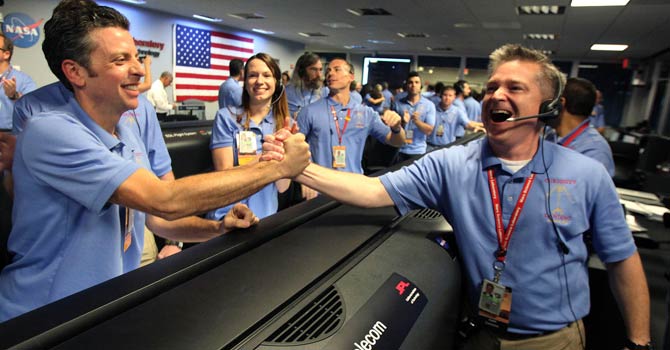
PASADENA: NASA on Sunday successfully landed its $2.5 billion Mars Science Laboratory and Curiosity rover on the surface of the Red Planet, marking the most ambitious attempt to reach Mars in history.
“Touchdown confirmed,” said a member of mission control at NASA's Jet Propulsion Laboratory as the room erupted in cheers. “We are wheels down on Mars. Oh, my God.”
A dusty image of the rover's wheel on the surface, taken from a rear camera on the vehicle, confirmed the arrival of the car-sized rover and its sophisticated toolkit designed to hunt for signs that life once existed there.
A second image arrived within seconds, showing the shadow of the rover on Mars.
When the landing was announced after a tense, seven minute process known as entry, descent and landing, the room filled with jubilation as chief scientists distributed Mars chocolate bars to the NASA staff members.
However, success was anything but certain with this first-of-its-kind attempt to drop a six-wheeled chemistry lab by rocket-powered sky crane on an alien planet. NASA's more recent rover dropoffs were done with the help of airbags.
In the final moments, the spacecraft accelerated with the pull of gravity as it nears Mars' atmosphere, making a fiery entry at a speed of 13,200 miles (21,240 kilometers) per hour and then slowing down with the help of a supersonic parachute.
After that, an elaborate sky crane powered by rocket blasters kicked in, and the rover was lowered down by nylon tethers, apparently landing upright on all six wheels.
Scientists do not expect Curiosity to find aliens or living creatures.
Rather they hope to use it to analyze soil and rocks for signs that the building blocks of life are present and may have supported life in the past.
The project also aims to study the Martian environment to prepare for a possible human mission there in the coming years.
It has already been collecting data on radiation during its eight and a half month journey following launch in November 2011 from Cape Canaveral, Florida.
Earlier on Sunday, Mars program director Doug McCuistion called the science “absolutely crucial” to finding out if Earthlings are alone, how Mars evolved from a wet to a dry planet and how accessible Mars may be for human explorers in the future.
“If we succeed, it will be one of the greatest feats in planetary exploration ever,” he told reporters. “Our success rate has been pretty darn good recently.”
However, he cautioned that “these things are really hard to do” and admitted that “we may not be successful.”
Attempts by global space agencies since 1960 have resulted in a near 40 percent success rate in sending landers, orbiters or other spacecraft for flybys to Mars. NASA has the best record.