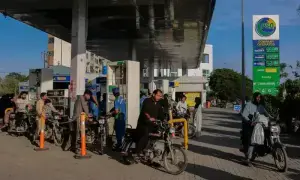
Trucks containing Nato supplies. — Reuters Photo
Trucks containing Nato supplies. — Reuters File Photo

PESHAWAR: Pakistan on Saturday resumed Nato supplies, allowing 14 containers to cross into Afghanistan from its northwestern border at Torkham, officials said.

Pakistan had temporarily stopped Nato supplies over security concerns on July 24 after gunmen attacked a convoy of Nato trucks, killing a driver, in the town of Jamrud on the outskirts of the main northwestern city Peshawar.

“The Nato supplies have been resumed from today and we sent 14 containers” for international troops in Afghanistan,” a local administration official told AFP on condition of anonymity because he is unauthorised to speak to media.

A local intelligence official also confirmed resumption of supplies and the departure of 14 Nato containers to Afghanistan.

A senior local customs official, Ubaidullah Khan, however, put the figure of containers, which left for Afghanistan, at seven, adding that they carried food stuff and clothes.


Opinion

Editorial

Pakistan’s moment
Updated 20 Jun, 2026

Pakistan’s moment

Pakistan’s diplomats are second to none, and if these states seek to engage this country constructively, a new modus vivendi for the subcontinent can be reached.
Menacing water plans
20 Jun, 2026

Menacing water plans

IN April last year, India suspended the decades-old Indus Waters Treaty, which contains no provision allowing it to...
World Refugee Day
20 Jun, 2026

World Refugee Day

WORLD Refugee Day, observed today around the globe, marks 75 years since the adoption of the 1951 convention ...
Digital deal
19 Jun, 2026

Digital deal

THINGS have moved rapidly where the Iran-US memorandum of understanding is concerned. While the physical document ...
Failing the public
19 Jun, 2026

Failing the public

WHETHER it is Sindh’s struggle to secure clean drinking water or Balochistan’s difficulty in improving the...
Crushed lives
19 Jun, 2026

Crushed lives

COURTS and commissions have often been up in arms over the health and ecological hazards associated with...