0
0

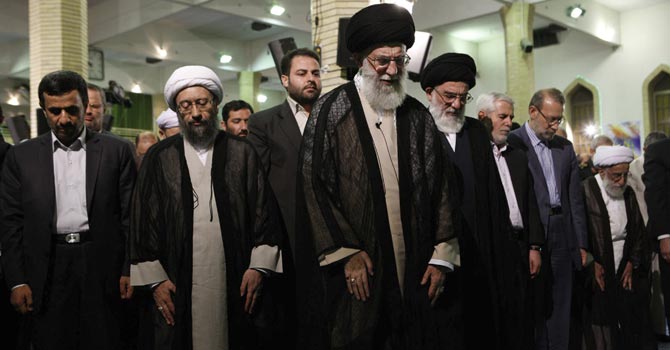
TEHRAN: Western-led sanctions and diplomatic pressure will not force Iran to halt its nuclear program, Iran's Supreme Leader said Wednesday.
Ayatollah Ali Khamenei, who has the final say on all state matters in Iran, voiced confidence that the Islamic Republic can beat the latest punitive measures aimed at blocking the country's vital oil and banking industries over the disputed program.
''They (the West) explicitly say they need to increase pressures, tighten sanctions to force Iranian authorities to reconsider their calculations,'' Khamenei said in comments broadcast on state television. ''But a look at the facts leads us not only to avoid reconsidering our calculations, but to move on our intended path with greater confidence.''
The latest European Union sanctions against Iran's vital oil industry came into effect on July 1, three days after the U.S. tightened measures that prohibit international banks from completing oil transactions with Iranian banks. The moves, a response to Iran's refusal to suspend uranium enrichment, further complicate the country's ability to conduct trade abroad.
The West suspects Iran is pursuing a nuclear weapon. Iran says the program is for peaceful purposes such as power generation and medical treatment. Israel has indicated it might attack Iran if sanctions fail to rein in the nuclear program.
On Wednesday, Israeli Defense Minister Ehud Barak said Israel might have to make ''tough and crucial decisions'' about its security, warning that if Iran were allowed to obtain nuclear weapons, dealing with the matter then ''will be far more complicated, far more dangerous and far more costly in resources and human life.''
In his remarks, Khamenei said he felt some countries partaking in the US-led sanctions will not continue them over the long term because of economic drawbacks, calling the sanctions a challenge that could be overcome.
''Although there are challenges in the path of the Iranian nation, there is no dead-end,'' he said. Khamenei said Iran has offered some concessions in the past, but claimed the West is unwilling to allow what Iran calls a peaceful nuclear program.
He was referring to a period between 2003 and 2005 when Iran agreed under former reformist president Mohammad Khatami to suspend uranium enrichment and all related activities as part of confidence building measures to dispel fears that Tehran was not seeking nuclear weapons.
''The West became so arrogant during that period that they opposed possession of three centrifuges which our officials had agreed. But now there are 11,000 centrifuges operating in the country,'' he said.
Centrifuges are machines that spin at supersonic speed to purify uranium. Uranium enriched to low level is used to fuel a nuclear reactor but higher enrichment makes it suitable for use in building a nuclear weapon.
Iran's suspension of nuclear advancements coincided with a period of small steps toward easing the diplomatic freeze between Tehran and Washington, but tensions quickly returned following the election in 2005 of President Mahmoud Ahmadinejad and moves to restart Iran's nuclear efforts.
The US and its allies accuse Iran of using its civilian nuclear program as a cover to develop an atomic bomb, but Iran has denied the charges and says its nuclear program aims at producing electricity and radioisotopes used to treat cancer patients.
Khamenei also urged Iran's politicians to show unity and avoid bickering in efforts to overcome the sanctions, which experts say have driven up the cost of imports by 20 to 30 per cent. Ahmadinejad's conservative rivals in parliament are openly criticizing the handling of the economy and failing to prevent a sharp rise in food prices in recent months.
''The reality is that there are problems but one should not blame this or that. It must be resolved through unity and wisdom,'' Khamenei said. ''You should avoid useless disputes and publicizing these disputes in order to protect the nation's unity.''
Iran's parliament speaker has acknowledged that 20 per cent of Iran's economic problems are due to sanctions, a rare public acknowledgment by a top official that sanctions are biting.