0
0

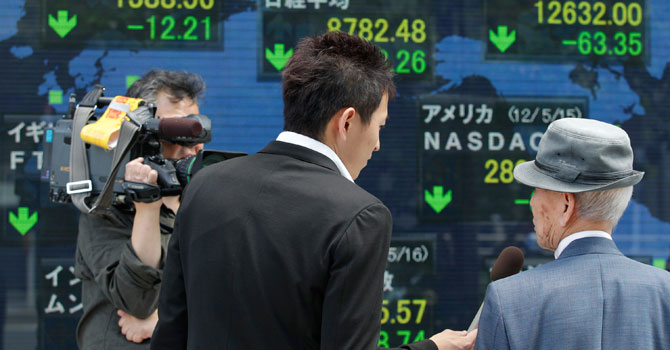
TOKYO: Asian shares fell on Wednesday on worries that the global economic slowdown will erode corporate earnings, with the market unconvinced the euro zone can decisively bring down struggling member states' borrowing costs even after yields pulled back.
The euro zone's three-year debt crisis, which began with its peripheral members, has engulfed the region's larger economies Spain and Italy. In a sign of sustained tension, Rome said on Tuesday that it may want to tap euro zone aid to ease its borrowing costs as market jitters persisted.
European stocks were likely to drop, with financial spreadbetters calling the main indexes in London, Paris and Frankfurt to open down as much as 0.7 per cent. US stock futures held steady.
MSCI's broadest index of Asia-Pacific shares outside Japan was down 0.2 per cent, after slipping to a new low for the month in the wake of a four-day losing streak in US stocks. Japan's Nikkei average shed 0.5 per cent.
“There is a sore lack of momentum in the market,” said Chung Seung-jae, an analyst at Mirae Asset Securities, referring to the Korean equities market, which fell 0.2 per cent.
“In addition to pressure stemming from global growth worries, we have disappointing corporate earnings.”
Hopes for more investment to spur growth helped to limit losses in China and Hong Kong shares. Premier Wen Jiabao said in comments published on the government's website on Tuesday that China must maintain reasonable investment growth to stand up to the headwinds from global economic uncertainties.
“We are still awaiting more details on how Beijing plans to push infrastructure investment which will give greater clarity on profitability for that sector, but otherwise sentiment remains quite weak,” said Jackson Wong, Tanrich Securities vice-president for equity sales.
The notion that Europe was moving towards putting its rescue fund into action and Spain was set to receive the first batch of aid for its troubled banks by the end of July buoyed European shares and lowered Spanish and Italian yields on Tuesday.
But a hearing by the German Constitutional Court into whether the euro zone's bailout fund, known as the European Stability Mechanism, and planned changes to the region's budget rules are compatible with German law renewed fears of a protracted struggle to resolve the debt crisis.
The euro last traded at $1.2256, pinned near a two-year low of $1.2225 hit in early Monday Asian trade.
The ESM is a crucial tool in helping to bring down borrowing costs of indebted nations and breaking the link between the sovereign debt problem and the banking sector stress in Europe.
“Investors have grown sceptical about the decision-making process in Europe and this has hurt euro sentiment,” said Andrew Wilkinson, chief economic strategist at Miller Tabak & Co in New York.
JGBS DRAW INTEREST
With risk aversion deeply rooted in the markets, investors were pouring money into safer assets such as bonds issued by sturdier euro zone economies, including the Netherlands and France, as well as by Japan and international organisations, said a portfolio manager at a Japanese insurance company.
“Money, seeking places to park, is finding its way into sovereign debt, especially Japanese government bonds,” he said.
“JGBs are not cheap in absolute terms but still look valuable relative to US Treasuries or German Bunds, given Japan's low inflation rate,” he said, adding that the European Central Bank's cut in the deposit rate to zero could prompt euro zone banks to shift into safe haven bonds some of the 800 billion euros ($980 billion) they have parked at the ECB overnight.
Some money market traders have also said a probe into an interest rate-fixing scandal for Libor, or London interbank offered rate, could affect Tibor, the Tokyo interbank lending rate, which has traditionally been set high.
An easier interbank lending rate would push down rates on loans and provide incentives for banks to put their money to work in higher-yielding bonds, traders said.
The 10-year JGB yield fell to 0.785 per cent, its lowest since June 2003.
Commodities and oil, which have recently been hurt by weak data from the United States and China, the world's biggest and second-biggest economies, regained their footing on Wednesday after sharp drops in the previous session.
China's second-quarter gross domestic product report due on Friday will likely show the slowest growth in at least three years, after this week's benign inflation and weak imports pointed to softening domestic demand while uncertainties over the external economic downturn clouded the prospect for exports.