0
0

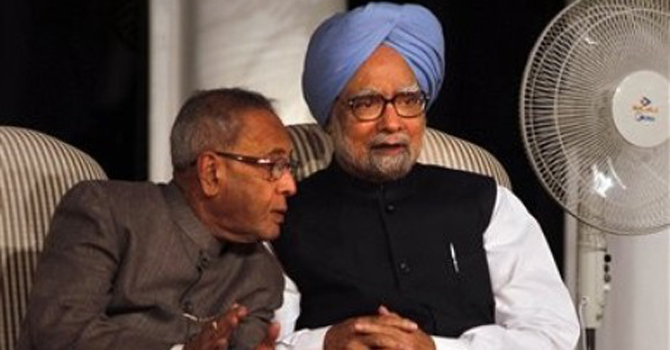
NEW DELHI: India's prime minister has hit back at critics of his graft-tainted government, stressing his own “high standard” of personal integrity and lauding his administration as a beacon of transparency.
In an interview Friday in the Hindustan Times newspaper, Singh also argued that the Indian economy was healthier than media “pessimism” suggested, and promised further measures on tax issues that have rattled foreign investors.
Singh rarely grants media interviews, but has ramped up his public statements since taking on the finance ministry portfolio last month, in what analysts see as an effort to secure his legacy.
Singh is not expected to continue as premier after elections in 2014 and his personal reputation has taken a beating during his second term, amid a series of high-profile corruption scandals and accusations of policy drift.
“Coming to the personal criticism, not only have I maintained a high standard of integrity in my conduct, I have endeavoured to raise the levels in the system as well,” Singh said.
Citing legislation like the Right To Information Act and a Whistleblowers Bill, the premier said his administration had made important strides in improving official accountability that would benefit future generations.
“Never before in the history of India have so many steps been taken in such a short time to bring in transparency into the functioning government, make government accountable to the people for its actions and bring in measures to control corruption,” he said.
“Just as the pessimism over the economy is more in the markets and less on the ground, even in the case of corruption, I do not think there has been any explosion in corruption under my watch,” he added.
Singh's ruling coalition has been embroiled in a series of scandals.
The most high profile case involved former telecom minister A Raja, who quit in November 2010 over the sale of second-generation (2G) telecoms licences at far below their commercial value to selected companies.
Raja was later arrested and is currently on trial.
Singh, who as finance minister in 1991 was credited with opening the Indian economy after decades of quasi-socialist planning, took over the ministry again last month, after Pranab Mukherjee quit to run for president.
Since then he has urged officials to revive the economy's “animal spirit” and reverse a “climate of pessimism” that has set in over recent years.
Global ratings agencies have warned they may downgrade India's debt to junk status with the economy reeling from gaping fiscal and current account deficits and stubbornly strong inflation.
The economy grew by 5.3 per cent between January and March—its slowest quarterly expansion in nine years—and the rupee has lost more than a quarter of its value against the US dollar over the last 12 months.
“The India growth story is intact,” Singh insisted, while acknowledging that the country was passing through “challenging” times.
Promising to bring “complete clarity” on all tax measures, he stressed the importance of reassuring foreign investors at a time of decreasing capital inflows that have exacerbated India's current account deficit.
“We want the world to know that India treats everyone fairly and reasonably and there will be no arbitrariness in tax matters,” he said.
His remarks will fuel speculation that the government is ready to back away from efforts to aggressively tax past financial transactions involving firms like British phone giant Vodafone.