0
0

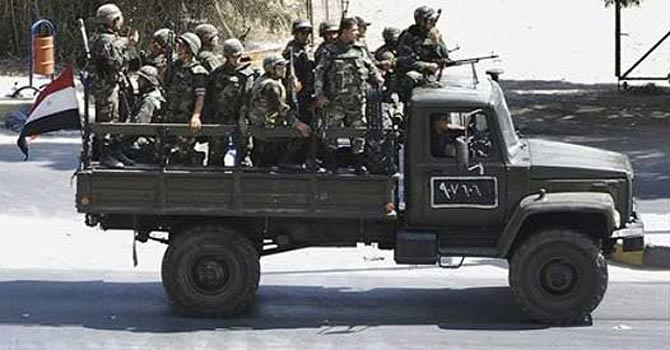
BEIRUT: At least 16 government troops were killed on Sunday in clashes with rebel fighters in the northern province of Aleppo, the Syrian Observatory for Human Rights reported.
“The clashes happened almost simultaneously at dawn,” the Observatory's Rami Abdel Rahman told AFP in Beirut by telephone.
The fighting took place in the town of Dara Aza, and at military checkpoints near the town of Al-Atarib and the village of Kafr Halab, the Britain-based watchdog said.
The Observatory reported that, following an attack on an artillery battalion, a number of soldiers defected, taking a large number of weapons with them.
“This is one of the bloodiest weeks in the conflict,” Abdel Rahman said.
According to the Observatory's figures, 94 people were killed in Syria on Monday, 62 on Tuesday, 88 on Wednesday, 168 on Thursday, 116 on Friday and 116 on Saturday.
“It's like we are in a war,” Abdel Rahman said. “Sometimes when two countries are at war, not even 20 people are killed a day. But now in syria it has become normal to have 100 killed each day.”The mounting death toll was a result of the international community's inability to agree on a way to resolve the crisis, he said.
“The UN observers have suspended their mission and this is a very bad decision. They are just staying in Syria and not going out to observe,” said Abdel Rahman.
“Either go out and observe properly or leave,” he said, his frustration palpable.
For its part, state news agency SANA reported that on Saturday the bodies of 46 military and law enforcement members were “escorted from Aleppo Military Hospital, Tishreen Military Hospital and Harasta Police Hospital in Damascus to their final resting place.”
Solemn funeral ceremonies were held for the martyrs who were targeted by armed terrorist groups while they were in the line of duty in the provinces of Damascus, Homs, Aleppo, Idlib and Daraa,” SANA added.
More than 15,000 people, the majority civilians, have been killed in Syria since the outbreak of the revolt against the regime of President Bashar al-Assad in March 2011, according to Observatory figures.