0
0

THE reduced federal transfer of funds including from the federal divisible pool to Khyber Pakhtunkhwa may increase its budget deficit to over Rs22bn.
However, this may not be the final figure because the federal transfers depend on the revenue collection and staggered disbursements of committed amounts.
In case the Federal Board of Revenue (FBR) misses the revenue target of Rs1952 billion by end June 2012, the financial flows to the province will be further squeezed, putting the KP government in a difficult situation as the province depends on the federal government for over 92 per cent of its revenue.
Aside from this, the issue of the past arrears of the KP’s net hydro profits long pending with the federal government also largely remains unresolved. The province has not received the expected one-third of the capped net hydro profits in the current fiscal year. As a result, the provincial government does not have enough resources to fund the development projects, which are either in the middle of or close to completion.
In the last budget the federal government had earmarked Rs159 billion to KP from the federal divisible pool. But according to subsequent data, the province received only Rs97 billion by end March against the target of Rs112 billion, resulting in a shortfall of Rs15 billion.
Under the 7th National Finance Commission (NFC) award, KP was to receive Rs13 billion in the first nine months as special grants - just one per cent of the divisible pool- for the ‘war on terror’, but it got Rs11 billion. The target for the total transfer under this head is Rs18.022 billion.
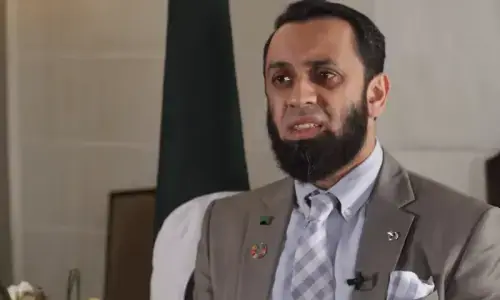
Despite reduced resource flows, the KP finance minister, Humayun Khan, believes that the financial health of his province is on sound footing, but admits that the slow down in federal flows may squeeze the fiscal space. Being a PPP minister he avoided complaining against the federal PPP-led coalition government and claimed that the provincial economy is moving ‘well on target’.
The KP government has so far received only Rs1.6 billion as against the capped amount of Rs6 billion on the account of net hydro profits, a shortfall of over Rs4 billion. He confirmed the withholding of net hydro profits of the province by the federal government. However, he said Chief Minister Amir Haider Hoti has already taken up this issue. “We are negotiating with the federal government to de-cap the net hydro profits,” the minister told Dawn.
On the other hand, the net hydro profit arrears, pending since 2004-05, have touched Rs25 billion. Last year the government assured the province that it would release an amount of Rs2.5 billion per month to clear the net hydro profits arrears. But since March, the province has not received the promised instalments. The finance minister said the province has taken up the issue with the federal government for early payment.
The finance minister however was satisfied with the resource distribution under the 7th NFC award and the provincial government’s share in the federal public sector development programme (PSDP). He said the province has been allocated enough projects under the PSDP for the year 2012-13. The minister was also pinning his hope in more funds with the realisation of the FBR’s revenue target. Asked why the provincial revenue is not up to the mark, the minister said the economic activities slowed down because of the ‘war on terror’ and the poor law and order situation.
The reduced fiscal space has affected development programmes as they have received only 55 per cent of spending so far. However, an official of the finance ministry said 20 to 25 per cent of the project finances will be released in the month of June. It is feared that the funds cannot be utilised properly within the space of only a month. It also reflects on the provincial government’s incapacity to fully utilise the development spending efficiently and prudently.
The provincial government is also facing a shortfall in its tax revenue collection by more than Rs2 billion. It has failed to work out an effective strategy for tapping into revenues from agriculture, real estate and other sectors. Less than 100 people are paying the agriculture income tax. The finance minister has no plan to raise resources at provincial level.
The collection of general sales tax on services (GST) is the responsibility of the provinces but in KP it is collected by the FBR. The target projected for the GST on services was Rs10.030 billion for the current fiscal year. But the province received only Rs1 billion against the target of Rs7 billion in the July to March period. The FBR performance may compel the provincial government to collect GST on services through a dedicated provincial set-up.
Finally, the federal government had committed Rs13.806 billion as straight transfers on account of royalty on oil and gas, but KP did not receive the expected amount.—Mubarak Zeb Khan