0
0

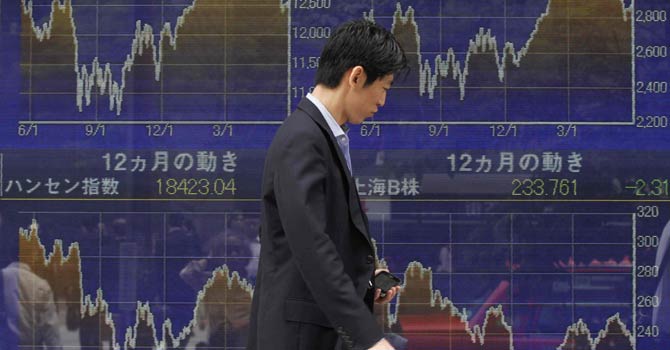
TOKYO: Asian shares and commodities slid while the euro fell to its lowest in almost two years against the dollar on Thursday, as surging borrowing costs in troubled Spain raised fears that it could fail to rescue its banks and may need to seek a bailout.
Investors fled from risk assets to US government bonds, with the benchmark 10-year Treasury yield falling below 1.6 per cent in early Asian trade on Thursday, its lowest in at least 60 years. The 10-year Japanese government bond yield hit a nine-year low of 0.810 per cent.
The dollar and the yen were also beneficiaries of escalating risk aversion although gold, a traditional safe-haven asset, struggled in the face of the greenback's strength.
MSCI's broadest index of Asia-Pacific shares outside Japan tumbled as much as 1.6 per cent, and was set for its worst month in eight months with a drop of nearly 12 per cent. The pan-Asia index was down 0.3 per cent for the year.
The index was dragged down as some key Asian bourses – Hong Kong, Australia and Korea - temporarily fell to negative territory for t h e year.
Japan's Nikkei was down 1.4 per cent on the day and on track for its biggest monthly drop in two years.
European shares were likely to tread lower, with spreadbetters predicting major European markets would open down as much as 0.2 per cent. US stock futures were nearly unchanged.
“The situation in Spain at the moment is untenable, not only is there concern over the state of its banking sector but there is little confidence its government will actually be able to bail them out,” said Michael Creed, an economist at the National Australia Bank.
A caution by Spain's central banker that Madrid will miss deficit targets for this year pushed Spanish 10-year yields above 6.7 per cent, close to 7 per cent, a level seen as unsustainable and which could push Spain to seek a bailout just as Greece, Portugal and Ireland have done.
The cost of insuring against a Spanish default scaled a record high near 600 basis points while Italy, which is also struggling with huge public debt, saw its 10-year yield top 6 per cent for the first time since January.
Yields on all German bond maturities hit record lows on Wednesday, pushing the premium investors demand to hold Spanish debt over German debt to its highest since the launch of the euro at around 543 basis points.
FIRM DOLLAR SLAMS COMMODITIES
Oil prices extended losses and copper hit 2012 lows near $7,422 a tonne on Thursday.
US crude futures eased 0.3 per cent at $87.59 a barrel and were set for their worst month since late 2008. Brent crude fell 0.3 per cent at $103.15 a barrel, on track for its worst month in two years.
“Investors were already exposed to the problems in Spain, but what really disturbed the market were oil prices and US bond yields which broke out of range to hit long-period lows,” said Lee Seung-wook, an analyst at Kiwoom Securities.
The dollar index, measured against a basket of major currencies, extended its rally to 83.11, its highest since September 2010.
The strong dollar and intensifying risk aversion sent the Thomson Reuters-Jefferies CRB index, a global benchmark for commodities, tumbling 1.7 per cent to its lowest levels since September 2010 on Wednesday. A stronger dollar typically weighs on dollar-based commodities.
The dollar index was on the verge of closing above its 100-month moving average at 81.82, which would generate a buy signal which in turn could spur a sustained period of dollar strength for the next couple of years to as high as 101.00-106.00, some analysts said.
The index has in the past 30 years generated four successful buy signals which have resulted in significant dollar moves, they added.