49
49

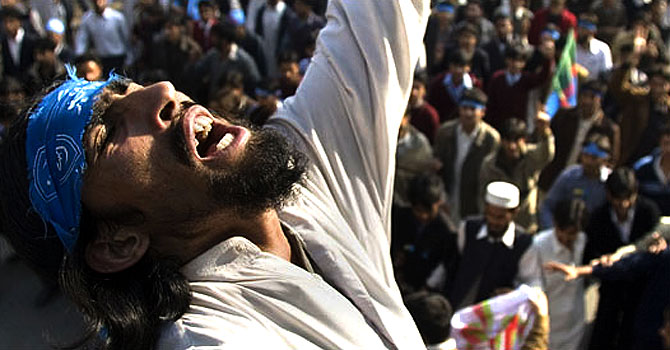
On Sunday, May 13, 2012, Awais Aqeel was outside Punjab University’s (PU) Hostel-16, when eight men appeared on motorbikes and opened fire at him. Before anyone could see who they were, the attackers had fled from the scene. Meanwhile, Aqeel lay dying in a pool of blood.
Almost instantly, an uproar broke out within the Islami Jamiat-i-Tuleba (IJT) at the murder of their top man. Anger pursued for the entire week in violent bouts. The furious IJT members assaulted teachers and attacked the vice chancellor’s (VC) office. Later that week, they ended up clashing with the police on Mall Road. The students even allegedly set fire to at least two buses, both belonging to Daewoo – a South Korean enterprise which has closed its services until, they said, security was guaranteed by the Punjab Government.
Varsity violence Last Friday, the Mall Road clashes remained the centre of attention. Addressing the media at Lahore Press Club, senior Jamaat-i-Islami (JI) leader Liaquat Baloch accused the administration of protecting the murderers.
“The PU administration and the provincial government are providing support to the killers,” he said. “This case has become a test for the Punjab Government and to add insult to injury, our students have been attacked by the police while protesting peacefully.”
Another JI leader, Amir-ul-Azeem, has alleged the involvement of key university officials in the incident.
According to IJT, Aqeel was killed by Abrar Watto – a disowned Jamiat activist and a member of Shabab-e-Milli –JI’s youth wing (IJT is not a youth wing, it is a student wing).
PU teachers say that a few days before Aqeel’s murder some IJT activists had misbehaved with some faculty members at the Khalid Bin Waleed Hostel. Even after the murder, they say, some Jamiat activists had manhandled two senior faculty members, besides damaging dozens of flowerpots outside the VC Office.
“We are sick and tired of their ‘badmaashi’ (hooliganism). It is about time they were stopped,” said one teacher complaining about Jamiat.
“We will have to leave the university if Jamiat doesn’t.”
The Academic Staff Association (ASA), a representative body of the Punjab University’s faculty members has been observing an academic boycott against the Jamiat rowdiness on campus.
Jamiat denies these reports on record.
Speaking to the press, they have made claims that in fact it is them who are being targeted. But the PU administration remains resolute. In fact they state that the murdered young man was not even a PU student anymore.
“The PU administration confirms that Awais Aqeel was no more a student of the varsity as he had failed in LLB Part-I Annual Examination 2011, under roll number 1927,” said the PU spokesman. “Neither was Watoo a student of PU.”
While murders are not a regular feature, the Jamiat has nevertheless been associated with incidents of violence from time to time. They deny this too.
The PU has always remained a hotbed of political activity, even though ironically, Jamiat is the only political wing that ‘owns’ it.
In fact many aspects arise from this incident, and a look into the background of student politics in the Punjab University must be understood.
“One important thing to understand here is that the Jamiat was not always strong,” says Dr Mehdi Hasan, veteran journalist, and also a student activist during the 50s. “It became strong after the progressive parties were banned in the mid 50s, especially the Communist Party (CPP), and then thanks to military dictators who wanted their power enforced, Jamiat was used as a pawn. And it is also very important to understand that while there was always an array of political movement in Karachi and East Pakistan, in Punjab University, the only party wing was the Muslim Students’ Federation (MSF) which weakened after the creation of Pakistan and then after the ban on DSF (Democratic Students’ Federation) Jamiat gained complete monopoly which continues till today.”
This observation points to the fact that when it comes to student politics in the Punjab University, it has always been IJT which has been heading the situation. Only during several short spans of time have some other parties entered the arena. Some parties were banned, others died out themselves while some others did not bother to strengthen their student political wings.
Dr Munawar Sabir, a professor from PU’s Geography department who has been at the university for over 30 years, adds to this.
“The situation at the Punjab University has many interesting dichotomies,” he says. “Those parties who boycott the national election are better at their movement on a student level. They have more hold on students. Secondly, since the Afghan war, militancy has penetrated these student parties too. The Jamiat which is a harbinger of newly enrolled students have taken many of those under their wing who have been involved in the Afghan War, and have introduced them as ‘mujahideens’. Then again the religious parties have always sided with the military governments so they have very much been there. Dictators had a guarantee by these student wings to help them.”
Another important point that both Dr Mehdi and Dr Munawar have pointed out is that while the communist parties spent their time merely discussing what should be done, the Jamiat was spending its time actually doing it.
When they made it to the mainstream and ironically also following what political analysts observe to be structural and administrative inspirations from communist parties, the Jamiat tended to grow stronger and even sometimes more popular among students.
“No one for instance has a more disciplined approach,” says Dr Mehdi. “No one gives attention to the students’ issues. Parties like the PPP who have won votes thanks to student movements back in the 70s, and later have today stopped giving attention to their own wings. So when students especially those from rural areas or small towns come to study, Jamiat is first to take up their issues and to give them attention.”
“Imagine a person coming from a rural area who has no friends, or acquaintances in a huge urban city like Lahore,” says Dr Munawar. “The Jamiat takes them in their fold, gives them power and acceptability – a new identity – who would not want that? These people will soon have the power to kick open the door of the VC’s office. Today in PU Jamiat is so important that there are wings penetrating everywhere. The policy decisions are made based on what they want, because there is a teacher’s wing. There are legal wings so if anyone is in trouble they can be bailed out. They are everywhere.”
He says they are given identity, prestige and power. But, he says there are some things that the Jamiat has probably never been involved in. Selling or encouraging the use of drugs is one of these.
That is not all.
Some students, even those who remain politically neutral, admit that the Jamiat helps resolve their problems.
“We occasionally have issues of proper facilities in our hostels, and whenever the Jamiat has been told they have helped us,” says Fakhra of the Final Year. “They do a lot for the students. But yes political penetration at the level of decision making sometimes does cause disturbance. Certain policies are not made because they don’t have the support of Jamiat.”
Weapons and fascism Even though murder is not common, Dr Mehdi Hasan who says he has been following the violence level there says that since the past few years about 15 to 20 students have been killed because of student violence propelled by politics, with no one party at fault.
“That is not to say that IJT has never been involved,” he clarifies. “In 1997, I remember some IJT activists opened fire at a Shia majlis gathering in the university premises and killed about four to five people. This was following their remarks on the majlis that they would not stand such ‘nonsense’ on university. Meanwhile they do whatever they want. Today, at least two or three hostels are under the complete and total control of the IJT, not counting those which are under partial control. They are known to provide their supporters with motorbikes and cell phones, and in case of any untoward incident also compensate families with money.
As for weapons, we all know the level of weaponisation all over Pakistan whether it’s the Punjab University of the Karachi University. The difference is just this that previously, a pistol was used, now a Kalashnikov is used.”
If this form of organized violent behavior has penetrated so far into PU then the students who are meant to be the most educated and passionate section of society in any country, are in a dangerous situation.
“Militarization of students has resulted in them not even understanding what they are fighting for anymore,” says another teacher of the Urdu department. “Unfortunately these people always use religion as a tool to get their ideas across. They do things in the ‘name of’ religion, not actually what religion asks them to do, which is spread peace and humanity.”
He says IJT’s monopoly does not allow any new party to take hold either.
“When the ISO or PTI have tried in the past to root themselves, these people turned violent on them,” he says.
But Saeed Ahmed, a news editor of a progressive Urdu paper says that IJT has also been given a tough time, although he too admits to the fact that many parties bowed out of the scene and left IJT to rule the roost.
“Before the dismemberment of Pakistan, there were student’s organizations in every province, including East Pakistan. The PU has a phenomenal mix of students coming in from all areas so it has an important position politically speaking.
In the 60s and 70s we had more organizations. We had a Punjab Students’ Organization. We also had a Punjab Students’ Union (1968 to ‘74) which along with PSO gave the Jamiat a very tough time in the 1960s. I still remember one time when the VC was beaten up so badly by some Jamiat boys that he was carried out in an ambulance. Those boys today are now men who are regarded as top leaders in the Jamaat-e-Islami. Some have even switched parties. When their aggression became too much to take, CM Punjab Ghulam Hyder Wyne asked for MSF to be brought back to stand up against the Jamiat. A group called QSF (Quaid-e-Azam Students’ Federation) was formed too as a result in the 80s.”
He also blames Jamiat of being involved in a campaign in 1969 of removing three or four very senior teachers who belonged to the Communist Party including Prof Amin Mughal, Prof Manzoor Ahmed, and Prof Eric Cyprian.
“When an organization gains so much monopoly in total isolation it tends to become fascistic in nature,” he says. “And when the organization becomes fascistic, there are some cracks that start to occur.” Though Saeed does not say that the Jamiat or the JI is cracking, he is certainly pointing out the fact that this killing of Awais Aqeel was done by another faction of the JI itself. If this is not a splinter group then what is? “When one man or a group of certain people on top have all the power there are bound to be power struggles. That is when they turn to this. That is what happened with the Communist party in Russia, and even in Karachi you can see the example of the MQM-A and the MQM-Haqiqi.”
In other words he means this is one of the turning points of the future of Jamiat’s political power, especially in PU.
As a solution to this Saeed Ahmed maintains that there should be more student groups coming up.
“The PM has supposedly lifted the ban on students’ wings,” he says. “Why do the students not form other groups? Unfortunately though, several factors have led to a lot of de-politicisation in PU. Students run away from politics mistaking it for a violent game.”
But Dr Munawar says that while politics is extremely important among students, the immediate solution is to replace the current system with meritocracy.
“Instead of holding elections there should be a system where only those students who gain merit in their subject areas, are the ones who lead other students especially in activities,” he says. “I am not saying politics should be banned. But this manner of doing politics in which only one political party handles all student affairs is very unfair to most of them.”
He laughs at the notion that the Jamiat is popular.
“I ask them to their faces, if you really worked for the students to such an extent, then why among 10,000 students who pass out each year, are so few of them your ambassadors?”
Jamaat's view Speaking about the murder and the fact that IJT’s own faction was involved, Abdul Muqeet the official IJT official at PU said that Watoo had been expelled from IJT due to his anti-party acts, adding that he had even formed a rival group to take revenge.
“An FIR has been filed against Watoo, Imran Tarar and two of their friends,” he said. “We deny all allegations against us that say that we support any form of violence.”
Speaking to Dawn the national Nazim of IJT, Zubair Safdar said that the problem was the Watoo was involved in arms and ammunition and IJT had removed him thrice from the party and had also asked the administration to expel him from the university. However he says some people within PU were supporting him and his newly formed faction. After repeated removal from IJT, Watoo decided to vent his anger and revenge upon the nearest student leader he came across.
“It was not personal revenge,” he says. “Instead of Awais, it could have been some other leader of IJT.”
He questioned the credibility of teachers who themselves used violent tactics to cause rifts between students themselves.
“They feel threatened by our popularity,” he said. “That is why often they do violent acts and break window panes and blame it on us. Has anyone ever asked why the teachers have their own political party in PU? Why should the teachers try and intimidate students? I would like to clarify that IJT is against any form of violence.”
Safdar says that there are student wings working in all universities in Pakistan and there was no issue if anyone else came to PU to practice politics among students.
“Any party that wants to form a students wing here is welcome,” he says. “Why should we stop them? IJT is not the only party in the campus. There are other religious parties too. But through an understanding we have come up as the one with the most majority. As for monopoly, ever area has its own monopoly party, but we don’t exercise fascism. We also strongly disapprove of arms use.”
Meanwhile, a senior PU official seeking anonymity said that rifts between student unions were disturbing the peaceful atmosphere of the university. He said that JI and IJT activists were dragging the PU administration into the issue, whereas the administration had no concern with the matter. He hinted that a large-scale evacuation operation would have to be held sooner or later in PU’s hostels.
That however does not give off very good vibes. Not only did the CM not respond to the teachers association in holding an operation after the incident, but over 20 of the Jamiat people who were arrested after the Mall Road clashes were released later the same day. There has been no intervention on part of the CM.
But while this is going on, classes are still suspended at the university. Students are complaining about that and still feel intimidated by the threat of violence looming over their heads. Teachers are still unsure of when normalcy will return. And once again the Punjab government is under pressure from both sides.
Note: Shabab-i-Milli Pakistan is a youth wing of JI. It works outside educational institutions. In 1994, Jamaat decided to disown its previous youth group Pasban, and the new group Shabab-i-Milli was formed.
The author is a freelance journalist.