0
0

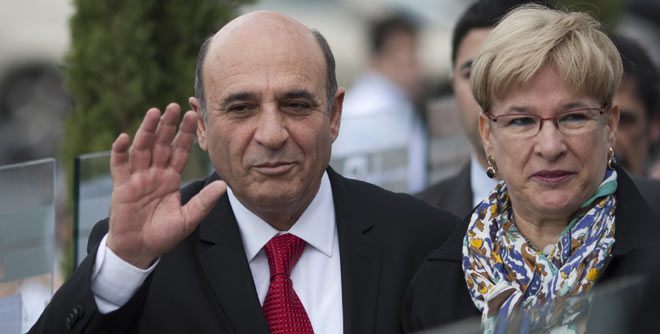
JERUSALEM: Israel's new parliamentary opposition leader said Tuesday that the Jewish state faces the danger of being replaced by a binational Jewish-Arab entity if it fails to separate itself from the Palestinians. Former military chief Shaul Mofaz won leadership of the centrist Kadima Party last month.
''The threat of us losing the Jewish majority and Israel becoming a binational state is the biggest threat to Israel, and time is working against us,'' he told Israel Radio. ''The threat of a binational state that we are bequeathing to our children really keeps me awake at night.''
The Iranian-born Mofaz, in one of his first interviews since winning the Kadima primary last month, said Israel must resume negotiations with the Palestinians.
Talks are stalled after the failure of repeated efforts over the past two decades to reach a deal on carving out a Palestinian state in the West Bank, Gaza and east Jerusalem, territories Israel captured in the 1967 Mideast war.
Mofaz's comments came a day after former Palestinian Prime Minister Ahmed Qureia struck a similar theme from the other side of the Mideast equation, saying the Palestinians might abandon the ''two-state solution'' strategy and aim for a single state consisting of Israel plus the West Bank and Gaza, in which all ethnic and religious groups had equal status.
In an Associated Press interview Monday, Qureia condemned the government of Prime Minister Benjamin Netanyahu for continuing to settle the occupied West Bank with Jews and blocking Palestinian access to their hoped-for capital in Jerusalem.
''If this is the policy, I think it is a big lie to talk about the two-state solution,'' said Qureia. ''They are killing the opportunity of two-state solution. If it dies ... there are other choices. ... One state is one of the choices.''
The 12 million people who live in Israel plus the Palestinian areas are roughly equally divided between Arabs and Jews, and the Arab birthrate is higher. In Israel itself, Jews account for about four-fifths of its almost 8 million people.
Dovish Israelis have cited the demographic threat for years in backing an Israeli pullout from Palestinian areas. Israel withdrew unilaterally from Gaza in 2005, partly because of that issue. However, two Israeli offers in the last decade for a Palestinian state in Gaza, most of the West Bank and parts of Jerusalem failed to produce an accord.
Netanyahu has also recently mentioned the emerging binational reality as a reason to pursue peace talks. But his views on the terms of a deal fall far short of meeting the Palestinian demands for a near-total pullout from the occupied areas.