



 14
14

This is part two of a two-part series. Find part one here.
By now another man, a police constable on duty outside the prison the night Bhutto was hanged; starts telling his version of the hanging. He claims he heard the eyewitness account of the hanging from his senior officers who watched the execution.
“He was a brave man. When they came to take him to the gallows, he asked those army and police officers to salute him first because, he said, he was still an elected prime minister. Then he shaved, put on new clothes and walked straight to the gallows without any signs of weakness. He died peacefully, no screaming, no shouting for help as other condemned prisoners do. And when he died a very pleasant aroma, like that of spring flowers, spread all around. The officers were so impressed, they saluted his dead body.”
This was May of 1979. Bhutto was hanged in April and already a martyr and a saint for those who loved him.
Those who did not – and still do not – had their own versions of the hanging story. They said Bhutto could not walk when brought out of his cell and had to be carried to the gallows on a stretcher. They said he looked very nervous and shaky and died quietly. Nobody saluted him.
Bhutto lovers pay little attention to such blasphemy.
As the constable stopped his story, an eerie silence prevailed, broken only by occasional coughs and groans. But the silence had little effect on the wind, which wailed on through the streets all night. When it blew harder, those of the banyan tree joined the wailing. Then the sun came out, a deep red spilled over the sky.
The day came suddenly. The sun wasted no time baking an already subdued city. The mangy old dog crept out of the charpoy, looked around for shadow and hid himself behind the nearby bushes.
The women came down from the roofs and looked into their pots and pans for pieces of bread saved from last night’s dinner to prepare breakfast for their men still tossing and turning on their charpoys. But it was difficult to ignore the sun for long so they woke up and ate the leftover breads with weak, watery tea. Some went to work but most stayed at home.
A group of Bhutto’s supporters was holding a rally to protest his hanging more than a month after he was hanged. The Bhutto lovers of the wordsmith’s street also wanted to join the rally.
“I will go, yes, I will,” said the old man when the wordsmith asked him if he was also going.
Why?
“I can never forget those eyes. They were so hollow, so empty and yet full of complaints. They seem to be complaining that we did nothing to save him. I want to do my part now,” he said.
Memories of that summer still haunt our wordsmith. They always will, he says. He was a cub reporter at a local newspaper when General Zia ulHuq hanged his former boss and prime minister.
The event was so big that the paper sent its entire editorial staff to the field. So, although an apprentice, our wordsmith found myself covering the biggest story that he, perhaps, ever shall.
He still remembers the night Bhutto was hanged. He was among dozens of journalists waiting for the news outside Rawalpindi’s central prison where Bhutto was jailed. Most people believed that Zia would hang him. They said there was one grave and two bodies and one of them had to go in. If Zia did not hang him, Bhutto would hang Zia when he got the chance. Still, everybody was shocked when he was hanged.
From where the wordsmith stood, he could see the former presidential palace where Bhutto lived first as president and then as the prime minister of Pakistan. Although the government had not formally announced the date of execution, on April 3 the word got around that prison authorities were making unusual security arrangements while troops cordoned off the entire area. So journalists rushed to the central prison.
It was not a public hanging, but the journalists hoped to see the dead body when brought out of the prison and handed over to his relatives. But they were not allowed to do so.
Soon after the sunset an army truck came, collected the journalists and took them to a nearby camp where they were asked to spend the night. Afraid of a violent public reaction, the government did not want the news of the hanging out until it was over. So the army officers made a pact with the journalists that they would be told the news as soon as Bhutto was hanged if they sat quietly and enjoyed their hospitality.
At dawn they were told that Bhutto had been hanged and his body had been flown to his native town, Larkana. They sent the information to the newspapers where people had been waiting for it all night.
Until then it all looked very mechanical, just like any other story.
Later, some journalists went to a roadside tea-stall as they often did after filing their stories, and ordered cups of thick, milky tea and buns.
It was while sipping the tea in that café that the enormity of the event hit them.
It felt like being cut by a razor blade, no blood or pain for a while -- not until the sweat seeps in the cut. But they still did not know how to react.
Some of them loved Bhutto some did not. Some thought he was a man who could have done a lot for the country but did not.
But that morning, Bhutto was everybody’s hero. All remembered him as someone they had elected to rule, not to be hanged. They were not sorry for Bhutto alone but also for themselves. They felt cheated, deceived, slighted. Those in power hanged an elected prime minister, and did not even consult those who had elected him. It seemed as if their votes and opinion had no importance. They felt helpless.
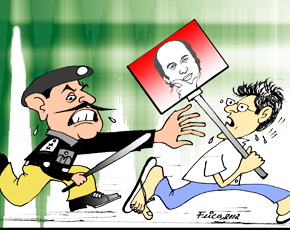
Later in the day, while returning home, our wordsmith saw a small group of students fighting a pitched battle with police near a college. The students were inside the college and were throwing stones at the policemen. Police responded with tear gas shells. The journalists stopped to watch.
While watching those students, the wordsmith felt a strong urge to join them. He too wanted to shout insults at the police, throw stones at them and chant anti-government slogans. But he was a journalist and a coward too. So he hid behind, what he called, “the rules of the game.”
“I could report what I saw, but I could not take part. I knew that it would compromise my neutrality. Still I had this strong desire to show my anger, to vent out my frustration,” he explained.
“Shall I pick up a stone and throw it at the police? Shall I join the crowd and chant anti-government slogans with them? Or shall I simply watch them, go back to my office and write my story, I wondered,” he said.
“It seemed like hours before I bent down and picked up a stone. Now I had the stone in my right hand. I could feel its sharp corners. I rolled it over in my hand three or four times, looked left and right and finally threw it at the police with full force.”
“I was scared.”
“But nobody was looking.”
It was lost in a barrage of stones coming from inside the college. Probably it did not hit anyone. Apparently our wordsmith’s first act of defiance went unnoticed. But he felt relieved.




























