0
0

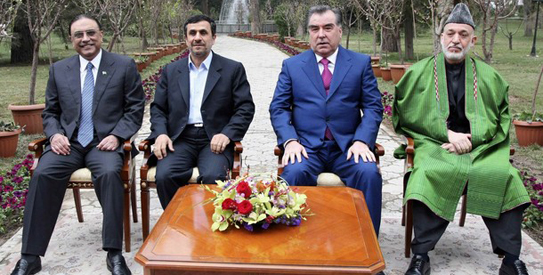
The current move of the heads of states of Tajikistan, Pakistan, Iran and Afghanistan to boost intra-regional trading, coming as it does after the West’s economic sanctions against Iran, has acquired a strategic significance.
The Dushanbe meeting held in late March has tried to realise the potential for the regional trade. “Possibilities abound—ranging from enhancing bilateral trade with Kabul and Tehran to exploring new markets in Tajikistan and the other Central Asian states to penetrating deeper into the Chinese markets,” says a senior official of Trade Development Authority of Pakistan (TDAP).
Just six months earlier, in September 2011, Dushanbe had been the venue of another quadrilateral meeting of the heads of states of Tajikistan, Afghanistan, Pakistan and Russia. In that meeting Pakistan and Tajikistan had agreed to expand bilateral cooperation in key sectors like energy, banking, IT/telecom, road transportation and infrastructure etc.
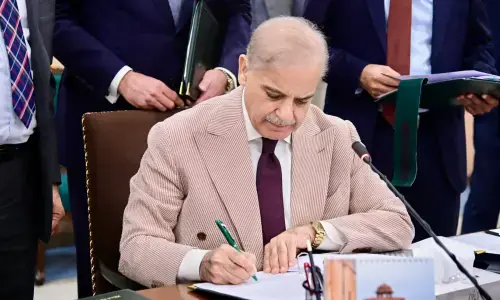
The inauguration of a branch of NBP in Dushanbe by President Zardari indicates that some practical steps are being taken to improve economic co-operation.
NBP officials say that their branch would focus exclusively on trading finance, adding that routing Pakistan-Tajikistan trade through the bank is expected to boost bilateral trade volume to $100 million within next fiscal year from just $25 million now.
Last year from May 30 to June 3, a delegation of the Federation of Pakistan Chambers of Commerce and Industry had visited Tajikistan and met top state officials and business leaders there. They agreed that Tajikistan would expedite work on plans to export electricity to Pakistan through Wakhan Corridor passing through Chitral.
President Zardari is reported to have taken up this issue with Tajik President Emomali Rahmon. The proposed Central Asia South Asia (CASA-1000) transmission line through which Tajikistan would export up to 1000 MW of electricity to Pakistan featured in their talks. And Pakistani president is reported to have pointed out that regional and international support for the project was crucial.
Whereas the FPCCI delegation’s visit to Dushanbe had discussed specific areas of bilateral economic cooperation and some of its members had even signed MoUs with Tajik businessmen “the recent meeting between the heads of the states has articulated their political will to usher in a new era of regional economic cooperation,” Pakistani ambassador to Tajikistan said in a briefing in Dushanbe.
Tajikistan has agreed to sell coal to Pakistan and an MoU in this regard has already been signed. KASB (from Pakistan ) had also signed an agreement with Orient Bank of Tajikistan for processing of export documents. Karachi-based Pak Denim has finalised an MoU to invest in textile complex in Dushanbe for production of textiles and textile made-ups on joint venture basis.
Besides textiles, there exists a lot of scope for bilateral cooperation in pharmaceutical manufacturing, cement production, livestock management, food processing, fisheries, IT technology and value-addition in agricultural produce.
In FY11, Afghanistan emerged as seventh largest trading partner of Pakistan and its second biggest export market after the US. TDAP officials believe that our land-locked neighbour would soon find a place in top five trading partners once the intra-regional trade among Afghanistan, Pakistan, Iran and Tajikistan begin to expand.
“The reason is simple,” said one of these officials. “Whereas Afghanistan’s trade with Tajikistan would rather be direct, it would rely on us in executing trade with Iran. For us, it would open up opportunities to export more of our own products to Afghanistan and to re-export some of the Iranian products with or without value-addition. Similarly, using land routes of Afghanistan we would be able to boost our exports not only to Tajikistan but to other Central Asian states as well.”
Currently, Pakistan’s exports to Central Asian states including Tajikistan total $100-$150 million. In Tajikistan there is a lot of demand for ethnic jewellery, pharmaceuticals, food items, fruits, vegetables, fish, meat and their preparations and sport goods etc.
Demand for these and other goods including cutlery, engineering goods, surgical items, wheat, rice, cotton, sugar, cement, electronics and automobiles also exist in other Central Asian states.
Last year, Pakistan finalised a new more comprehensive Afghan Transit Trade Agreement which is in operation. President Zardari is reported to have conveyed to his Tajik counterpart his desire to include Tajikistan and other Central Asian states into the fold of this agreement.
TDAP officials say they would soon hold meetings with Pakistani exporters to devise a strategy for boosting trade with Iran and Central Asian states in the light of the resolution made at Dushanbe summit conference. Pakistan has already decided to export up to one million tonnes of wheat to Iran in a barter deal.
Government officials say, Pakistan is interested in getting Iranian fertiliser for its wheat but this and other details of the deal will be finalised soon at a meeting between Pakistani and Iranian officials due in April.
Pakistan Sugar Mills Association suggested that Pakistan should export at least 200,000 tonnes of sugar to Iran also under a barter agreement for Iranian fertiliser. Mr Javed Kayani who heads the association says the proposal needs immediate attention of the government as Iran is preparing to import 1.6 million tonnes of sugar from the international market.
“Pakistan-Iran bilateral trade which was less than $750 million in FY11 can reach $1 billion in this fiscal year and jump to $2 billion next year, if both countries employ such innovative approaches (like barter deals) for boosting trade,” a senior TDAP officials told Dawn.
In FY09 and FY10, Pakistan’s bilateral trade with Iran was well over $1 billion. But it fell substantially in the last fiscal year. “That is why Iran is determined to find fresh approaches including barter deal and currency swap with Pakistan to not only bring the two-way trade back to previous levels but to expand it further.”
He said that the inauguration of two-way Pakistan-Iran trade gates at Chaghi last week would help in expanding daily trade volumes between the two countries.
Earlier, there had been only one gate for the border trade and hundreds of traders of both countries had to waste a lot of time to leave or enter Pakistan.