



 0
0

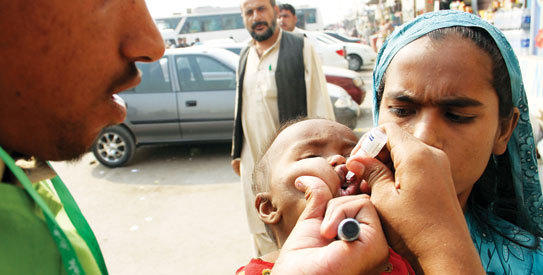
Pakistan was recently in the global spotlight as the country with the world’s largest reservoir of polio virus, at 198 cases, concentrated largely in Quetta, Qila Abdullah and Pishin in Balochistan and Karachi. Neighbouring India Bangladesh, Nepal and Sri Lanka are now polio-free. Parents are shattered to see their children’s lives devastated by this lifelong crippling disease. What worsens the picture is the extreme vulnerability of children to polio.
The spread of polio is a tailor-made scenario: the virus is tricky, spreading by a variety of modes: faecal-oral transmission, through which the virus multiplies in the intestines, and is subsequently transferred through faeces and /or droplets with sneezing or coughing; indirectly, through contaminated soil, or by touching infected persons, or through sexual contact among older individuals. To top it all, airborne polio virus maintains its virulence for long time periods. Carriers of the virus may remain completely asymptomatic.
In short, it is a dangerous situation that this country is in: it is at risk of becoming the node for world-wide spread of the virus. Undoubtedly some of the key reasons for proliferation and poor performance are national disasters and armed conflict, internal migration, strife and unrest, endemically unhygienic conditions and poor quality immunisation programmes; Taliban threats have also added to the problematic mix: “Polio drops will rob your children of their virility”, they say. The drops have been referred to as ‘haraam’—beliefs such as these have been lapped up by an ignorant/ unaware public, adding to speedy propagation of the virus.
Before polio becomes yet another reason for Pakistan’s descent into chaos, it is urgent to strive for the ideal of a polio-free country. There is only one way of eliminating the polio virus: mass vaccination. Every possible means to ensure this, in the shortest possible time, is a critical necessity. In the ’90s, the country had a high of 20,000 cases, which was lowered to 28 in 10 years; there is no reason why this effort cannot be replicated.
Already, following the alarm registered over high polio incidence, government officials have improved oversight and accountability; high-level task forces have been established, with effectively functioning monitoring cells. At national and provincial levels, district-specific plans are being translated to Union Council level, critically necessary for public outreach in the absence of satisfactory health infrastructure. The efforts of vaccinating teams and LHWs (Lady Health Workers) are now supplemented with expanded environmental surveillance to determine the dynamics of polio circulation.
The Expanded Programme of Immunisation (EPI) needs greater efficiency for coverage of polio and other communicable diseases. Political will and commitment at the top must be equally matched at all tiers of governance down below. Previously weak monitoring systems are now in the process of being strengthened; concentrated nodes of the polio virus currently receive concerted and sustained effort for elimination of the virus.
Said one health official: “Vaccinators must be sensitised about the importance of their role in polio eradication; they need more encouragement.” Vaccination of migrant populations is of critical importance.
Paediatrician Dr Z Bhutta at Aga Khan Medical University, Karachi, is optimistic about such a campaign: “New strategies have the potential to re-invigorate eradication efforts. Ulema are working to convince parents and families to vaccinate their children; LHWs are going from door to door, ensuring that every child in their region is vaccinated; Rotarians are playing a significant role in eradication efforts too.”
Inexplicably, the media, as a strong arm of information and communication has not been fully utilised. The majority public lacks the basic awareness of means of spread of this disease. Despite the absence of optimal health infrastructure, the public can be provided with effective, usable health information via press, radio and television. Pakistan will be failing its populace if it does not recognise that health is a basic human right, which has been denied to its people for far too long.
Creativity and innovation need to be brought in to the polio eradication effort: why not ‘polio vaccination camps’ in katchi abadis and rural locales? They could be made fun occasions to attract children and parents, with skits for children, cartoon characters, and films for parents to understand how polio spreads and how it can be prevented. If every conceivable product can be marketed via innovative strategies, why cannot similar strategies be used to ‘market’ the polio vaccine?
Educational institutes can be brought into the “Eradicate polio” effort. Why not have “Polio months”—why limit this to only “Polio days” or weeks? Each country needs its uniquely designed overall strategy to overcome this scourge: so too does Pakistan.
Czechoslovakia overcame polio in just one short year following the advent of the Salk polio vaccine, with mass vaccination drives. India recently achieved it with unswerving political commitment, outstanding public health leadership, clear lines of accountability, intolerance of weak performance and systematic enforcement of best practices. Pakistan had done the same in the ’90s; it now needs to repeat that success once again.




























