



 0
0

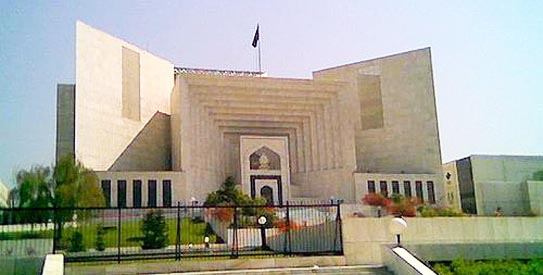
ISLAMABAD: The Supreme Court explained in a detailed judgment on Wednesday why it held that no violation of any statutory provisions had been committed in the sale of the Habib Bank Limited and at the same time had a word of caution about frivolous petitions.
On Nov 29 last year, a bench comprising Justice Tassaduq Hussain Jillani, Justice Mian Saqib Nisar and Justice Ejaz Afzal Khan had rejected petitions of former secretary of the Planning Commission Dr Akhtar Hassan Khan, Barrister Zafarullah of the Watan Party and HBL employees against privatisation of the bank.
The court held that the privatisation of the bank by the Cabinet Committee on Privatisation was within the purview of Privatisation Commission.
The process was neither tainted with lack of transparency or mala fides, nor the successful bidder lacked qualifications prescribed in law.
Therefore, the sale was in accord with the best practices around the world and the law declared by the Supreme Court.
Before issuing the judgment the bench deplored a common practice where in the name of public interest litigation matters which were neither of public importance nor related to enforcement of a fundamental right or public duty were brought before the court.
The judgment also reproduced the observations made in the 2004 Ashok Kumar Pandey versus State of West Bengal case in which the Indian Supreme Court had held that the public interest litigation is a weapon which should be used with great care and circumspection.
The judiciary has to be extremely careful to see that behind the beautiful veil of public interest an ugly private malice, vested interest or publicity seeking is not lurking.
It is to be used as an effective weapon in the armoury of law for delivering social justice to citizens, the verdict said, adding that the attractive brand name of public interest litigation should not be used for suspicious products of mischief.
“It should be aimed at redressal of genuine public wrong or public injury and not publicity oriented or founded on personal vendetta.”
The court, the verdict said, must be careful to see that a body of persons or member of public, who approaches the court is acting bona fide and not for personal gain or private motive or political motivation or other oblique consideration.
“The court must not allow its process to be abused for oblique considerations. Some persons with vested interest indulge in the pastime of meddling with judicial process either by force of habit or from improper motives.
Often they are actuated by a desire to win notoriety or cheap popularity,” the verdict said, adding that the petitions of such busy bodies deserved to be thrown out by rejection at the threshold, and in appropriate cases with exemplary costs.



























