0
0

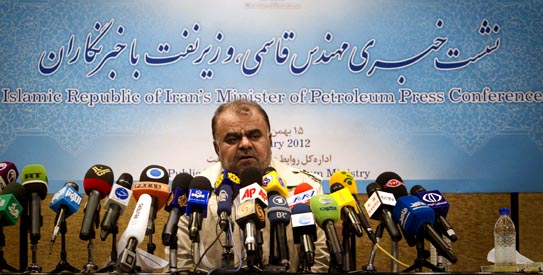
TEHRAN: Iran's oil minister said the Islamic state would not retreat from its nuclear programme even if its crude oil exports grind to a halt, the official IRNA news agency reported on Saturday.
But he also called on the European Union, which accounted for a quarter of Iranian crude oil sales in the third quarter of 2011, to review its decision last week to bank Iranian oil imports from July 1.
“We will not abandon our just nuclear course, even if we cannot sell one drop of oil,” Rostam Qasemi told reporters, according to IRNA.
Tension with the West rose last month when Washington and the European Union imposed the toughest sanctions yet on Iran in a bid to force it to provide more information on its nuclear programme. The measures are aimed at shutting off the second-biggest OPEC oil exporters' sales of crude.
Qasemi said Iran would cut oil exports to some nations in Europe - he did not specify which - in retaliation for the 27-state EU's decision to stop importing Iranian crude.
“Our oil exports will certainly be cut to some European countries ... We will decide about other European countries later,” Qasemi told a news conference, IRNA reported.
He urged Europe to reconsider its ban, and said the oil market is in balance now but would be thrown into turmoil without Iranian crude supplies.
“Unfortunately the EU has succumbed to America's pressure. I hope they would review their decision on sanctioning Iran's oil exports,” Qasemi said.
“The international crude market will experience turmoil in the absence of Iranian oil with unforeseen consequences on oil prices,” he said.
However, analysts say the global oil market would not be greatly affected if Iran were to turn off the oil tap to Europe.
The EU's ban on Iranian oil came after US President Barack Obama signed new sanctions into law on New Year's Eve that would block any institution dealing with Iran's central bank from the US financial system.
If fully implemented, these measures will make it impossible for countries to buy Iranian oil.
ALTERNATIVE CRUDE BUYERS Brent crude prices rose to near three-month peaks on Friday, partly thanks to oil investors covering short positions ahead of the weekend due to the standoff between the West and Tehran over its nuclear programme.
The United States wants buyers in Asia, Iran's biggest oil market, to cut imports to put further pressure on Tehran, which is scrambling to find new buyers and persuade existing customers to keep doing business with it.
But Iran remains a key supplier for many countries, and some of its major customers are seeking waivers from Washington from the sanctions while they look for alternative sources of oil.
Saudi Arabia, Iran's regional rival, has promised to make up any shortfall in supply.
Iranian officials have said sanctions have had no impact on it, while the country's supreme leader Ayatollah Ali Khamenei threatened on Friday to retaliate against the West for sanctions.
Qasemi also played down the importance of Europe as a market for its exports.
“We have no problem to find other crude buyers to replace the European countries,” he was quoted as saying.
The United States and its allies say Iran is trying to develop weapons under cover of a civilian nuclear programme. But energy-rich Iran denies this, saying it needs nuclear technology to generate electricity.
Washington and Israel have not ruled out military action if diplomacy fails to resolve the standoff.
Iran has warned of firm retaliation if attacked, including targeting Israel and US bases in the Gulf and closing off the vital oil shipping route through the Strait of Hormuz.
But Qasemi played down the possibility of Iran blocking the crucial waterway.
“Iran is not after tension, and closure of the Strait is a politically motivated issue,” he said.
Isolated Iran is also facing problems over the price it charges neighbour Turkey for its natural gas exports. Turkey said on Jan. 31 that it was taking Tehran to international arbitration over the matter.
Qasemi rejected Ankara's complaint that the price was too high. “Iran surely cannot decrease its natural gas price (for Turkey) without legal authorisation,” he said.
Iran exports 10 billion cubic metres of gas each year to Turkey, making it Ankara's second-biggest supplier after Russia.