0
0

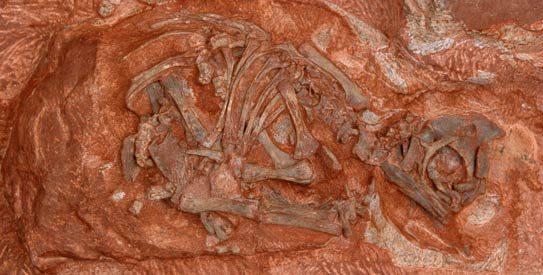
WASHINGTON: Tiny footprints and fossil embryos at the oldest dinosaur nesting site ever found have revealed new details about how these ancient creatures reared their young, according to research published on Monday.
The nest belong to mid-sized dinosaurs from the Early Jurassic Period known as Massospondylus, which grew to four to six meters (13 to 20 feet) long as adults. Their eggs, however, are only six centimeters in diameter.
The traces left behind show that hatchlings stayed in the nest until they doubled in size, and that the young Massospondylus walked on four legs while young, but then likely stood upright on two legs as adults.
The analysis led by Canadian and South African researchers is based on findings at an excavation in Golden Gate Highlands National Park in South Africa, and is published in the Proceedings of the National Academy of Sciences.
The fossils date to 190 million years ago, presenting the oldest known evidence of such behavior among dinosaurs.
The first fossilized dinosaur embryo was in Golden Gate in 1976, and the first details about unhatched dinosaurs found inside fossilized eggs at the site were published to international fanfare in 2005.
At least 10 nests have now been uncovered at various levels, each holding as many as 34 eggs in close-knit clutches.
“The eggs, embryos, and nests come from the rocks of a nearly vertical road cut only 25 meters (yards) long,” said paleontologist Robert Reisz, a professor of biology at University of Toronto Mississauga.
“Even so, we found 10 nests, suggesting that there are a lot more in the cliff, still covered by tons of rock. We predict that many more nests will be eroded out in time as natural weathering processes continue.” Researchers believe the layout of the nests suggest that the site was returned to repeatedly by the dinosaur mothers, who laid eggs together as a group and carefully organized their eggs in their nests.
“Even though the fossil record of dinosaurs is extensive, we actually have very little fossil information about their reproductive biology, particularly for early dinosaurs,” said David Evans, associate curator, Vertebrate Palaeontology at the Royal Ontario Museum.
“This amazing series of 190 million year old nests gives us the first detailed look at dinosaur reproduction early in their evolutionary history, and documents the antiquity of nesting strategies that are only known much later in the dinosaur record.”