0
0

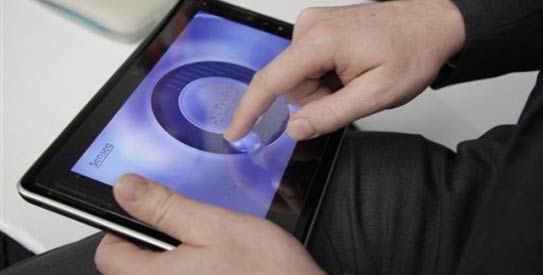
SEOUL: Tired of long waits at the hospital for medical tests? If Korean researchers have their way, your smartphone could one day eliminate that – and perhaps even tell you that you have cancer.
A team of scientists at Korea Advanced Institute of Science of Technology (KAIST) said in a paper published in Angewandte Chemie, a German science journal, that touch screen technology can be used to detect biomolecular matter, much as is done in medical tests.
“It began from the idea that touch screens work by recognizing the electronic signs from the touch of the finger, and so the presence of specific proteins and DNA should be recognizable as well,” said Hyun-gyu Park, who with Byong-yeon Won led the study. The touch screens on smartphones, PDAs or other electronic devices work by sensing the electronic charges from the user’s body on the screen. Biochemicals such as proteins and DNA molecules also carry specific electronic charges.
According to KAIST, the team’s experiments showed that touch screens can recognize the existence and the concentration of DNA molecules placed on them, a first step towards one day being able to use the screens to carry out medical tests.
“We have confirmed that (touch screens) are able to recognize DNA molecules with nearly 100 percent accuracy just as large, conventional medical equipment can and we believe equal results are possible for proteins,” Park told Reuters TV.
“There are proteins known in the medical world like the ones used to diagnose liver cancer, and we would be able to see the liver condition of the patient.”
The research team added that it is currently developing a type of film with reactive materials that can identify specific biochemicals, hoping this will allow the touch screens to also recognize different biomolecular materials.
But confirming that the touch screen can recognize the biomolecular materials, though key, is only the first step.
Since nobody would put blood or urine on a touch screen, the sample would be placed on a strip, which would then be fed into the phone or a module attached to the phone through what Park called an “entrance point.”
“The location and concentration of the sample would be recognized the same way the touch of the finger is recognized,” he added.
There are no details yet on a prospective timetable for making the phone a diagnostic tool, however.