0
0

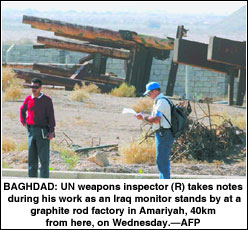 BAGHDAD, Nov 27: Iraq gave UN weapons experts access to see what they wanted on their first day of inspections after a nearly four-year break, the head of the two teams that went out on Wednesday told reporters.
“The team was able to complete the inspection work as it planned with the cooperation of the Iraqi side and we had access to what we wanted to see,” said Frenchman Jacques Baute, who led an International Atomic Energy Agency (IAEA) team on a visit to a military industrial complex in Baghdad’s northeastern suburbs.
“We managed to do all the things that we planned to do,” said Greece’s Dimitri Perricos, who led a team from the United Nations Monitoring, Verification and Inspection Mission (UNMOVIC) on a search of a graphite factory in Al-Amiriya, 70 kilometres west of the capital.
“We got the activities and the data we wanted to get in order to be able to assess further the capabilities of the sites, and we included in that computer circuits so that we would be assured that there is nothing within the computer system that we found.”
One team of inspectors visited a missile facility near the capital and the other visited a graphite facility, they said. They did not give details about the results of the inspections.
Witnesses said a group of inspectors spent three hours at a large military compound east of Baghdad, and another team drove to the Saddam General headquarters, a small industrial complex near Ramadi, 140kms northwest of Baghdad.
Journalists in around 50 vehicles had raced behind the convoys of white cars carrying the UN symbol across Baghdad, a city of around five million people.
At one point there was an hour-long traffic jam involving inspectors, media and escorting Iraqi officials.
Two press vehicles cannoned into each other in their haste.
Bemused locals looked on at the frenzied chase, with police holding back civilian traffic to let the visitors through.
The inspectors split into two groups, escorted by officials from Iraq’s monitoring directorate.
One team briefly lost way, driving along the same road twice and unwilling to ask their escorts the way for fear of giving their destination away.
Witnesses said there was some pushing and shoving as journalists tried to force their way into the sites, but Iraqi officials managed to keep the press back.
Cameramen scaled the walls in some instances to get shots of the proceedings.
An Iraqi official said the inspection went smoothly.
“They had questions and we replied to all of them and there were not any problems,” Haitham Mahmoud, head of the Al Tahadi Factory, told reporters in English.
The military compound visited by UNMOVIC inspectors is run by Iraq’s military industrialization commission. It has several buildings and security was tight.
Iraqi guards stopped journalists from accompanying the experts. A large portrait of President Saddam Hussein with the slogan “God preserve Iraq and Saddam” stood by the gate.
“I think everybody feels excited and anxious to get going and very determined to start this systematic inspection,” Melissa Fleming, spokeswoman for the International Atomic Energy Agency (IAEA), told reporters as inspectors left their hotel.
“We are just hopeful that things will go well today. We are looking forward to a good day of inspection,” Fleming said.
UN Secretary-General Kofi Annan, asked by France’s Europe 1 radio about the start of the inspectors’ mission, replied “I think it got off to a rather good start.”
Baghdad has been given until Dec 8 to declare any nuclear, chemical or biological weapons in an initial report to the United Nations security council.
The heads of the inspection teams said on Tuesday they would leave no stone unturned on their missions and that, unlike their predecessors, they had a strong mandate to look inside Saddam’s own, sprawling palace compounds at any time.
Under the new resolution, the inspectors must give their first report to the security council by Jan 27.—AFP/Reuters