0
0

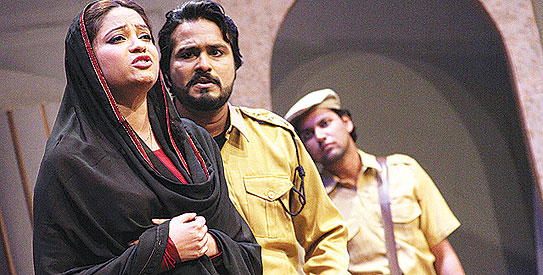
KARACHI: Whoever tries to produce an Urdu play written in the former half of the 20th century for 21st century audiences treads a fine line: the time-span is not long enough to treat the setting of the play in classical terms and not short enough to classically deconstruct the text.
So achieving flawlessness is nearly impossible. What could be accomplished, though, is a true representation of that timeframe through linguistic truthfulness more than contextual correctness, which may go with the content of the play the way its author aspired to.Agha Hashr Kashmir’s Nek Parveen is a play that he penned (1910) when he had already developed a reputation of being one of the foremost playwrights in India. Many of his dramas at the time were either inspired or adapted from plays written in other languages. Nek Parveen was based on Henry Arthur Jones’ The Silver King. (Jones was aided by Henry Herman).
The Napa Repertory Theatre’s presentation of Nek Parveen, directed by Zia Mohyeddin, struck a chord with the audience on Friday at the Arts Council theatre. The production managed to catch the fancy of theatre lovers to a large extent.
When the curtain draws, some carousing men are seen discussing, among other things, Afzal’s beautiful wife Parveen (Aiman Tariq). In the very beginning Afzal’s (Nazrul Hasan) character is revealed when he admits to his intractable alcoholism, cursing himself for being unable to mend his ways. Parveen is a faithful, compliant better half who thinks the primary purpose of her life is to serve her husband in a duty-bound manner. Her husband provides a contrasting image by being incorrigible, and despite the assertion of Parveen and his loyal servant Tahseen (Akbarul Islam) that they’re with him come what may, he keeps condemning himself. Afzal’s old friend Munir’s (Owais Mangalwalla) entry into his house and striking up a conversation with his wife sows seeds of jealousy in Afzal and he gets into a brawl with Munir.
Afzal’s other three friends Asad (Paras Masroor), Nabbu (Sunil Shankar) and Abbu (Ali Rizvi) in the meantime are at Munir’s place. Asad has been lusting after Parveen from the time when she was not married and still has feelings for her. When Munir comes into his own house he sees the three already there and a scuffle ensues. Nabbu accidentally kills Munir. Afzal, under the influence of alcohol, looking for Munir with a gun in his hand enters the scene. Asad and company find the situation in their favour and after knocking Afzal unconscious create a scene depicting Afzal as Munir’s killer.
After coming into his senses, Afzal thinks of himself as the murderer and despite repeated assurances from his wife and servant that they will be by his side he opts for escapism. Asad exploits the situation and tries to take advantage of Parveen, but she remains steadfast in being devoted to her husband, who she thinks is now dead. Abbu redeems himself and becomes a good person. Afzal returns from oblivion in the guise of a beggar, but is now a rich man. He helps his family, wife and daughter Bano (Muskan Fatima). In the end truth is revealed and the melodrama reaches its happy ending.
Characters of a lawyer Mirza Chonga (Ather Abbas), his wife Zulfan (Fizza Hasan) and their servant Zeetak (Meesam Naqvi), along with Nabbu provide timely and worthy comic relief in the play through their antics, mainly by virtue of their verbal ding-dong.The first half of the play had a linear movement as the melodramatic tones of the characters drowned out the undertones of the script. It was after the 10-minute break that the play picked up and caught pace which the audience thoroughly enjoyed. Nazrul Hasan, till the time he played the part of a tipsy individual, appeared as if he’s trying to imitate Zia Mohyeddin. Perhaps he followed the director’s instruction to a T. In the second half, he looked much at ease and was more fluent in the garb of a beggar.
Aiman Tariq’s occasional fumbling could be overlooked. But given the fact that she’s now a professional actress, her stresses and pauses left much to be desired, as oftentimes her rendition of sentences which carried innate rhyming lacked rhythm.
Paras Masroor as the out-and-out villain was convincing. If he gesticulated a tad less, he’d be more effective and less filmy.
Akbarul Islam was the star of the show. His measured performance as an old, devoted servant was ably complemented by his calculated delivery of lines. His enunciation of phrases and idiomatic expression was credible.
No less impressive was Meesam Naqvi as Mirza Chonga’s aid. His comic timing, particularly in the scene in which he describes what he did to his former boss, was worth watching.
What remained noticeable throughout the play was the diligence of its actors. They sounded conscious of the fact that getting the correct pronunciation of words was of paramount importance to them, which is understandable because Zia Mohyeddin directed the play. There was no gimmickry, the lighting was uniform and the costumes looked pretty commonplace. The set, for a major chunk of the production, did commensurate with the subject rather well.
The play will run till Jan 8.