0
0

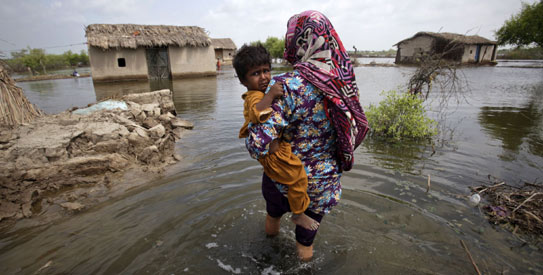
Earlier this year I visited a makeshift camp just outside Mirpurkhas city housing about 45 displaced families. It was in danger of being flooded, and the only protection the families had against the elements were blue plastic sheets distributed by an NGO. But even in these dire straits, the women at the camp had something to be grateful for. The same organisation had constructed curtained toilets, a small but life-changing facility. Until then, living in the open on the roadside, these women had to wait till nightfall to relieve themselves.
They were victims of the 2011 floods, which followed a cataclysmic deluge last year. While the floods this year were not as severe in terms of the number of people and the area affected, 700,000 people were displaced, at least six million acres were submerged and 2.3 million acres of crops were destroyed. An under-funded and inadequate response to the disaster meant that with the onslaught of winter, many who lost their homes and livelihoods were still living in makeshift camps and shelters, ill-equipped to battle the cold or meet many of their most basic needs.
Human rights activist I. A. Rehman feels that even the limited assistance could have gone a longer way if it had been allocated equally and according to international principles that govern disaster response and displacement. Instead, the government was guilty of neglect and people suffered from “distorted allocation and wrong methods,” he says. As an example, he explains that only when the Human Rights Commission of Pakistan put out a statement criticising the government for ignoring a particular area was a team dispatched there with aid. In addition, Rehman points out, all those affected by disasters or displacement are not equal. Women, children and orphans are more vulnerable than others.
According to principles laid down by the United Nations, those affected have the right to evacuation and to basic facilities such as schooling for children and privacy for women. A coordinated national response designed to address some of these fundamental needs was sorely missing in 2011.
— Rubab Karrar is a Dawn staffer