0
0

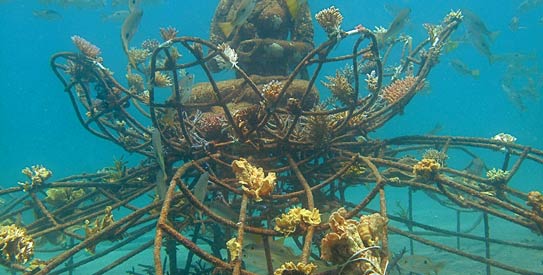
PEMUTERAN, Indonesia: Cyanide fishing and rising water temperatures had decimated corals off Bali until a diver inspired by a German scientist’s pioneering work on organic architecture helped develop a project now replicated worldwide.
Based on “Biorock” technology it is implemented in 20 countries, mainly in Southeast Asia, the Caribbean, Indian Ocean and Pacific.
In the turquoise waters of Pemuteran off the north coast of Bali where the project was launched in 2000, a metal frame known as “the crab” is covered with huge corals in shimmering colours where hundreds of fish have made their homes.
“It’s amazing, isn’t it ?” Rani Morrow-Wuigk says proudly. The 60-year-old German-born Australian first dived in Pemuteran bay back in 1992, to see its beautiful reefs.
But at the end of the nineties rising water temperatures had led to the near-disappearance of the reef, already badly affected by cyanide and dynamite fishing in the area.
“I was devastated. Basically, all the corals were dead. It was gravel and sand,” Rani recalled.
But when German architect and marine scientist Wolf Hilbertz told her about a discovery he had made in the 1970s, the diver’s ears pricked up.
Hilbertz had sought to “grow” construction materials in the sea, and had done so by submerging a metallic structure and connecting it to an electric current with a weak and thus harmless voltage.
The ensuing electrolysis had provoked a build-up of limestone, in a kind of spontaneous building work.
When he tested out his invention in Louisiana in the United States, Hilbertz saw that after a few months oysters progressively covered the whole structure, and colonised the collected limestone.
More experiments were carried out and the same phenomenon was confirmed for corals.
“Corals grow 2-6 times faster. We are able to grow back reefs in a few years,” Thomas J. Goreau, a Jamaican marine biologist and biogeochemist, told AFP.
Goreau began working with Hilbertz in the mid-1980s to develop Biorock technology, and he has continued their work since Hilbertz’s death four years ago.
When Rani saw the discovery, it gave her an idea for how she might save “her” bay.
She decided to expand the project to 22 structures using her own money with the help of Taman Sari, the holiday resort in front of the coral restoration project.
Today there are around sixty of these “cages” in Pemuteran bay, across a surface of two hectares, and the reef has not only been saved from near-death, it is flourishing better than ever before.
“Now we’ve got a better coral garden than we used to have,” said Rani.
Biorock not only revives the corals but it makes them more resistant, in particular against bleaching and global warming.
“Biorock is the only method known that protects corals from dying from high temperatures. We get from 16-50 times higher survival of corals from severe bleaching,” Goreau said.
The evidence of this has been on show in Pemuteran, said Rani.
“We had coral bleaching happening in the last two years. The water temperature was 34 degrees (93 Fahrenheit), instead of 30. Only 10 per cent of the corals were affected and two per cent died. Whereas, in 1998, they basically all died”.
The local community in Pemuteran has also been won over after early reticence on the merits of the project.
“At first, I thought he was a crazy ‘bule’ (white guy) putting iron in the water,” Komang Astika said, recalling his first meeting with Goreau, but in 2000, Komang joined the project when he left college.
Today he is the diving instructor and manager in charge of the Biorock information centre, located on Pemuteran beach and set up with funds from the sponsorship programme, “Adopt a baby coral” (http://biorockbali.webs.com/).
The tourists have also cottoned-on. “It was a poor village when I arrived,”Rani said, “since 2000, the number of dive shops doubled.”And the local fishermen have also seen the merits of the project they initially regarded as a threat to their livelihoods.
“At the beginning, the fishermen didn’t want Biorock because we were trying to stop them fishing. They were saying ‘It’s my ocean,’ but now they see the fish coming back and the tourists coming,” said Astika.