0
0

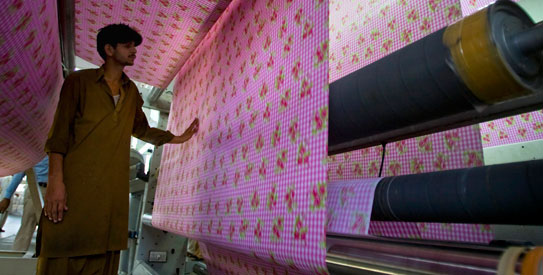
ISLAMABAD, Dec 20: Pakistan’s textile and clothing exports witnessed a decline of over 19 per cent in November over the same month last year, suggests data of the Federal Bureau of Statistics here on Tuesday.
The fall started since October owing to shrinking demand in the international market especially from Europe owing to Euro-zone crisis. But the industries seem to have no plan to cope with the situation which will deteriorate in days until stability in the world markets.
Last year, the export proceeds recorded an impressive growth because of rising cotton prices in the international market and slight resumption of demand for Pakistan’s low value-added products, especially raw materials.
In absolute terms, the textile exports in November reached $819.172 million as against $1.027 billion during the same month last year, reflecting a decline of 19.14 per cent. This decline must send fears to policy-makers that shrinking export proceeds in the sector may result in lay-offs.
A sector-wise analysis shows negative growth in export of raw cotton, cotton yarn, cotton cloth and cotton carded and value-added finished products, like garments, knitwear, bed wear and towels.
The only area, where some impressive growth was recorded was in export of tents during the month under review over last year.
Even the overall growth in textile and clothing in the past five months posted a negative growth of 1.30 per cent, as it reached $5.02 billion in July-Nov this year from $5.086 billion over the corresponding period last year.
Former chairman of the All-Pakistan Textile Mills Association Gohar Ijaz had claimed that the textile and clothing exports could touch the figure of $20 billion by end June 2012. But he conditioned it with energy supply and reduction in interest rates.
Mr Ijaz however, did not count on demand in international market, which plummeted owing to the escalating debt crisis. As a result, Pakistan’s exports declined tremendously to Europe despite the government reduced interest rates and depreciated Pakistani currency in the past couple of months.
Last year, textile and clothing sectors exports reached around $15 billion by the end of June 2011. This growth, however, was mainly driven by the rise in cotton prices in the international market.
At the same time, there was a significant decline in import of machinery in the value-added sector to increase quality and capacity of production.
Statistics show that textile machinery imports declined by 26 per cent in July-Nov this year over the last year, reflecting that the industrialists have no plan for expansion of their industrial units in the current year.
Contrary to growth in textile and clothing, export of traditional products or non-textile products increased by 20.2 per cent to $4.367 billion during the July-Non period of the current fiscal year as against $3.633 billion in the corresponding period last year.