0
0

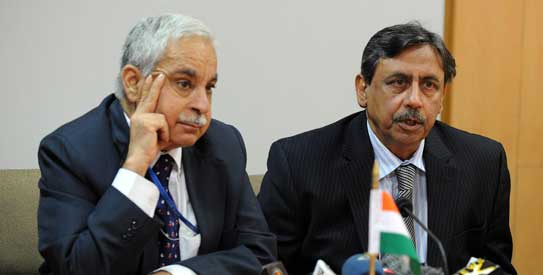
NEW DELHI: The commerce secretaries of India and Pakistan began a two-day meeting here on Monday with an ambitious agenda to end their decades-old aloofness estimated to have cost billions of dollars in aborted annual trade.
It was not surprising then that India’s Rahul Khullar and Pakistan’s Zafar Mahmood, clearly mandated to make it all happen, began with political comments usually reserved for higher diplomacy.
The Press Trust of India (PTI) said Mr Mahmood had come armed with a “political backing and mandate”. His opening remarks indicated so. “I want to assure you that please have trust and faith in the process. Times have changed. World is coming closer.”
Mr Khullar, while welcoming Pakistan’s decision to grant the Most Favoured Nation (MFN) status to India, said he was aware that expectations from these talks were running high. People including business communities and politicians were keen for a breakthrough to lay a foundation for preferential trading arrangements.
“With such clear political vision, we are now obliged to walk the talk,” Mr Khullar said.
India granted the so-called MFN status to Pakistan in 1996 and Pakistan reciprocated earlier this month.
Before leaving Islamabad for New Delhi on Saturday, Mr Mahmood had said: “...Hopefully, you will hear good news after two days.” He had also indicated a “major breakthrough” in the talks.
India-Pakistan trade stands at a paltry $2.65 billion but, by current estimates, in an unfettered regime it should be touching over $11 billion.
During his talks with Pakistan’s Prime Minister Yousuf Raza Gilani on the sidelines of the Saarc Summit in the Maldives last week, Indian Prime Minister Manmohan Singh had offered to sign a Preferential Trade Agreement with Pakistan, committing to eliminate duties on all goods by 2016.
India has also been backing the European Union proposal to grant special trade concessions to Pakistan where floods caused havoc to its economy last year. MFN status is a World Trade Organisation rule under which countries are required to give equal treatment to their trading partners.
Mixed signals emanating from Islamabad had caused confusion following announcement of the decision of the Pakistani cabinet on granting MFN status to India. However, Pakistan Foreign Minister Hina Rabbani Khar had clarified on the margins of the Saarc Summit: “We will not backtrack on a cabinet decision. So let me categorically say that and I don’t see a lot of room for confusion.”
The current trade problems are complex even if political impediments were to abate. While India has slammed the “positive list” approach by Pakistan as an obstruction to fair trade, Pakistan has objected to a slew of non-tariff barriers that India imposes on its part. Indian officials say the barriers were not Pakistan-specific.
At the heart of Monday’s discussions and what they would perhaps conclude on Tuesday are typical non-tariff barriers imposed by both sides. These include: Trade Facilitation and Customs Procedures, technical barriers to trade and sanitary and phytosanitary measures, financial measures, para-tariff measures and not the least, visas.
Sources close to the talks said there could be conclusion on the rail and road routes on the Wagah-Attari sector as well as the Khokhrapar-Munabao sector. In a more complicated vein for Pakistan, India is seeking permission to use the road link to Afghanistan. With connectivity as the theme at the Saarc summit, it would not be far-fetched to expect Pakistan to claim and even get access to connect with Bangladesh and Nepal in the not too distant future.