0
0

Field Marshal Ayub Khan was ambitious. After taking over as chief martial law administrator, he drew his lines for the years to come. He aimed at securing at least two tenures as president, but he knew little of people’s power. The 1965 presidential poll had a lesson for him: he could not go unchallenged.
The man who had come claiming to be ‘messiah’ was looking for a safe return to presidency. To ensure his position he had promulgated the Political Parties Act, 1962 but there were other factors too. Ayub Khan’s tenure was to end on August 8, 1965. He had already joined Pakistan Muslim League (Convention).
He had let loose secret agencies, sworn to his loyalty, to report on the people. His buddies showed him green pastures with not a single leaf turning against him. He had fallen prey to officialdom while some political fortune seekers were striving to save him. The opposition was looking for a candidate to challenge him.
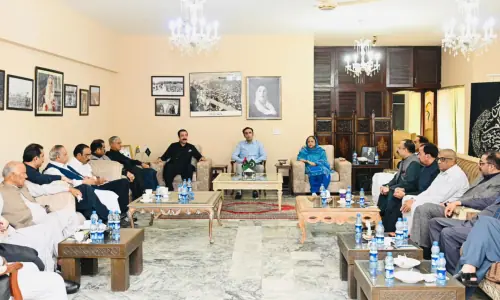
In East Pakistan, Shaikh Mujeeb rose from a student leader during the language riots of 1952 to a serious Bangla leader; Maulana Bhashani also rose to the occasion. Along with some leaders from West Pakistan, all agreed to form a joint opposition bloc to contain Ayub’s ‘might’. This came about July 21, 1964 in the form of Combined Opposition Parties (COP). Muslim League Council, Jamaat Islami, Awami League, National Awami Party and Nizam-i-Islam Party became partners.
Leaders such as Chowdhary Mohammad Ali, Maulana Maudoodi, Khwaja Nazimuddin, Mir Jaffar Khan Jamali, Mahmoodul Haq Usmani, Shaikh Mujibur Rahman, Maulana Abdul Hamid Bhashani, Shaikh Abdul Majid Sindhi, all joined hands. All agreed that since no leader in both wings was capable to face Ayub’s might, it was decided to choose someone acceptable to both wings. After deliberations, the name of Miss Fatima Jinnah, the younger sister of the Founder of the Nation, was accepted.
Miss Jinnah was living a quiet life and used to issue only a few statements on national days. After the lifting of martial law she had hoped that democracy would return but it didn’t happen. After many meetings, she accepted the request to challenge Ayub Khan. This was a breakthrough in the political history of Pakistan that a woman had been accepted as a candidate for the highest post, as it had been opposed by Jamaat-i-Islami. On September 17, 1964, the COP announced her candidature.
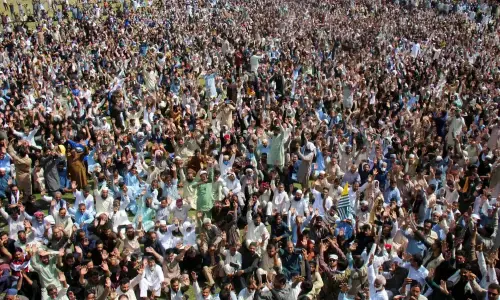
The COP had agreed upon a nine-point programme envisaging a parliamentary democratic system, provincial autonomy, reining in the president by curtailing his powers, lifting the ban on political parties and ensuring freedom of judiciary. The system of electioneering entailed that the leaders of both parties would address public meetings followed by addressing the Electoral College, i.e., the 80,000 basic democrats that were made to represent 110 million people. Miss Jinnah began her campaign from Karachi, Hyderabad and Sukkur, ending at Peshawar. Her rallies at Nishtar Park and National Stadium were eye-openers for Ayub Khan. The speeches made Miss Jinnah and Ayub Khan were varied. While Miss Jinnah criticised the government policies, Ayub Khan charged politicians with corruption. While Ayub had the official finances at his disposal, average citizens funded Miss Jinnah meetings. Besides gathering in millions at public meeting, Bengalis formed a human chain of about 500 kilometres from Dhaka to Chitagong to show solidarity with Miss Jinnah.
When the electioneering was in full swing and Miss Jinnah was in East Pakistan, the COP suffered a loss. Khwaja Nazimuddin, whose house was the venue of COP formation, died on October 22, 1964.
The bureaucrats, the official machinery and ‘volunteers’ were busy mustering support for Ayub. The misuse of power and funds has been vividly described by Qudratullah Shahab, one of Ayub’s aides, as saying ‘ … tens of millions of rupees had been put at the disposal of the Muslim League Convention, import licences were issued and sold to businessmen. Everybody took his share with impunity. The magnitude of distribution of money and political bribery shown in the Ayub’s election campaign is unsurpassed in the history.’
The date for presidential polls was contemplated in March 1965 and the new president had to take oath on March 31 but the COP electioneering had moved Ayub to reconsider. On one of the well-wishers’ advice he advanced the poll date to January 2, 1965. As the date neared the BD members began ‘disappearing’. This was understandable. Some were enjoying hilly climes of Murree, others in Karachi’s cosy atmosphere of posh hotels and many more enjoyed the hospitality of the Sardars, Chaudharies, Khans and Waderas; and many more were guests of business tycoons.
The polling day arrived. All cities and towns gave a festive look. As the evening drew in people were glued to their radio sets. Generally, the results of cities are received immediately after the closing but this time the first result came from a distant village in Commila, East Pakistan. By ten o’clock almost all results had been announced. Ayub Khan had won. He bagged 28,927 votes from West Pakistan as against 10,263 of Miss Jinnah; from East Pakistan he got 20,720 votes while Miss Jinnah had 18,080 votes.
For Miss Jinnah’s supporters the result was stunning. A number of independent newspapers called it a manipulated election which should have been won by Miss Jinnah. Undoubtedly opposed to an army of tamed bureaucracy, greedy political workers and with absolute power, the fight that Miss Jinnah put up opened Ayub Khan’s eyes. However, it had no lasting bearing on his thinking. He learnt no lesson and treaded on a path of friction pushing the country in a more precarious direction.
Shaikhaziz38@gmail.com