0
0

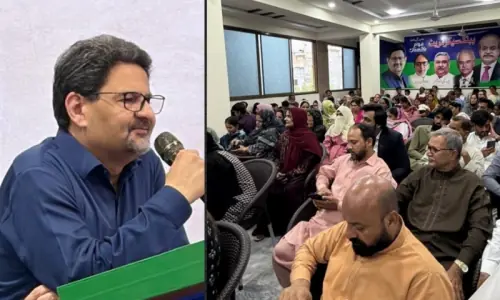
SWABI, Sept 20: Speakers at an international workshop have stressed that both short- and long-term plans should be drawn for energy sector development and management in order to meet the increasing energy demand of the rapidly growing population in the Muslim countries.
They were speaking at the concluding session of the workshop on “Total energy management” at Ghulam Ishaq Khan Institute of Engineering Sciences and Technology, which was organised here on Tuesday by the Faculty of Mechanical Engineering and sponsored by Islamic Development Bank (IDB).
Experts from the IDB member states, including Afghanistan, Albania, Gambia, Indonesia, Malaysia, Maldives, Uganda, Sudan, Kyrgyz Republic and Iraq participated in the workshop. They said that the Islamic world was lagging behind in the energy sector and the leadership should take this issue seriously.
Ms Maslan Lamnia Sinaga, officer of the Ministry of Energy and Mineral Resources, Indonesia, said that without bringing improvement in the energy sector achieving sustainable industrial growth would remain a difficult task. She said that the member states had the capability to improve their energy sector and protect environment if they put their heads together.
“As the energy requirements are continuously increasing the Muslim countries must work out a plan to meet the energy needs of their populations,” she said.
Salaheldin Hassab Elgabow, director Strategic Planning Department, Sudan, said that leaders and experts of the Muslim countries should hold regular meetings to discuss ways and means for bringing improvement in the energy sector while also working for transferring knowledge to the young generation.
“The Muslim youth have the ability to work and excel in various fields, including energy, but presently they lack modern education,” he said.
Dr Ali Hasan Abdulhadi, Professor at the University of Technology, Baghdad, said that there was a great need for cooperation among the Muslim countries to overcome their energy problems. He said that the countries should frame policies for sharing their experiences and knowledge. Prof Abdul Halim Shamsuddin, director National Centre for Renewable Energy, Kuala Lumpur, also stressed cooperation among the energy experts of the Muslim countries.
Prof Fazal Ahmad Khalid, pro-rector (academic) of the GIK Institute, said that the workshop provided a good opportunity to the experts of the IDB member states to discuss the issues related to energy sector, including efficient energy management.