0
0

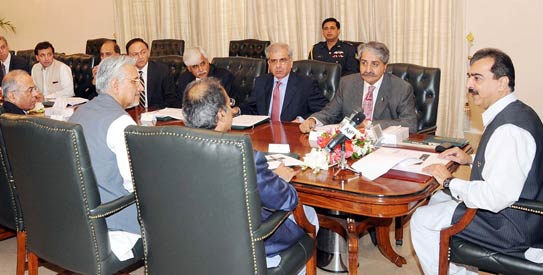
ISLAMABAD: Fearing a severe energy shortfall during Eid holidays, Prime Minister Yousuf Raza Gilani, federal ministers and senior officials put their heads together on Friday to find a way out of cash and technical constraints hampering full capacity utilisation in the power sector.
Almost all the 15 smaller IPPs have exhausted their fuel stocks and are running their operations on daily supplies despite a mandatory requirement of maintaining 30-day stocks, an official who attended the meeting told Dawn. Besides, Qadirpur gas field will be on a three-week annual maintenance shutdown from Aug 28, reducing supplies by 450 million cubic feet per day and power generation by over 700MW.
Officials said the possibility of delaying the shutdown was discussed at the meeting but not approved for the fact that it had already been delayed. A further delay in maintenance may expose the country to an early gas crisis owing to increased winter demand and also exonerate maintenance contractors from damages in case of any fault.
As an interim arrangement, the prime minister asked the ministries of finance and water and power to release Rs25 billion to Pakistan State Oil and independent power producers (IPPs) by Sept 15 to enable them to generate electricity to a level that “people are subject to minimum loadshedding during Eid holidays”, an official statement said.
But representatives of smaller IPPs did not see this liquidity as enough to keep their plants running. The major chunk of the Rs25 billion will go to PSO whose receivables are in excess of Rs160 billion. “That means smaller IPPs will get only peanuts but we have to find out how the disbursement shares are worked out,” an IPP representative said.
He said the PSO supplied fuel to Hubco, Kapco and Wapda’s generation companies. Wapda’s payables to Hubco and Kapco alone stand at Rs130 billion, while smaller IPPs have to recover Rs79 billion. “A couple of billion of rupees would not ease IPPs’ difficulties and some of them may be forced to declare force majeure and shut down, perhaps even before Eid,” he said.
But the problems do not end here. At least five PSO ships loaded with oil and diesel are docked at Karachi ports but Wapda’s inability to pay is not allowing it to lift the fuel required to keep power plants running.
Adverse weather conditions and capacity limitations to store imported furnace oil, diesel and petrol are adding to the problem and increasing freight costs.
According to sources, the petroleum secretary warned of a breakdown of the entire petroleum and gas chain unless Rs88 billion was cleared upfront. He is reported to have said at the meting that stocks ranging between 19 and 34 days of different petroleum products were at ports or in storages but not being lifted by power companies because of cash problems.
The prime minister asked the members of a special committee on loadshedding to sit with the provincial governments and other public sector consumers to clear outstanding dues. The committee, however, appears far from finding a solution.
On the other hand, a finance ministry official said it would be difficult even to provide Rs25 billion immediately. “We are working on some proposals and crystallising numbers to see how much funds are required and how these can be arranged.
Things will perhaps be clearer in a few days,” he said.
The prime minister asked the committee to immediately resolve the issue of circular debt which was the major hurdle in electricity generation resulting in unbearable burden of loadshedding for the people and the industry.
The finance minister informed the prime minister that his committee would submit to the cabinet next month its recommendations which would address the problem of unscheduled loadshedding comprehensively.
Officials of the water and power and finance ministries remained engaged in consultations till late in the evening but could not reach a consensus.
Sources said there were indications that honest consumers who had been paying bills regularly might be the ultimate losers and forced to absorb the burden of system losses and defaults of the provincial governments and public sector consumers.
“That would be the most tragic point in the entire saga,” an official said.