1
1

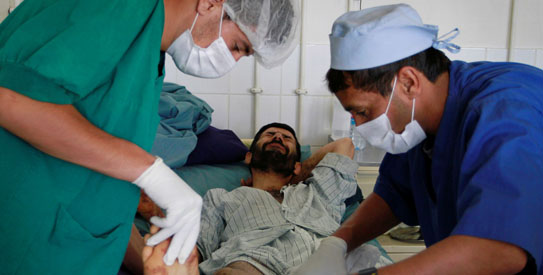
KABUL: The Taliban were raining fire on his checkpoint when Afghan policeman Jan Agha heard the whooshing sound of an incoming rocket just as he was tying a tourniquet on his bloody hand ripped by a machine gun bullet.
He moved fast, but couldn't get far enough. Shrapnel from the rocket sprayed his legs, breaking both in several places.
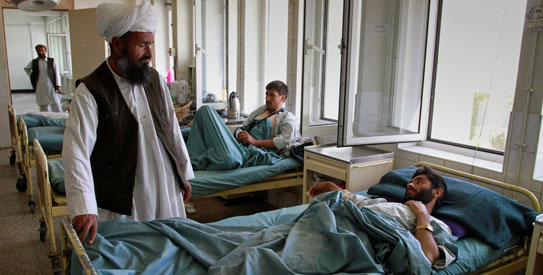
"If I had been standing where I was, I would have been killed," the 26-year-old Agha said, lying in a hospital bed in Kabul.
Agha of Maidan Shahr in Wardak province lived to tell his story, but many of his comrades don't. Afghan policemen on the front line of the war suffer more deaths and injuries than Afghan soldiers or US-led coalition forces. And the human toll on the 130,600-member police force is likely to rise as it increasingly takes over from foreign troops who are to end their combat mission in 2014.
There were 2,770 Afghan policemen killed during the two-year period that ended March 19, the last day of the most recent Afghan calendar year. That's more than twice the 1,052 Afghan soldiers or 1,256 US and other foreign troops who died during the same period. Moreover, 4,785 Afghan policemen were wounded in the two-year period compared with 2,413 Afghan soldiers.
The statistics were obtained from the Afghan ministries of interior and defense and the US-led coalition.
"For anyone to say 'When will the Afghans start fighting and dying for their country?' I can tell you that they are doing that right now." Gen. David Petraeus, the former top commander in Afghanistan, recently testified in the US Senate.
The Afghan National Police force has come under criticism for corruption, and many call it unprofessional and under equipped. Illiteracy is rife, despite six weeks of training and literacy lessons that recruits undergo. Still, questions remain about whether it will be able to handle the increased duties as foreign troops leave.

Police officials acknowledge the problems. But they also point to the risks that members of the force are constantly facing. While the troops of the more than 160,000-member Afghan National Army move in offensives against Taliban and insurgents, police are at the forefront trying to keep a longer-term hold on territory, patrolling their towns, stopping suicide bombers from slipping through checkpoints and trying to foil potential attacks.
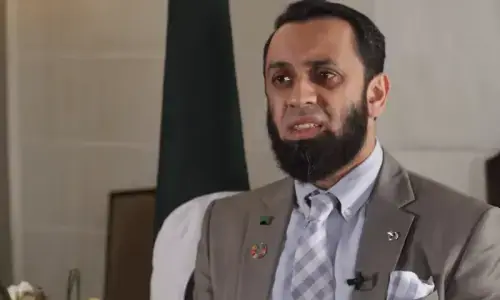
"It is true that corruption is a liability in the police force, but (critics) tend to forget about the sacrifices and the hard work and the bravery of the Afghan police," said Hanif Atmar, who was interior minister from 2008 to 2010.
Police, for example, are the main force involved in eradication of poppy crops, making them the target of hatred from farmers, drug dealers and the fighters that profit from the drug trade, said Zemeri Bashary, a former ministry spokesman who now handles security for international organizations in Afghanistan.
"They are the first barrier against all the bad guys — whether they're terrorists, insurgents, drug dealers," Bashary said.
Interior Minister Bismullah Khan said in an interview on Wednesday that most police casualties are from roadside bombs. "Unfortunately, we are on the front line. Sometimes the casualties go up and sometimes they go down, but we are obliged to fight against the enemy," he said.
On average, between 1,200 and 1,400 policemen are killed every year, and up to three to four times that number are injured, said Atmar. Better intelligence networks would reduce that, he said, as would better equipment. Most police vehicles are unarmored, making them vulnerable to roadside blasts. "The police are expected to regularly patrol areas so they are easy targets," Atmar said.
Assassination is a danger. The police chief of southern Kandahar province and the top police commander in the north were killed in two suicide bombings this year. This month, insurgents hanged an 8-year-old boy in Helmand province because his father, a police officer, refused to give them a police vehicle.
In the hospital, Agha said his 6-year-old daughter and 4-year-old son sometimes try to stop him from going to work, fearing he won't come home.
When two of his close colleagues were killed two years ago by a mine, Agha said he was demoralized and thought about quitting. "But then I thought that if I leave and others leave too there will be no one left. That thought motivated me to stay and take revenge for my friends."
Casualties are one reason only about half the policemen re-enlist after their first tour of duty, police officials said. Still, police recruiting is strong. In June, 130,600 Afghans signed up, exceeding the target by more than 1,000, according to the US-led coalition.
Some join for patriotic reasons. They want to see their homeland secured by Afghans not foreigners.
"Police are serving this nation," said Abdul Jabar, a 30-year-old policeman from Parwan province who is recovering from a bullet wound to his leg that he received in a Taliban ambush. "If I can still walk, I will go back to my duty."
For many others, it's a matter of money. A new patrolman makes about $165 a month, considered a decent salary.
"My brother many times tried to stop me from joining. He said 'It's too dangerous. You will lose your leg,'" said Gul Mohammad, a 38-year-old father of five in Ghazni in eastern Afghanistan. "But I had to join to feed my family."
Last year, Mohammed's police vehicle was hit by a roadside bomb. He lost his right leg in the explosion.
He now works as a street cobbler, making less money.
"I don't see a good future ahead for myself," he said. "When I look at other people now I get upset. I used to be like them. I used to have both of my legs. I could walk like them."
Currently, if a police officer is killed on duty, his family receives the equivalent of around $2,200. The families of slain lower-level patrolmen receive about $1,500. The ministry pays the cost of treating wounded policemen.
In Kabul, Hedayatullah Khan, a 25-year-old patrolman, stood with his AK-47 stopping vehicles at a checkpoint, looking for possible suicide bombers.
Amid the noise of engines and blaring horns, Khan and the other patrolmen closely watched the traffic — boys driving donkey carts, vendors pushing ice cream carts, coalition Humvees, armored vehicles, cars and overcrowded buses.
"In the morning when I come out of my house after praying, I know I am in danger of being attacked," Khan said. "Even when I go to sleep at night, I have the feeling that death is following me."